

COURTKUTCHEHRY SPECIAL SERIES ON LANDMARKS JUDGEMENTS ON WILLS, CODICIL & PROBATE
Uma Sashi Devi (Deceased) Through Legal Representatives v. Dibakar Banerjee and Others: Supreme Court
Upholds Brother’s Claim Under 1932 Will, Ends Family Estate Dispute With ₹5 Lakh Settlement
Inheritance Battle Over Mother’s Estate Finally Resolved
Probate Not Required Under French Law, Sister’s Appeal Dismissed
By Vishwas Kumar
New Delhi: March 23, 2026:
On 11 July 2012, the Supreme Court of India delivered its final word in the long-running inheritance dispute in Uma Sashi Devi (Deceased) Through Legal Representatives v. Dibakar Banerjee and Others (Civil Appeal No. 4110 of 2006). The case centered on ownership of the estate left by the siblings’ mother, pitting sister Uma Sashi Devi against her brother Dibakar Banerjee.
all important case laws on wills every lawyer should know about Uma Sashi Devi Case
The sister’s claim rested on alleged settlement deeds, while the brother asserted his rights through a 1932 Will executed under French law, which governed succession in the former French territories. Courts at every stage—the trial court, appellate court, and the High Court—ruled against the sister, holding that the Will was valid and enforceable. Importantly, they clarified that probate was not required under French law, a point that became decisive in the dispute.
When the matter reached the Supreme Court, the bench comprising Justice Deepak Verma and Justice K.S. Panicker Radhakrishnan upheld the earlier rulings. The Court dismissed the sister’s appeal, reaffirming the principle that probate was unnecessary in this context. Recognizing the decades-long bitterness between the parties, the Court facilitated a monetary settlement of ₹5 lakh, effectively closing the case and bringing peace to the family.
This judgment is significant not only for its reaffirmation of succession principles under French law but also for its pragmatic approach in encouraging settlement. By validating the Will and ensuring financial closure, the Supreme Court balanced strict legal interpretation with the need to end prolonged litigation. The ruling stands as a reminder of how inheritance disputes can span generations, and how the judiciary can play a crucial role in resolving them with finality.
For More, Read Here the Summary of the Judgement from the Book: WILL WRITING SIMPLIFIED, read below or open page no 436, Chapter 14.1 in the book. (Online book purchase link available here on: Buy online: Amazon | Flipkart
|
|
Case Summary |
: |
Uma Sashi Devi (Deceased) Through Legal Representatives v. Dibakar Banerjee and Others. |
|
|
Court |
: |
Supreme Court of India |
|
|
Citations |
: |
(2012) 07 SC CK 0048: Civil Appeal No. 4110 of 2006. |
|
|
Link |
: |
|
|
|
Decided on |
: |
11 July 2012 |
|
|
Coram |
: |
Hon’ble Mr. Justice Deepak Verma and Hon’ble Mr. Justice K.S. Panicker Radhakrishnan. |
|
|
Relevant Paragraphs |
: |
Para Nos. 1–30 |
1. Facts of the Case:
The dispute was between siblings over properties left by their mother, Smt. Mrinalini Devi. The sister, Uma Sashi Devi, filed Title Suit No. 26 of 1973 before the Subordinate Judge, Hooghly, seeking declaration of title over properties in Schedules A, C & D (allegedly settled in her favour) and partition of Schedules B & E. The brother, Sudhangshu Kumar Banerjee, contended that their mother had already executed a Will dated 19.09.1932 before a Notary Public at Chandernagore, bequeathing all properties exclusively to him. The Trial Court dismissed the suit; the Appellate Court remanded; the High Court of Calcutta (Division Bench) set aside the remand and directed a decision on merits. On remand, the Appellate Court dismissed the appeal. The Second Appeal (No.178/1997) before the Calcutta High Court was also dismissed, leading to the present appeal before the Supreme Court.
2. Law Points Involved:
(i). Requirement of probate under Section 213 of the Indian Succession Act, 1925 for a Will executed in French Chandernagore in 1932.
(ii). Applicability of French Civil Code and Chandernagore (Assimilation of Laws) Act, 1955.
(iii). Admissibility and proof of secondary evidence regarding lost Deeds of Settlement.
(iv). Jurisdictional question whether the Indian Succession Act applied to French territories prior to assimilation.
3. Acts / Provisions / Articles Referred:
(i). Civil Procedure Code, 1908 — Section 96
(ii). Indian Succession Act, 1925 — Section 213, Section 213(2)
(iii). French Civil Code
(iv). Chandernagore (Assimilation of Laws) Act, 1955
4. Judgements Referred:
(i). Division Bench of the Calcutta High Court in earlier remand proceedings
(ii). Lower Appellate Court and Trial Court decisions (Title Suit No.26/1973; Title Appeal No.183/1981)
5. Obiter Dicta:
The Court observed it was “unfortunate that siblings are fighting for ownership over properties left behind by their mother.” It emphasized the desirability of amicable settlement among close family members rather than prolonged litigation.
6. Ratio Decidendi:
Since the Will dated 19.09.1932 was executed in French Chandernagore, where the Indian Succession Act was not then applicable, and the testatrix died in 1971, the Will was governed by French law. Under Section 213(2) of the Indian Succession Act, probate was not required for such Will. The Deeds of Settlement relied upon by the plaintiff were not proved as per law since no foundation for secondary evidence was laid. Hence, the plaintiff failed to establish title or right of partition.
7. Final Ruling:
Appeal disposed of by consent settlement. Respondents (heirs of the brother) agreed to pay ₹5,00,000 to appellants (heirs of the sister) in installments over 18 months. Property in Schedule A not to be alienated till full payment. Disputes deemed concluded. No costs.
8. Gist / Dispute and Final Decision:
Ownership dispute between sister and brother over mother’s estate. Sister’s claim based on alleged settlement deeds; brother’s claim based on a 1932 Will under French law. Trial, appellate, and High Court decisions went against the sister. The Supreme Court upheld the legal position that probate was not required and dismissed the claim, finally facilitating a monetary settlement of ₹5 lakh to bring the decades-long family litigation to an end.
Read full Judgement Here:
Uma Sashi Devi (Deceased) Through Legal Representatives v. Dibakar Banerjee and Others.
Supreme Court of India
(2012) 07 SC CK 0048: Civil Appeal No. 4110 of 2006.
You Can Also Purchase the Book from here on: Buy online: Amazon | Flipkart
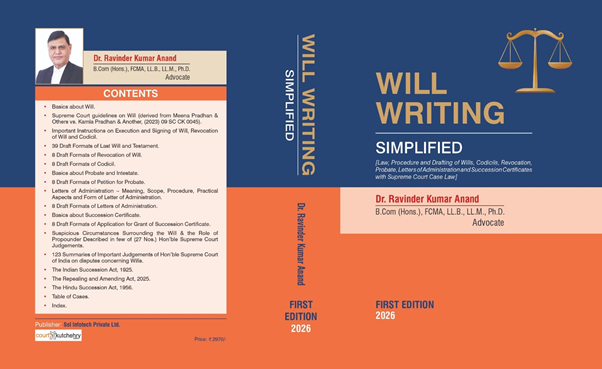
OUR RECOMMENDATION: Check out 123 Key Judgements, as highlighted in the book, WILL WRITING SIMPLIFIED, for the quick research and reference purposes. Click the link here: https://www.courtkutchehry.com/pages/blog/123-supreme-court-judgments-on-wills/
Keywords for SEO & Faster Searches
- Uma Sashi Devi v. Dibakar Banerjee Supreme Court
- 2012 inheritance dispute judgment India
- French law succession India
- Probate requirement under French law
- Civil Appeal No. 4110 of 2006 Supreme Court
- ₹5 lakh settlement estate dispute India