
Watch the Video
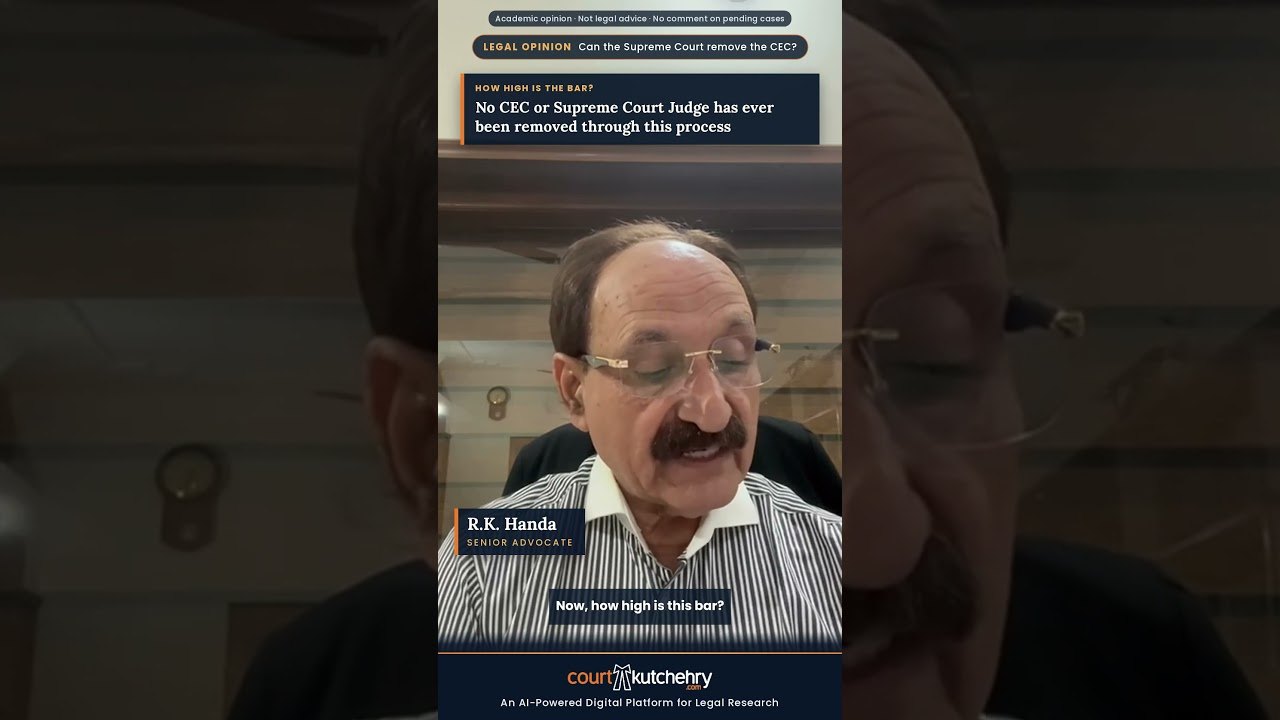
In this short video, CourtKutchehry sums up a constitutional question in one line: can the Supreme Court remove the Chief Election Commissioner? “Three doors are open, three are locked, and there is only one road with six steps.” The Short is a teaser for the full video by Mr. R.K. Handa, Senior Advocate. This article unpacks that line, door by door and step by step, with the source of each. Like the Short, it is academic opinion, not legal advice, with no comment on pending cases.
The 3-3-6 Map at a Glance
| Part of the line | What it means | Where it comes from |
|---|---|---|
| Three open doors | What the Supreme Court can examine | Writ jurisdiction; judicial review of statutes |
| Three locked doors | What the Court cannot do to the CEC | Article 324(5) read with Article 124(4) |
| One road, six steps | The only lawful way to remove a CEC | Article 124(4)–(5), Judges (Inquiry) Act, 1968 |
The starting point is Article 324(5): the Chief Election Commissioner cannot be removed except in like manner and on the like grounds as a Judge of the Supreme Court. Section 11(2) of the 2023 Act on Election Commissioners repeats it.
The Three Open Doors
- Was the appointment lawful? Through a writ of quo warranto the Court can ask by what authority a person holds a public office. It tests authority, not suitability: The University of Mysore v. C.D. Govinda Rao, (1963) 08 SC CK 0021.
- Is the law valid? The Court can decide whether the 2023 Act is constitutional.
- Is the Commission working as the law requires? The Court can enforce the rules on how the Commission takes decisions.
In Anoop Baranwal v. Union of India, (2023) 03 SC CK 4108, a Constitution Bench set an interim selection process, but claimed no power to remove a Commissioner.
The Three Locked Doors
- The Court cannot remove the CEC.
- It cannot suspend him; the Constitution provides no such power.
- It cannot direct him to resign.
Why locked? The Constitution gives the key to Parliament, and Article 142 cannot override an express provision: Supreme Court Bar Association v. Union of India, (1998) 04 SC CK 0099. The protection serves the Commission’s independence, as explained in T.N. Seshan v. Union of India, (1995) 07 SC CK 0148.
Remember this line: the Court can question how the umpire was appointed, but only Parliament can send the umpire home.
The One Road: Six Steps, With Their Source
| Step | What happens | Source |
|---|---|---|
| 1. Notice | Motion signed by at least 100 Lok Sabha or 50 Rajya Sabha members | Section 3(1), Judges (Inquiry) Act |
| 2. Admission | The Speaker or Chairman admits or refuses it | Section 3(1) |
| 3. Committee | A Supreme Court Judge, a High Court Chief Justice, a distinguished jurist | Section 3(2) |
| 4. Inquiry | Charges, hearing, evidence; a clean finding ends the matter | Sections 3 and 4 |
| 5. Special majority | Each House: majority of total membership and two-thirds of those present and voting, in the same session | Article 124(4); Section 6 |
| 6. President’s order | Removal takes effect only by order of the President | Article 124(4) |
The Court treats this as a complete code. In Sub-Committee on Judicial Accountability v. Union of India, (1991) 05 SC CK 0019, it held that Article 124(4)–(5) with the 1968 Act is a complete code for removal.
Key Takeaways
- Three open doors: lawfulness of the appointment (quo warranto), validity of the 2023 Act, and how the Commission functions.
- Three locked doors: no removal, no suspension, no direction to resign by the Court.
- Six steps: notice, admission, three-member committee, inquiry, special majority in both Houses, the President’s order.
Frequently Asked Questions
What are the “three open doors” in the Short?
The lawfulness of the appointment, the validity of the 2023 Act, and how the Commission functions.
Can the Supreme Court suspend the CEC while a case is pending?
No. The Constitution provides no such power.
On what grounds can a CEC be removed?
Only proved misbehaviour or incapacity, the same grounds as for a Supreme Court Judge.
Does the Short comment on any pending case?
No, and nor does this article.
Where can I watch the full explanation?
Watch Mr. R.K. Handa, Senior Advocate, in the full video: https://youtu.be/NIVyk8505PA.
Conclusion
The Short’s line maps the Constitution’s design: three doors open so that appointments and the law stay answerable, three locked so that the umpire cannot be removed by litigation, and one six-step road left with Parliament and the President.
That is how the Commission stays independent of the Government and the courts alike.
▶ Watch the video: Three doors are open, three are locked, and there is only one road with six steps.
▶ Watch the full episode: Can the Supreme Court Remove the Chief Election Commissioner? | R.K. Handa, Senior Advocate
📖 Read the full article: Who Can Remove the Election “Umpire”? The Chief Election Commissioner, the Supreme Court and the Six-Step Road
Research Judgments Like These on CourtKutchehry
Every judgment cited in this article, and lakhs more, can be searched and read on CourtKutchehry. Searching and reading judgments is free. A membership adds unlimited summaries, all related judgments, original court PDF downloads, bookmarks, notes and the CourtKutchehry AI assistant.
| Membership | Price | Works out to | AI credits |
|---|---|---|---|
| Monthly (1 month) | ₹599 | ₹599 / month | 1,000 / month |
| Quarterly (3 months) · Save 16% | ₹1,499 | ₹499.67 / month | 1,100 / month |
| Six-monthly (6 months) · Save 33% | ₹2,399 | ₹399.83 / month | 1,200 / month |
| Yearly (12 months) · Save 44% · Best value | ₹3,999 | ₹333.25 / month | 1,300 / month |
Every plan is a one-off purchase for a fixed period: nothing auto-renews and no card is kept on file. Prices are exclusive of applicable tax, which is added at checkout. Extra AI chat credits can be topped up from ₹99. A free verified account gets 5 summaries and 50 AI trial credits.
Prices are as displayed on courtkutchehry.com on 20 November 2026 and are subject to change without notice. Please check the pricing page for the current plans and offers.
For more judgments, legal opinions and case analysis, visit courtkutchehry.com
Visit CourtKutchehry →