
Watch the Video
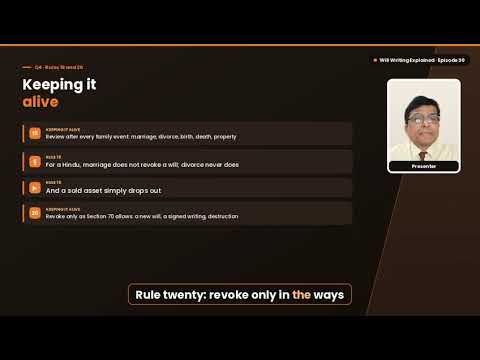
In this 13-minute video, CourtKutchehry presents the grand finale, Episode 30, of “Will Writing Explained”: Your Wish. Your Will. Your Family’s Peace. The episode sums up the whole series in 30 simple rules, from writing and signing a will to probate after the 2025 amendment, adds six Supreme Court judgments every family should know, and ends with a grand quiz. The video is for education and general awareness only, not legal advice. This article sets out thirty rules drawn from the law covered in the series, with the cases behind them.
▶ Watch on YouTube: Thirty Rules for a Dispute-Proof Will | Will Writing Explained Ep 30
Part 1: Before You Write (Rules 1–6)
- Make your will while you are healthy. A will made on a sickbed invites questions about capacity and influence.
- Use a language you understand. If someone else writes it, record that it was read over and explained to you.
- Identify yourself clearly and revoke earlier wills expressly, so there is no doubt which document is your last will.
- Describe each property precisely: address, survey or flat number, bank, folio or policy details.
- Will only what is yours. A Hindu can will self-acquired property and his or her own interest in coparcenary property (Section 30, Hindu Succession Act), not a daughter’s or son’s share by birth.
- No stamp paper is needed. A will on plain paper is valid if properly signed and attested.
Part 2: What to Put in It (Rules 7–12)
- Name every close family member: spouse, children and dependent parents, even those who get nothing.
- Give reasons for unequal shares or exclusions. Exclusion alone is not suspicious, but unexplained silence can be fatal.
- Appoint an executor, and an alternate in case the first cannot act.
- Secure your spouse’s home with a clear right of residence if ownership goes to the children.
- Add a residuary clause so that anything not specifically mentioned still has a destination.
- Keep conditions simple and lawful. Complicated conditions breed litigation.
Part 3: Signing and Witnesses (Rules 13–18)
- Sign at the end and initial every page, as Section 63 of the Indian Succession Act, 1925 contemplates.
- Two attesting witnesses must each see you sign (or receive your acknowledgement of signature) and sign in your presence (Section 63(c)).
- Never use a beneficiary, or a beneficiary’s spouse, as a witness. For wills governed by Section 67, such as Christian wills, a bequest to an attesting witness or the witness’s spouse is void, though the will otherwise stands. Section 67 is not among the provisions applied to Hindu wills, but a beneficiary-witness still invites suspicion.
- Keep beneficiaries out of the process. The biggest beneficiary should play the smallest role.
- Get a doctor’s note on mental condition if you are elderly or unwell.
- Consider registration. It is optional, and it is evidence, not a substitute for proof.
Part 4: Keeping and Changing It (Rules 19–22)
- Keep the original safe and tell your executor where it is. You may also deposit it in a sealed cover with the Registrar.
- Change it properly, by a codicil or a new will signed and attested with the same formalities. Handwritten changes on the old will cause disputes.
- Know when marriage matters. A Hindu, Buddhist, Sikh or Jain will is not revoked by marriage (Section 57); for Christian wills, Section 69 provides that marriage revokes an earlier will.
- Review the will after major events: marriage, birth, death, divorce, sale or purchase of property, or moving abroad.
Part 5: After Death (Rules 23–27)
- The executor pays in order: funeral and death-bed expenses, grant expenses, recent wages, other debts, and only then legacies (Sections 320 to 325).
- Probate is optional after 2025. The Repealing and Amending Act, 2025 omitted Section 213 with effect from 20 December 2025, but probate remains available and binds the whole world.
- Probate proves the will, not the title. Ownership disputes go to a civil court.
- Do not sit on a probate petition. Article 137 of the Limitation Act applies, though the right to apply is a continuing one; long delay also breeds suspicion.
- Mutation is not title. Revenue entries are for fiscal purposes; a disputed will goes to the civil court.
Part 6: If There Is a Dispute (Rules 28–30)
- Know the burden. The propounder proves execution, capacity and free will and dispels suspicion; the challenger proves fraud, coercion or undue influence.
- Suspicion needs facts. Courts act on real circumstances, not on whether the will seems fair.
- Win it in the trial court. Examine at least one attesting witness (Section 68 of the Evidence Act, now Section 67 of the Bharatiya Sakshya Adhiniyam, 2023), plead precisely and build the record; appeals rarely disturb findings of fact.
Remember this line: your wish becomes your family’s peace only if your will can be proved after you are gone.
Six Supreme Court Judgments Every Family Should Know
The finale picks out six Supreme Court judgments. Here are six leading Supreme Court cases from the series that capture its main lessons:
- H. Venkatachala Iyengar v. B.N. Thimmajamma, (1958) 11 SC CK 0008: the propounder must prove signature, sound mind, understanding and free will, and remove suspicious circumstances to satisfy the court’s conscience.
- Smt. Jaswant Kaur v. Smt. Amrit Kaur, (1976) 10 SC CK 0028: delay, weak witnesses, unexplained exclusion of the wife and a beneficiary’s prominent role must be convincingly explained.
- Kavita Kanwar v. Pamela Mehta, (2020) 05 SC CK 0022: probate refused where the executor-beneficiary played a prominent part and the doubts were not explained.
- Swarnalatha v. Kalavathy, (2022) 03 SC CK 0096: exclusion of a natural heir is not suspicious by itself, and courts do not apply Article 14 to dispositions under a will.
- Meena Pradhan v. Kamla Pradhan, (2023) 09 SC CK 0045: one who alleges fraud or undue influence must prove it; the propounder must still dispel genuine suspicion.
- Gurdial Singh v. Jagir Kaur, (2025) 07 SC CK 0233: a will that was silent about the testator’s living wife, with other circumstances, was held vitiated by the nephew’s undue influence.
Two more decisions round off the probate story: Kanta Yadav v. Om Prakash Yadav, (2019) 07 SC CK 0085 (no probate needed for a Delhi will of Delhi property, even before 2025) and Kanwarjit Singh Dhillon v. Hardyal Singh Dhillon, (2007) 10 SC CK 0119 (probate does not decide title).
The Grand Quiz
The series ends with a grand quiz. Test yourself on a few of the rules above:
- Does a will need stamp paper? No.
- Can your son’s wife, who inherits nothing, be a witness to your will? Yes; the people to avoid as witnesses are beneficiaries and their spouses.
- Is probate compulsory in Mumbai today? No, since Section 213 was omitted in December 2025.
- Does registration make a will unchallengeable? No.
- Does a mutation entry make the legatee the owner? No.
Key Takeaways
- Make a will early, clearly and only of what you own, naming everyone and explaining unequal choices.
- Sign properly before two independent witnesses; keep beneficiaries away from the process.
- Keep, review and change the will with the same formalities.
- After 2025, probate is optional but valuable; it proves the will, not the title.
- In disputes, the propounder proves the will and the challenger proves fraud, and the trial decides most cases.
Frequently Asked Questions
What makes a will dispute-proof?
No will is completely dispute-proof, but clear drafting, reasons for unequal shares, independent witnesses, a healthy testator and a beneficiary who stays in the background make a successful challenge very unlikely.
Can a beneficiary be a witness to a will?
The will remains valid. For wills to which Section 67 of the Indian Succession Act applies, such as Christian wills, the bequest to that witness or the witness’s spouse is void. Section 67 does not apply to Hindu wills, but using a beneficiary as a witness is still a suspicious circumstance and best avoided.
Is a registered will better than an unregistered one?
Registration is helpful evidence of date and identity, but an unregistered will is equally valid if properly executed and proved.
Is probate needed after the 2025 amendment?
It is not compulsory anywhere in India, but it is still available and binds everyone on the will’s genuineness.
Does marriage cancel a will?
Not for Hindus, Buddhists, Sikhs and Jains. For Christians, marriage revokes an earlier will under Section 69 of the Indian Succession Act.
Where can I watch the full explanation?
Watch the grand finale in 13 minutes: https://youtu.be/D_m7IfU7nc4.
Conclusion
Thirty episodes come down to a simple idea. A will is the one document in which you speak after you are gone, so it must speak clearly, be made freely and be capable of proof. Every rule in this list serves that purpose.
Your wish, your will, your family’s peace: write it while you can, sign it properly, keep it safe, and let it do its work when the time comes.
▶ Watch the video: Thirty Rules for a Dispute-Proof Will | Will Writing Explained Ep 30
📖 Read more: Supreme Court Succession Law: Landmark Rulings That Shaped Probate Principles
Research Judgments Like These on CourtKutchehry
Every judgment cited in this article, and lakhs more, can be searched and read on CourtKutchehry. Searching and reading judgments is free. A membership adds unlimited summaries, all related judgments, original court PDF downloads, bookmarks, notes and the CourtKutchehry AI assistant.
| Membership | Price | Works out to | AI credits |
|---|---|---|---|
| Monthly (1 month) | ₹599 | ₹599 / month | 1,000 / month |
| Quarterly (3 months) · Save 16% | ₹1,499 | ₹499.67 / month | 1,100 / month |
| Six-monthly (6 months) · Save 33% | ₹2,399 | ₹399.83 / month | 1,200 / month |
| Yearly (12 months) · Save 44% · Best value | ₹3,999 | ₹333.25 / month | 1,300 / month |
Every plan is a one-off purchase for a fixed period: nothing auto-renews and no card is kept on file. Prices are exclusive of applicable tax, which is added at checkout. Extra AI chat credits can be topped up from ₹99. A free verified account gets 5 summaries and 50 AI trial credits.
Prices are as displayed on courtkutchehry.com on 20 November 2026 and are subject to change without notice. Please check the pricing page for the current plans and offers.
For more judgments, legal opinions and case analysis, visit courtkutchehry.com
Visit CourtKutchehry →