
Watch the Video
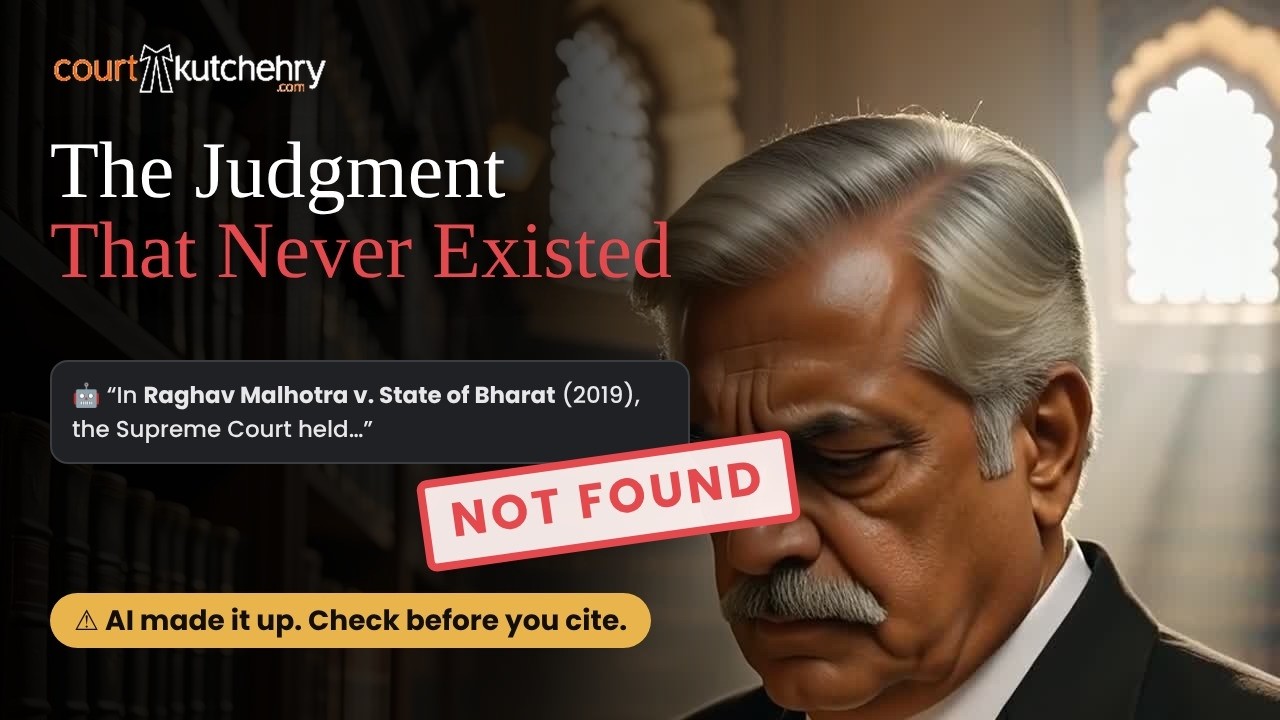
In this 1-minute video, Adv. Vinayak Pawar narrates the story of a young advocate who asks a general AI chatbot for a Supreme Court judgment the night before her first big hearing, only to find that the judgment never existed. He also recounts the real 2023 New York case where lawyers were sanctioned for citing AI-invented cases. This article explains why this happens and how to verify every citation.
▶ Watch the short version: The Judgment That Never Existed 😨 AI Made It Up
The Night Before Her First Big Hearing
The video tells a story many young lawyers will recognise. An advocate has her first big hearing the next morning. Late at night, she asks a general AI chatbot for a Supreme Court judgment that supports her case. The answer looks perfect: a case name, a citation, even a neat paragraph of reasoning.
There is only one problem. The judgment never existed. (The chatbot citation shown in the video is fictional, for illustration only.)
Why a Perfect-Looking Answer Can Be Wrong
General AI chatbots are trained to produce fluent, likely-sounding text. They are not, by default, looking up an official database of judgments each time they answer. So when asked for a case that fits a proposition, a chatbot may produce something that looks like a real citation: a plausible party name, a believable year and reporter, and confident language.
This is often called a hallucination. The danger is not that the answer looks wrong. The danger is that it looks right.
It Has Already Happened: New York, 2023
In Mata v. Avianca, Inc., a personal-injury case before a federal court in New York, lawyers filed a brief citing several decisions that turned out not to exist. They had been generated by ChatGPT. When the court and the other side could not find the cases, the lawyers were asked to explain. In June 2023, the court sanctioned the lawyers and their firm, imposing a monetary penalty and requiring them to inform the judges whose names had been falsely attached to the invented opinions.
Indian courts have also begun to confront the problem. In 2026, the Supreme Court took serious note of a trial court order that relied on judgments which could not be found in official records and were reported to be AI-generated.
What This Means for an Advocate
A lawyer who cites a judgment tells the court that the judgment exists and says what it is cited for. That is part of the advocate’s duty to the court. Citing a case that does not exist, or misquoting one, can embarrass the client, damage the lawyer’s credibility and lead to professional consequences. “The AI told me” is not a defence.
Remember this line: you are responsible for every citation you put before a court, whoever or whatever found it.
How to Verify Every Citation
- Open the actual judgment. Never rely on a summary, a chatbot answer or a forwarded message. Read the full text from an official or reliable source.
- Match the details. Check the party names, court, bench, date and citation. For Supreme Court judgments from 2023 onwards, the neutral citation (for example, a “2023 INSC” number) helps confirm the case.
- Find the paragraph. Locate the exact paragraph that supports your point, and quote it accurately with its paragraph number.
- Check that it is still good law. See whether the judgment has been overruled, distinguished or referred to a larger bench, and whether the statute has since changed (for example, IPC to BNS, CrPC to BNSS).
- Check the bench strength. A larger bench decision binds a smaller bench. Know which one you are relying on.
Using AI Tools Safely for Legal Research
AI can still be a useful starting point, if used carefully. The video shows Courtkutchehry AI, which answers from legal data and links each citation to the judgment itself, so the user can open and read the source. Whichever tool you use, the same rules apply:
- Prefer tools that show their sources and let you open the original judgment.
- Treat every AI answer as a research lead, not as authority.
- Verify with the original judgment before you rely on it in a draft or in court.
As the video itself says: AI answers are research aids. Always verify with the original judgment.
Key Takeaways
- General AI chatbots can produce fake but convincing case names and citations.
- In Mata v. Avianca (New York, 2023), lawyers were sanctioned for citing AI-invented cases.
- An advocate is personally responsible for every citation placed before a court.
- Always open and read the original judgment, match the citation and find the paragraph.
- Use AI only as a research aid, preferably one that links every answer to its source.
Frequently Asked Questions
Why do AI chatbots invent judgments?
Because general chatbots generate likely-sounding text rather than looking up an official database each time. They can produce a citation that looks real but does not exist.
What happened in the New York case?
In Mata v. Avianca, Inc. (2023), lawyers cited decisions generated by ChatGPT that did not exist. The court sanctioned the lawyers and their firm.
Can I cite a judgment I found through an AI tool?
Only after you have opened the original judgment, confirmed the citation and read the paragraph you rely on.
How do I check if a judgment is still good law?
Check whether it has been overruled, distinguished or referred to a larger bench, and whether the statute it interprets has changed.
Is the chatbot citation in the video real?
No. The video states that the chatbot citation shown is fictional, for illustration only, and the scenes are AI-generated.
Where can I watch the full explanation?
Watch Adv. Vinayak Pawar tell the story here: https://youtu.be/r6-n4PHI3eo.
Conclusion
The judgment that never existed is not just a story. It has already happened in courtrooms abroad and has reached Indian courts too. The cause is simple: a fluent answer was trusted without being checked.
The cure is equally simple. Open the original judgment, read it, and verify it before you cite it. Use AI to find leads faster, but let the judgment itself be your authority.
▶ Watch the video: The Judgment That Never Existed: Why Lawyers Must Never Trust a General AI Chatbot |
📖 Read more: Supreme Court Flags Trial Court for Citing AI-Generated Fake Judgments, Calls It Judicial Misconduct
Research the Law on CourtKutchehry
CourtKutchehry gives you lakhs of Indian judgments, searchable for free. A membership adds unlimited summaries, all related judgments, original court PDF downloads, bookmarks, notes and the CourtKutchehry AI assistant.
| Membership | Price | Works out to | AI credits |
|---|---|---|---|
| Monthly (1 month) | ₹599 | ₹599 / month | 1,000 / month |
| Quarterly (3 months) · Save 16% | ₹1,499 | ₹499.67 / month | 1,100 / month |
| Six-monthly (6 months) · Save 33% | ₹2,399 | ₹399.83 / month | 1,200 / month |
| Yearly (12 months) · Save 44% · Best value | ₹3,999 | ₹333.25 / month | 1,300 / month |
Every plan is a one-off purchase for a fixed period: nothing auto-renews and no card is kept on file. Prices are exclusive of applicable tax, which is added at checkout. Extra AI chat credits can be topped up from ₹99. A free verified account gets 5 summaries and 50 AI trial credits.
Prices are as displayed on courtkutchehry.com on 20 November 2026 and are subject to change without notice. Please check the pricing page for the current plans and offers.
For more judgments, legal opinions and case analysis, visit courtkutchehry.com
Visit CourtKutchehry →