
COURTKUTCHEHRY EXCLUSIVE EXTRACTS FROM BEST SELLING BOOK: WILL WRITING SIMPLIFIED
Testator in Indian Will Law: Role, Duties, and Common Pitfalls Explained
Clarity in Language and Proper Execution Are Crucial for Valid Wills
Courts Rely on Testator’s Intention but Demand Compliance with Legal Formalities
By Vishwas Kumar
New Delhi: March 31, 2026:
When families fight over inheritance, the central question often becomes: What did the deceased really intend? The answer lies in the Will, and at the heart of every Will is the Testator—the person who makes it. Yet, many people are unaware of the responsibilities that come with being a Testator. It is not enough to simply write down wishes; the law requires proper execution, attestation, and clarity.
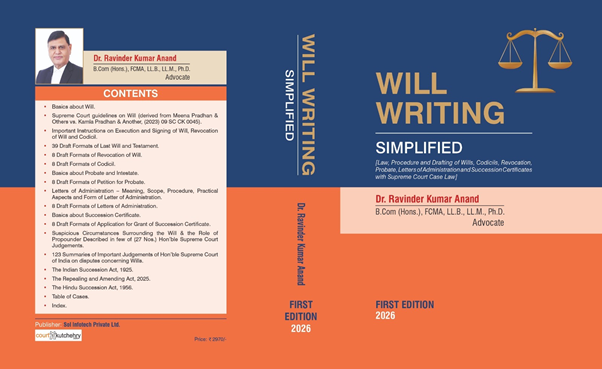
The extract from Will Writing Simplified by Dr. Ravinder Kumar Anand [📘 Buy Will Writing Simplified online on Amazon | Flipkart}
provides a concise but powerful explanation of the Testator’s role. This article expands on that extract, explaining in plain language what it means to be a Testator, the legal framework in India, and the implications for families and courts.
Detailed Explanation of the Extract
The extract states:
- “Testator or Executant is not expressly defined in the Indian Succession Act, 1925 but in general, a Testator or Executant is the person who makes/creates/executes his/her Will.”
→ Meaning: The law does not give a formal definition, but in practice, the Testator is the person who writes and signs the Will. - “A Testator is an individual who creates and executes a legal document detailing his/her wishes regarding his/her estate and the appointment of an Executor to manage it until final distribution.”
→ Meaning: The Testator decides how property will be divided and who will manage the process. - “In addition to making the Will, the Testator must ensure proper execution, attestation, and safe custody of the document.”
→ Meaning: The Testator must follow legal formalities and keep the Will safe. - “The clarity and unambiguity of the Testator’s language significantly influence judicial interpretation, especially where disputes arise.”
→ Meaning: Courts rely on the wording of the Will. If language is unclear, disputes are inevitable.
Legal Context
Indian Succession Act, 1925
- Section 59: Only persons of sound mind, not minors, can make Wills.
- Section 63: Requires signature of the Testator and attestation by two witnesses.
- Section 68, Evidence Act: At least one witness must testify if the Will is contested.
Hindu Succession Act, 1956
- Applies when there is no Will. Property devolves by intestate succession.
- A valid Will overrides these default rules.
Judicial Principles
Courts emphasize:
- The Testator’s intention is paramount.
- Suspicious circumstances must be explained by the propounder.
- Clarity of language is critical.
Examples and Case Studies
- Hypothetical Example:
A Testator writes: “My property shall go to my children.” The Will does not specify which property or which children. Courts face difficulty interpreting. Lesson: clarity matters. - Hypothetical Example:
A Testator appoints no executor. After death, family members fight over who should manage the estate. Lesson: always appoint an executor. - Hypothetical Example:
A Testator keeps the Will unsigned or without witnesses. Even if genuine, it is invalid. Lesson: follow formalities.
Historical and Comparative Context
- Colonial Legacy: The Indian Succession Act, 1925, consolidated testamentary law.
- UK Law: Wills Act 1837 requires two witnesses, similar to India.
- US Law: Requirements vary by state, but clarity and attestation are universal.
- Evolution in India: Courts emphasize free will, proper execution, and clarity of language.
Implications for Society, Families, and Courts
- Families: A clear Will prevents disputes and preserves harmony.
- Courts: Ambiguous Wills increase litigation, burdening the judiciary.
- Society: Properly drafted Wills ensure smooth transfer of wealth and protect vulnerable heirs.
FAQ Section
1. Who is a Testator?
The person who makes and executes a Will.
2. Is the Testator defined in law?
Not expressly in the Indian Succession Act but understood as the maker of the Will.
3. What must a Testator do?
Ensure proper execution, attestation, and safe custody of the Will.
4. Why is clarity important?
Courts interpret the Testator’s language. Ambiguity leads to disputes.
5. Can a Testator appoint an executor?
Yes, and it is advisable to ensure smooth administration.
6. What if the Testator fails to follow formalities?
The Will may be invalid, even if genuine.
7. Does the Testator’s intention always prevail?
Yes, but only if expressed clearly and in compliance with law.
Conclusion
The extract from Will Writing Simplified makes one principle clear: the Testator is the cornerstone of every Will. Their responsibility goes beyond writing wishes—it includes ensuring legal compliance, clarity, and safe custody. Courts give great weight to the Testator’s intention, but only when expressed unambiguously and executed properly.
For families, a well-drafted Will preserves harmony. For courts, it reduces disputes. For society, it strengthens trust in law. The lesson is simple: a Testator must be careful, precise, and legally compliant to ensure their final wishes are respected.
Book Reference
📘 Buy Will Writing Simplified online: 🔹 Flipkart
Sentences Used from Extract
- “Testator or Executant is not expressly defined in the Indian Succession Act, 1925 but in general, a Testator or Executant is the person who makes/creates/executes his/her Will.”
- “A Testator is an individual who creates and executes a legal document detailing his/her wishes regarding his/her estate and the appointment of an Executor to manage it until final distribution.”
- “In addition to making the Will, the Testator must ensure proper execution, attestation, and safe custody of the document.”
- “The clarity and unambiguity of the Testator’s language significantly influence judicial interpretation, especially where disputes arise.”
.
You Can Also Purchase the Book from here on: Buy online: Amazon | Flipkart
LEGAL RESEARCH RESOURCES: Check out 123 Key Judgements, as highlighted in the book, WILL WRITING SIMPLIFIED, for the quick research and reference purposes. Click the link here: https://www.courtkutchehry.com/pages/blog/123-supreme-court-judgments-on-wills/
Suggested Keywords
- Testator in Indian Will law
- Indian Succession Act Testator rules
- Executor appointment in Will India
- Attestation requirements for Will India
- Clarity in Will drafting India
- Probate disputes India
- Testamentary capacity India