
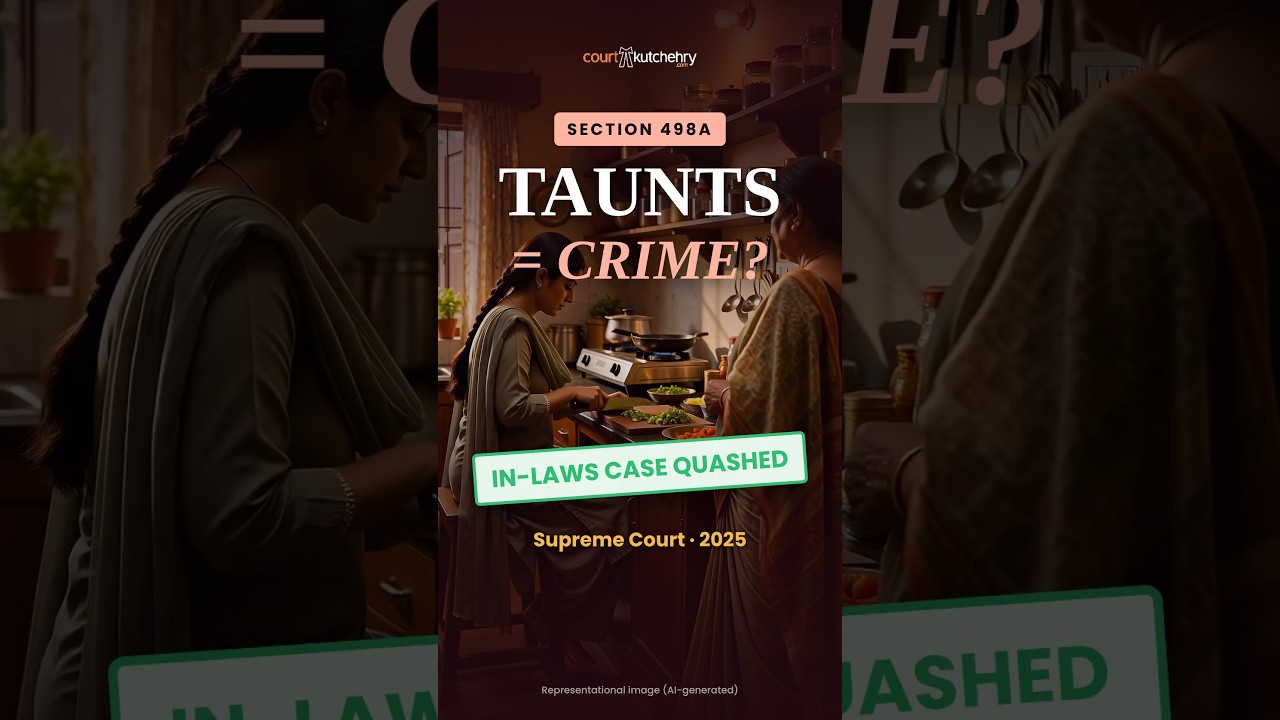
Watch the Video
In this 2-minute video, the CourtKutchehry channel explains the Supreme Court’s judgment in Kamal & Ors. v. State of Gujarat, which quashed a 498A case against a woman’s parents-in-law based on taunts, while letting the case against her husband continue. This article explains the facts, the ruling and three lessons. It is for general awareness only and is not legal advice.
▶ Watch on YouTube: TAUNTS ≠ 498A: SUPREME COURT QUASHES CASE AGAINST IN-LAWS
Saas Ke Taane: A Crime?
A mother-in-law’s taunts are a familiar part of many family stories. But can they be the basis of a criminal case for cruelty? And can the whole family be named in a 498A FIR? In Kamal & Ors. v. State of Gujarat, 2025 INSC 504, judgment dated 16 April 2025, the Supreme Court bench of Justice Manoj Misra and Justice Manmohan gave a clear answer.
The Marriage, the Divorce and the FIR
The couple married in 2005. In 2019, the husband filed for divorce. The wife received the summons in the divorce case and, three days later, lodged an FIR under Section 498A of the Indian Penal Code (and Section 411) against her husband and her parents-in-law. By then she had been married for about 14 years, and the allegations of harassment were raised for the first time.
What the FIR Actually Said About the In-Laws
- She was taunted over trivial issues after her parents-in-law began living with the couple.
- Her salary went to her father-in-law for household expenses.
- There were disputes about the children.
There were no specific dates, no details of particular incidents and no specific dowry demand against the parents-in-law.
Gujarat High Court: “Let the Trial Decide”
The in-laws asked the Gujarat High Court to quash the case under Section 482 of the Code of Criminal Procedure. The High Court refused, holding that the allegations of mental harassment and demands for her salary had to be tested at trial.
Supreme Court: “A Few Taunts Here and There…”
The Supreme Court disagreed with the High Court’s approach, which it described as “extremely pedantic”. It said that “a few taunts here and there is a part of everyday life which for happiness of the family are usually ignored.”
The Court also said that where allegations are made years into a marriage, and only after a divorce petition is filed, courts must examine whether they are made in good faith or for an oblique purpose.
Remember this line: to prosecute in-laws, the complaint must say who did what, and when.
In-Laws Quashed, Husband’s Case Continues
The Court quashed the proceedings against the father-in-law and mother-in-law. But it did not quash the case against the husband, because there were specific allegations of physical and mental cruelty against him. That part of the case will go to trial, and nothing here is a comment on its merits.
Three Lessons
- Specific allegations are needed. General statements against every family member are not enough to drag relatives through a criminal trial.
- Timing matters. An FIR filed immediately after a divorce notice will be examined closely for its motive, though timing alone does not make a complaint false.
- This is not a licence for cruelty. Real harassment remains a serious crime. From 1 July 2024, cruelty by a husband or his relatives is punishable under Section 85 of the Bharatiya Nyaya Sanhita, 2023 (the definition is in Section 86), which replaced Section 498A IPC.
Key Takeaways
- In Kamal v. State of Gujarat (2025 INSC 504), the Supreme Court quashed a 498A case against the parents-in-law.
- The Court said “a few taunts here and there is a part of everyday life”.
- Allegations against relatives must be specific: who did what, and when.
- An FIR filed soon after a divorce petition will be examined closely for motive.
- The case against the husband continues; genuine cruelty is punishable under Section 85 BNS.
Frequently Asked Questions
Are taunts by a mother-in-law cruelty under 498A?
Not ordinary taunts. The Supreme Court said a few taunts here and there are part of everyday life. Cruelty requires serious, specific conduct.
Can the whole family be named in a 498A case?
They can be named, but courts can quash the case against relatives where the allegations are vague and general, as here.
Why did the case against the husband continue?
Because the FIR contained specific allegations of physical and mental cruelty against him.
Does the timing of the FIR matter?
Courts look at it. Where allegations come years into a marriage and right after a divorce petition, courts examine whether they are made for an oblique purpose.
Which law now replaces Section 498A IPC?
Section 85 of the Bharatiya Nyaya Sanhita, 2023, with the definition of cruelty in Section 86, from 1 July 2024.
Where can I watch the full explanation?
Watch the 2-minute video here: https://youtu.be/7nEz0ec8HXM.
Conclusion
The Supreme Court drew a line between the ordinary friction of family life and the crime of cruelty. Vague complaints about taunts cannot be used to put an entire family through a criminal trial.
At the same time, the law against real cruelty remains fully in force. Where there are specific allegations, as against the husband here, the case goes to trial.
▶ Watch the video: TAUNTS ≠ 498A: SUPREME COURT QUASHES CASE AGAINST IN-LAWS
Research Judgments Like These on CourtKutchehry
Every judgment cited in this article, and lakhs more, can be searched and read on CourtKutchehry. Searching and reading judgments is free. A membership adds unlimited summaries, all related judgments, original court PDF downloads, bookmarks, notes and the CourtKutchehry AI assistant.
| Membership | Price | Works out to | AI credits |
|---|---|---|---|
| Monthly (1 month) | ₹599 | ₹599 / month | 1,000 / month |
| Quarterly (3 months) · Save 16% | ₹1,499 | ₹499.67 / month | 1,100 / month |
| Six-monthly (6 months) · Save 33% | ₹2,399 | ₹399.83 / month | 1,200 / month |
| Yearly (12 months) · Save 44% · Best value | ₹3,999 | ₹333.25 / month | 1,300 / month |
Every plan is a one-off purchase for a fixed period: nothing auto-renews and no card is kept on file. Prices are exclusive of applicable tax, which is added at checkout. Extra AI chat credits can be topped up from ₹99. A free verified account gets 5 summaries and 50 AI trial credits.
Prices are as displayed on courtkutchehry.com on 20 November 2026 and are subject to change without notice. Please check the pricing page for the current plans and offers.
For more judgments, legal opinions and case analysis, visit courtkutchehry.com
Visit CourtKutchehry →