COURTKUTCHEHRY EXCLUSIVE: EXTRACTS FROM BEST SELLING BOOK: WILL WRITING SIMPLIFIED
Meena Pradhan v. Kamla Pradhan (2023) vs. Leela v. Muruganantham (2025): Supreme Court’s Twin Pillars on Suspicious Wills
When Suspicion Is Speculative vs. When It Is Grave
Propounder’s Burden Shaped by Circumstances
By Vishwas Kumar
New Delhi: April 08, 2026:
The Supreme Court’s rulings in Meena Pradhan & Others v. Kamla Pradhan & Another (2023) and Leela & Others v. Muruganantham & Others (2025) together form a powerful jurisprudential framework on how Indian courts evaluate suspicious circumstances surrounding Wills. Lawyers frequently cite these two cases side by side because they illustrate contrasting scenarios: one where suspicion was dismissed as speculative, and another where suspicion was found grave and fatal to the Will’s validity.
For greater clarity on testamentary disputes and inheritance issues, you can also review this landmark Supreme Court judgment on wills and succession law in the case of Bhagwan Kaur vs Kartar Kaur and Others, highlighting key principles related to validity and execution of wills in India.
Meena Pradhan (2023): Suspicion Must Be Real, Not Fanciful
In Meena Pradhan, the Will was executed just seven days before the testator’s death. The challengers alleged unsoundness of mind, undue influence, and unfair disposition. However, the Court found:
- Clear attestation evidence from one witness (PW-2), satisfying Section 68 of the Evidence Act.
- No medical or factual proof of incapacity.
- Unequal bequest alone not suspicious.
- Allegations of bigamy or family disputes irrelevant to testamentary proof.
The Court emphasized that suspicious circumstances must be “real, germane and valid, not merely the fantasy of a doubting mind.” Since no genuine suspicion existed, the Will was upheld. The precedent reinforced that speculative doubts cannot override statutory compliance.
Leela v. Muruganantham (2025): Beneficiary’s Active Role Creates Grave Suspicion
In Leela v. Muruganantham, the Court faced a very different scenario. The beneficiary (Leela) purchased the stamp papers, concealed her involvement, and her brother acted as attesting witness. The Will contained contradictions about the testator’s health, mismatched signatures, and inconsistencies about the place of execution. The Court held:
- Active involvement of a beneficiary is a classic suspicious circumstance.
- Registration or formal proof does not cure suspicion.
- Propounder must prove comprehension and voluntariness, which was absent.
- Concurrent findings of lower courts declaring the Will not genuine were upheld.
Here, suspicion was not speculative but grave and legitimate, and the propounder failed to dispel it. The Will was rejected.
Key Precedent Established
Together, these cases establish a two-pronged precedent:
- Speculative suspicion cannot invalidate a Will (Meena Pradhan).
- Grave suspicion arising from beneficiary involvement or contradictions must be dispelled, else the Will fails (Leela v. Muruganantham).
This duality provides clarity: courts must distinguish between fanciful doubts and genuine red flags. Lawyers cite these cases to argue either side, depending on whether they seek to uphold or challenge a Will.
Why Lawyers Still Cite Them
- They provide a balanced framework: one case protects genuine testamentary intent, the other guards against manipulation.
- They clarify the burden on the propounder: heavier when suspicion is grave, lighter when suspicion is speculative.
- They reaffirm statutory compliance under Section 63 of the Succession Act and Section 68 of the Evidence Act.
- They strengthen the doctrine of judicial conscience: courts must be satisfied that suspicions are removed before accepting a Will.
- They emphasize respect for concurrent findings of fact, ensuring stability in succession disputes.
Together, these rulings are cited in petitions to either defend a Will against speculative attacks or to challenge one where beneficiary involvement or contradictions exist.
RESEARCH RESOURCES:
Read full will law judgments here. Click the link here: https://www.courtkutchehry.com/pages/blog/123-supreme-court-judgments-on-wills/
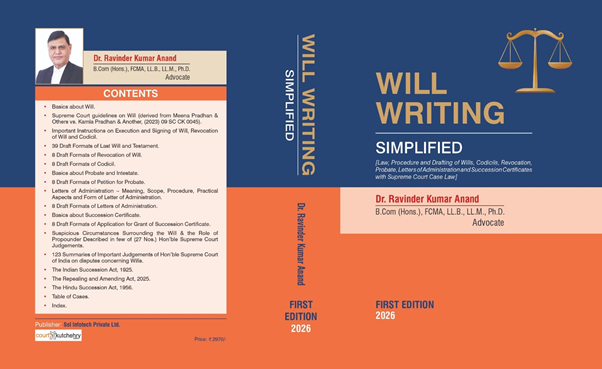
EXTRACTS FROM BOOK, WILL WRITING SIMPLIFIED, By Dr Ravinder Kumar Anand. [📘 Buy Will Writing Simplified online: Amazon | Flipkart ]
FAQ Section
Q1: How did the Court treat execution close to death in Meena Pradhan?
It held that timing alone is not suspicious if attestation is clear and capacity is proven.
Q2: Why was Leela’s involvement fatal to the Will?
Because she purchased stamp papers, concealed her role, and her brother was attesting witness — classic suspicious circumstances.
Q3: Does registration guarantee validity of a Will?
No. Both cases reaffirm that registration or formal proof cannot cure suspicion.
Q4: What is the difference between speculative and grave suspicion?
Speculative suspicion is based on conjecture (e.g., timing, unequal bequest). Grave suspicion arises from contradictions, forgery indicators, or beneficiary manipulation.
Q5: How do these cases affect the burden on the propounder?
In speculative cases, normal proof suffices. In grave suspicion cases, the burden is heavier — every doubt must be dispelled.
Q6: Why are these cases cited together?
Because they illustrate contrasting outcomes: one upholding a Will despite doubts, the other rejecting a Will due to genuine suspicion.
Q7: What role does judicial conscience play?
Courts must be satisfied that suspicions are removed before accepting a Will. In Meena Pradhan, conscience was satisfied; in Leela, it was not.
BOOK REFERENCE:
[📘 Buy Will Writing Simplified online: Amazon | Flipkart ]