
COURTKUTCHEHRY EXCLUSIVE: EXTRACTS FROM BEST SELLING BOOK: WILL WRITING SIMPLIFIED
Suspicious Circumstances in Will Disputes: Lessons from Supreme Court Landmark Judgment in H. Venkatachala Iyengar v. B. N. Thimmajamma & Ors.
How Indian courts scrutinize wills when doubts arise
The role of the propounder and why independent evidence matters
By Vishwas Kumar
New Delhi: April 02, 2026:
Few legal documents carry as much emotional and financial weight as a will. It determines how property, wealth, and legacy are passed on after death. But when a will is challenged, courts must carefully examine whether it truly reflects the testator’s intent. Suspicious circumstances—such as unnatural exclusions, doubtful health of the testator, or heavy involvement of a beneficiary in drafting—can cast serious doubt on its validity.
Relevant judgments are listed in these Supreme Court judgments on wills and testamentary disputes, which explain key principles of probate law.
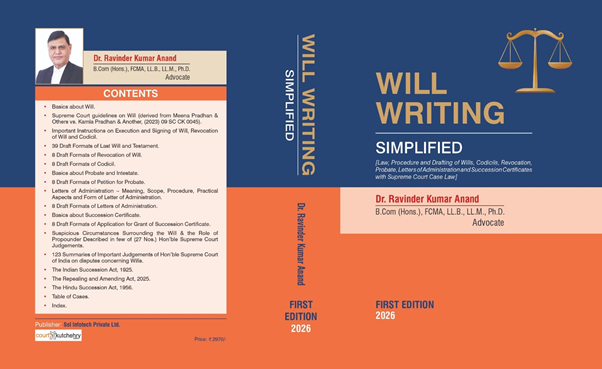
Dr. Ravinder Kumar Anand’s Will Writing Simplified [📘 Buy Will Writing Simplified online: Amazon 🔹 Flipkart] highlights this issue by referencing the landmark Supreme Court case H. Venkatachala Iyengar v. B. N. Thimmajamma & Ors. (1958). The extract lists suspicious circumstances identified by the Court and explains how they shaped the judgment. This article breaks down those circumstances in plain language, situates them within the Indian Succession Act, and explores their implications for families and society.
Detailed Explanation of the Extract in Plain Language
The extract identifies several suspicious circumstances surrounding the will in the case:
- Propounder’s Dominant Role
The appellant (propounder) prepared the draft, dictated it, and played a decisive role in execution. No independent witness corroborated the instructions. Courts saw this as suspicious. - Absence of Legal Assistance
Despite lawyers being available, the appellant drafted the will himself. The Court doubted that a bedridden 64-year-old woman could have instructed such a detailed legal document. - Artificial Recitals
The will contained elaborate legal arguments justifying the testatrix’s competence and property rights. The Court found these unnatural and likely inserted to counter future objections. - False Statements
The will claimed the testatrix gave her son ₹3,000 to buy a house, but this was contradicted by testimony. Such inaccuracies suggested fabrication. - Unnatural Exclusion of Grandchildren
Grandchildren received only nominal amounts despite cordial family relations. The Court found this improbable. - Benefit to Propounder’s Sons
The appellant’s sons received substantial benefits, even though the appellant was heavily indebted. The Court suspected this was designed to evade creditors. - Testatrix’s Weak Health
She was paralysed, bedridden, and frail. Though not unconscious, her capacity to comprehend was doubtful. - No Proof of Reading Over
Witnesses gave inconsistent accounts of whether the will was read to the testatrix. The Court held that evidence failed to show she understood its contents. - Non-production of Draft
The draft allegedly prepared by the appellant was destroyed. The Court noted that this deprived verification of whether it reflected her instructions. - Contrived Property Recitals
The will falsely asserted ownership of all properties and justified alienations. The Court saw these as artificial insertions. - Improbable Dispositions
Taken together, the dispositions were unfair and unnatural, requiring removal of strong suspicion. - Lack of Independent Witnesses
All witnesses were connected to the appellant. No neutral person was present when instructions were given.
Legal Context
The extract ties directly to principles under the Indian Succession Act, 1925:
- Section 63: Requires proper execution—signature by the testator and attestation by two witnesses.
- Burden of Proof: When suspicious circumstances exist, the propounder must dispel doubts and prove the will’s genuineness.
- Role of Propounder: Courts expect independent corroboration, especially when the propounder benefits substantially.
The case illustrates how courts apply these principles to protect against fraud and undue influence.
Examples and Case Studies
Hypothetical Example 1: Beneficiary Drafts the Will
If a son drafts his mother’s will without legal help and ensures most property goes to him, courts may view this with suspicion unless independent witnesses confirm her intent.
Hypothetical Example 2: Exclusion of Close Heirs
If grandchildren are excluded despite close ties, courts may question whether the testator truly intended this or whether undue influence was at play.
Hypothetical Example 3: Testator’s Weak Health
If a bedridden person signs a complex will without proof that it was explained to them, courts may doubt their capacity to understand.
Historical and Comparative Context
- India: Courts emphasize free will and sound mind. Suspicious circumstances shift the burden to the propounder.
- England: Similar principles—wills must be free from undue influence, and suspicious circumstances require strict proof.
- Civil Law Countries: Often require notarisation, reducing disputes but limiting flexibility.
India’s approach balances accessibility with judicial safeguards, ensuring wills are respected but scrutinized when doubts arise.
FAQ Section
Q1. What are “suspicious circumstances” in a will?
Situations that cast doubt on whether the will reflects the testator’s true intent, such as unnatural exclusions or heavy involvement of a beneficiary in drafting.
Q2. Who is the “propounder” of a will?
The person who presents the will in court and seeks to prove its validity.
Q3. What happens if suspicious circumstances exist?
The propounder must dispel doubts with strong evidence, such as independent witnesses or proof that the will was explained to the testator.
Q4. Can a bedridden person make a valid will?
Yes, but courts require clear proof that they understood and voluntarily executed it.
Q5. Why is independent corroboration important?
Neutral witnesses strengthen credibility and reduce suspicion of undue influence.
Q6. Can false statements in a will invalidate it?
Yes, inaccuracies can suggest fabrication and undermine its validity.
Conclusion
The extract from Will Writing Simplified shows how courts approach wills clouded by suspicion. The Supreme Court in H. Venkatachala Iyengar v. B. N. Thimmajamma highlighted circumstances such as false recitals, unnatural exclusions, and doubtful health of the testatrix.
The lesson is clear: a will must not only be executed properly but must also withstand scrutiny of fairness, authenticity, and free will. Families should ensure transparency, involve independent witnesses, and avoid undue influence. Courts, in turn, safeguard justice by demanding strict proof when suspicion arises.
Book Reference
[📘 Buy Will Writing Simplified online: Amazon 🔹 Flipkart]
Sentences Used from the Extract
Here are the exact sentences from the extract that were used to build this article:
- “Suspicious Circumstances Surrounding the Will & the Role of Propounder Described in few of (27 Nos.) Hon’ble Supreme Court Judgements.”
- “Case Title H. Venkatachala Iyengar v. B. N. Thimmajamma & Ors., (1958) 11 SC CK 0008: Civil Appeal No. 18 of 1955.”
- “Appellant (propounder) took a prominent part in preparing and executing the Will…This was treated as a serious suspicious circumstance. [Para 27, 36–37]”
- “Draft prepared by appellant without legal assistance…Court doubted that a 64-year-old, bedridden woman could have instructed such a detailed legal document. [Para 37]”
- “Elaborate and argumentative recitals in the Will…Court held these could not have emanated from her but were crafted to meet future objections — hence ‘unnatural and suspicious.’ [Para 24]”
- “False recitals and inaccuracies within the Will…Such false statements were seen as evidence of fabrication. [Para 24]”
- “Unnatural exclusion of grandchildren…Court found this exclusion unnatural and improbable, given cordial family relations. [Para 25]”
- “Substantial benefit to appellant’s sons…Court suspected they were meant to evade his creditors — another serious suspicion. [Para 26]”
- “Testatrix’s doubtful state of health and weak condition…Her capacity and comprehension were questionable. [Para 23]”
- “Absence of clear proof that Will was read over and understood by testatrix…Court held that evidence failed to show she understood contents. [Para 38]”
- “Non-production of draft Will…Court noted that absence of draft deprived opportunity to verify whether it reflected testatrix’s true instructions. [Para 37]”
- *“Artificial and improbable recitals regarding title and property…Court viewed these as contrived insertions to strengthen appellant’s# 📰 Supreme Court on Suspicious Wills: The Propounder’s Burden of Proof
Suggested Keywords for SEO
- Suspicious circumstances in wills India
- Propounder role in will disputes
- Indian Succession Act Section 63
- Supreme Court will judgments India
- Undue influence in wills India
- Probate disputes India
- Validity of wills India