
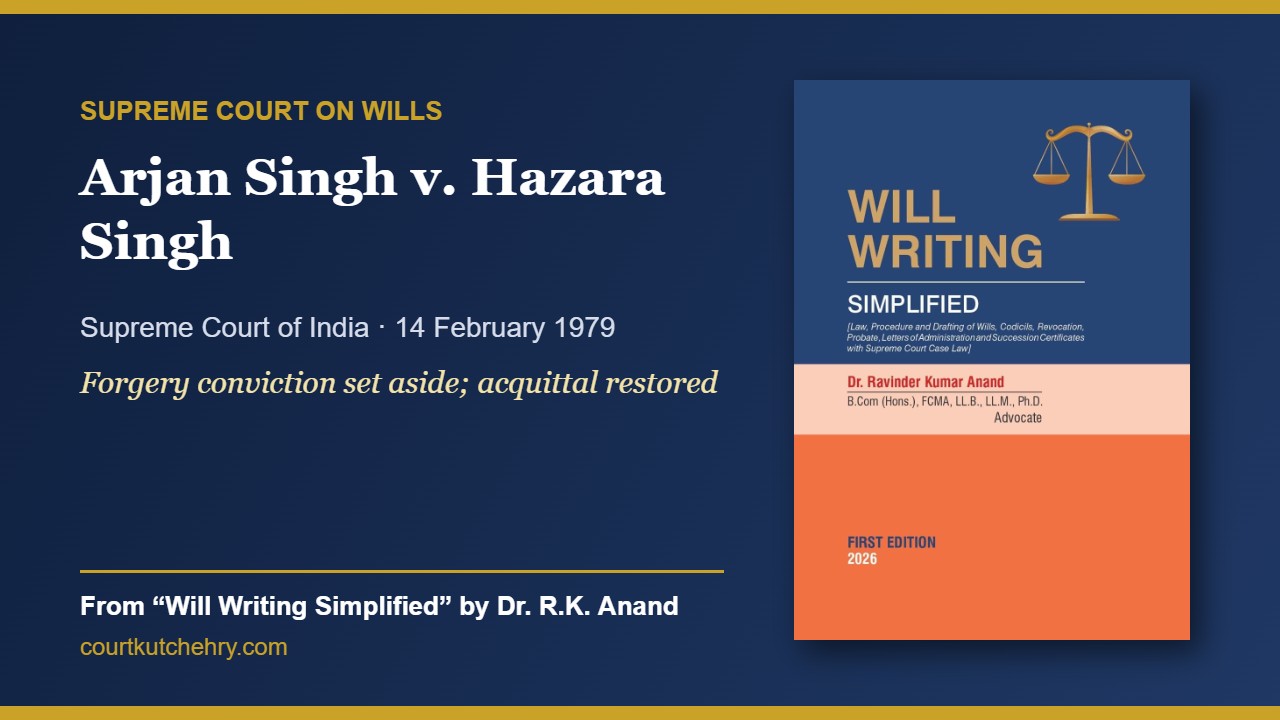
Most cases about Wills are civil disputes over property. This one was a criminal prosecution. The accused were charged with forging a Will in their own favour, and the only evidence of forgery was one expert’s opinion that the thumb impression on it did not match the testator’s. Three other experts said it did. The trial court acquitted; the High Court convicted. On 14 February 1979, the Supreme Court restored the acquittal. This article explains Arjan Singh & Ors. v. Hazara Singh and what it teaches about the line between suspicion about a Will and proof of the crime of forgery.
Case at a Glance
| Case | Arjan Singh & Ors. v. Hazara Singh |
|---|---|
| Court | Supreme Court of India |
| Citation | (1979) 02 SC CK 0045; AIR 1979 SC 1236; (1980) 1 SCC 613; Criminal Appeal No. 213 of 1974 |
| Decided on | 14 February 1979 |
| Bench | Justice S. Murtaza Fazal Ali and Justice A.D. Koshal (judgment by Justice S. Murtaza Fazal Ali) |
| Provisions | Sections 467 and 471, Indian Penal Code, 1860; expert opinion under the Indian Evidence Act, 1872 |
| Result | Appeal allowed; High Court’s conviction set aside; appellants acquitted and discharged from bail bonds |
The Facts
The charge concerned a Will, Exhibit PD, said to have been executed by Sahib Singh in favour of Arjan Singh and others. The prosecution case was that the Will was forged and that the accused had used it as genuine. The charges were under Section 467 IPC (forgery of a valuable security or Will) and Section 471 IPC (using a forged document as genuine).
There was no direct evidence of forgery. The case turned on the thumb impression on the Will. The prosecution’s expert, PW-7 Bhakhtawar Singh, said it did not match Sahib Singh’s admitted thumb impression on another document, Exhibit PA. Three defence experts, DW-4 Philip Hardless, DW-5 A.S. Bal and DW-9 Rattan Lal, said it fully matched.
The prosecution never suggested that the thumb impression had been taken from Sahib Singh after his death. That point was not raised in the complaint or in cross-examination.
What the Trial Court and High Court Held
- The trial court acquitted the accused, holding that on such conflicting evidence a conviction for forgery would be unsafe.
- The High Court, by an order of 24 November 1973, reversed the acquittal and convicted the accused under Sections 467 and 471 IPC, sentencing them to two years’ rigorous imprisonment on each count, to run concurrently. Finding PW-7’s trial evidence thin, the High Court had recalled and re-examined him. It also relied on a series of circumstances that, in its view, showed the Will was not genuine.
One of the accused, Bachan Singh, died, and the appeal abated as to him.
The Question Before the Supreme Court
Could the accused be convicted of forging a Will on the strength of one expert’s opinion, contradicted by three others, together with circumstances that cast doubt on the Will? Was the High Court right to reverse an acquittal on that material?
The Law on Forgery of a Will and Expert Evidence
A Will is expressly covered by Section 467 IPC, which punishes forgery of a valuable security, Will or authority to adopt. Section 471 punishes fraudulently or dishonestly using as genuine a document known to be forged. From 1 July 2024 these offences are found in the Bharatiya Nyaya Sanhita, 2023, which replaced the IPC, but the principles of proof remain the same.
Opinions of experts on handwriting and finger impressions are relevant under Section 45 of the Evidence Act, now Section 39 of the Bharatiya Sakshya Adhiniyam, 2023, which replaced the Evidence Act from 1 July 2024. Such opinion is evidence to be weighed, not conclusive proof. In a criminal case, guilt must be proved beyond reasonable doubt.
In a civil dispute over a Will, the propounder must remove suspicious circumstances, and if he cannot, the Will fails. In a criminal prosecution the burden is the opposite: it is for the prosecution to prove that the document was forged and that the accused forged or knowingly used it.
The Supreme Court’s Reasoning
1. No direct evidence at all
The Court began from the fact that “There is no direct evidence of forgery at all”. Everything depended on the comparison of thumb impressions.
2. One weak expert against three
PW-7 had examined the documents for only two or three minutes. In cross-examination he accepted that differences could arise from ink, pressure and similar factors. His evidence at the trial was slip-shod and cryptic, which is why the High Court had to recall him. Against him stood three defence experts who found the impressions identical. The Court found no real dissimilarity: the superficial differences were explained by different inks, the angle and size of the impressions, and the fact that one was taken with printer’s ink and the other with pad ink. It was, the Court said, “really a question of oath against oath”.
3. Civil suspicions do not prove a crime
The High Court had relied on circumstances such as the Will being unregistered, its failure to describe the property or refer to earlier Wills, delay in producing it before the mutation authorities, and inconsistent accounts of where and when it was written. The Supreme Court held that most of these were explainable or not very relevant, and that while they might weigh with a civil court deciding whether a Will is valid, “that will not take the place of proof in order to convict” on a criminal charge.
4. No good reason to reverse the acquittal
The trial court’s view that conviction would be unsafe was a reasonable one. The High Court gave no cogent reasons for displacing it and acted on suspicion rather than proof. The Court said it was unable to convict on “such a conflicting state of the evidence”.
The Final Decision
The Supreme Court allowed the appeal, set aside the High Court’s order, acquitted the appellants of the charges under Sections 467 and 471 IPC, and discharged them from their bail bonds. The judgment decided the criminal charge only; it did not decide, as a civil matter, whether the Will was valid.
Key Takeaways
- Forgery of a Will is a serious criminal offence under Section 467 IPC (now in the Bharatiya Nyaya Sanhita, 2023), but it must be proved beyond reasonable doubt.
- Expert opinion on thumb impressions is only opinion; where experts conflict, it cannot safely found a conviction on its own.
- Suspicious circumstances that may defeat a Will in a civil court are not proof of forgery in a criminal court.
- An appellate court should not reverse an acquittal without cogent reasons.
- Differences in ink, pressure and angle can explain apparent dissimilarities between thumb impressions.
Practical Lessons for Will Makers and Lawyers
- Sign rather than use a thumb impression if you can; where a thumb impression is used, have it taken clearly, in good ink, before reliable witnesses.
- Register your Will or deposit it, so that its existence and execution are independently recorded.
- Keep good specimens of your signature or thumb impression on admitted documents, which make comparison easier.
- For lawyers: choose the right forum. A doubtful Will is usually best challenged in civil or probate proceedings, where the propounder bears the burden.
- For prosecutors and complainants: an expert should have adequate time and good specimens; a quick, cryptic opinion will not survive contrary expert evidence.
Frequently Asked Questions
Is forging a Will a crime?
Yes. Section 467 IPC specifically covers forgery of a Will, and Section 471 covers using a forged document as genuine. These offences are now in the Bharatiya Nyaya Sanhita, 2023.
Can someone be convicted of forgery on an expert’s opinion alone?
Only if the opinion is reliable and the case is proved beyond reasonable doubt. In this case the single prosecution expert was contradicted by three defence experts, and the Court refused to convict.
Do suspicious circumstances prove that a Will is forged?
No. They may lead a civil court to reject a Will, but they do not take the place of proof for a criminal conviction.
Did this judgment decide that the Will was genuine?
No. It decided only that forgery had not been proved beyond reasonable doubt. Validity of a Will is a separate civil question.
Can a High Court reverse an acquittal?
Yes, but it must give cogent reasons. The Supreme Court held that the High Court had not done so here.
Conclusion
Arjan Singh v. Hazara Singh draws a firm line between two kinds of proceedings about a Will. In a civil court, unexplained suspicion can defeat a Will. In a criminal court, suspicion, however strong, cannot convict anyone of forging it.
For families caught in a dispute over a Will, the practical lesson is to pursue the civil remedy carefully and to treat criminal complaints with caution; without clear proof, they are unlikely to succeed.
Read More in “Will Writing Simplified”

This judgment is one of 123 Supreme Court judgments on Wills summarised in Chapter 14 of Will Writing Simplified by Advocate Dr. Ravinder Kumar Anand. The book covers the law, procedure and drafting of Wills, codicils, revocation, probate, letters of administration and succession certificates, with Supreme Court case law.
Special limited-period offer: available at 50% off on Amazon.
Buy Will Writing Simplified on Amazon →
Research Judgments Like These on CourtKutchehry
Every judgment cited in this article, and lakhs more, can be searched and read on CourtKutchehry. Searching and reading judgments is free. A membership adds unlimited summaries, all related judgments, original court PDF downloads, bookmarks, notes and the CourtKutchehry AI assistant.
| Membership | Price | Works out to | AI credits |
|---|---|---|---|
| Monthly (1 month) | ₹599 | ₹599 / month | 1,000 / month |
| Quarterly (3 months) · Save 16% | ₹1,499 | ₹499.67 / month | 1,100 / month |
| Six-monthly (6 months) · Save 33% | ₹2,399 | ₹399.83 / month | 1,200 / month |
| Yearly (12 months) · Save 44% · Best value | ₹3,999 | ₹333.25 / month | 1,300 / month |
Every plan is a one-off purchase for a fixed period: nothing auto-renews and no card is kept on file. Prices are exclusive of applicable tax, which is added at checkout. Extra AI chat credits can be topped up from ₹99. A free verified account gets 5 summaries and 50 AI trial credits.
Prices are as displayed on courtkutchehry.com on 20 November 2026 and are subject to change without notice. Please check the pricing page for the current plans and offers.
For more judgments, legal opinions and case analysis, visit courtkutchehry.com
Visit CourtKutchehry →