

COURTKUTCHEHRY SPECIAL SERIES ON LANDMARKS JUDGEMENTS ON WILLS, CODICIL & PROBATE
Sushila Devi v. Pandit Krishna Kumar Missir & Ors.: Supreme Court Upholds Will as Genuine, Dismisses Appeal
Trial Court’s Rejection Overturned by Higher Courts
Sound and Scholarly Testator’s Intent Recognized by Apex Court
By Vishwas Kumar
New Delhi: March 30, 2026:
On 8 February 1971, the Supreme Court of India delivered a crucial judgment in Sushila Devi v. Pandit Krishna Kumar Missir & Others (Civil Appeal No. 594 of 1967; (1971) 02 SC CK 0028), resolving a dispute over the authenticity of a Will that excluded the testator’s daughter. The case highlighted the delicate balance courts must maintain between suspicion and respect for testamentary freedom.
The Trial Court had earlier rejected the Will, branding it forged and unnatural due to the omission of the testator’s daughter. However, the High Court reversed this finding, emphasizing that the evidence of the attesting witnesses and the surrounding circumstances supported the Will’s validity. The matter then reached the Supreme Court, where Hon’ble Mr. Justice K.S. Hegde and Hon’ble Mr. Justice A.N. Grover examined the record in detail.
The apex court affirmed the High Court’s conclusion, holding that the Will was genuine and executed by a sound and scholarly testator. The Court observed that there were no suspicious circumstances surrounding its execution, and the attesting witnesses provided credible testimony. Importantly, the Court underscored that the mere exclusion of a natural heir does not automatically render a Will invalid, provided the testator’s intent is clear and lawful.
By dismissing the appeal, the Supreme Court reinforced the principle that testamentary freedom must be respected when supported by credible evidence. This ruling remains a guiding precedent in Indian succession law, clarifying that courts must not substitute conjecture for proof when assessing the validity of Wills.
The decision continues to be cited in cases involving contested Wills, serving as a reminder that judicial scrutiny must be grounded in evidence rather than suspicion.
For More, Read Here the Summary of the Judgement from the Book: WILL WRITING SIMPLIFIED, read below or open page no 436, Chapter 14.1 in the book. (Online book purchase link available here on: Buy online: Amazon | Flipkart
|
|
Case Summary |
: |
Sushila Devi v. Pandit Krishna Kumar Missir & Others. |
|
|
Court |
: |
Supreme Court of India |
|
|
Citations |
: |
(1971) 02 SC CK 0028: Civil Appeal No. 594 of 1967 |
|
|
Link |
: |
|
|
|
Decided on |
: |
08 February 1971 |
|
|
Coram |
: |
Hon’ble Mr. Justice K.S. Hegde and Hon’ble Mr. Justice A.N. Grover. |
|
|
Relevant Paragraphs |
: |
Para Nos.1–12 |
1. Facts of the Case:
The dispute concerned the genuineness of a Will alleged to have been executed by Mahamahopadhyaya Shyamnarain Chaturvedi on 25 November 1945. The testator died on 26 February 1946. Probate was sought before the District Judge, Saran. The trial court found that while the testator was of sound mind, the Will was not proved genuine. On appeal, the Patna High Court reversed that finding, holding the Will genuine. The Will substantially benefitted the testator’s grandson, Govindmani Tripathi, and son-in-law Kamla Prasadmani Tripathi, while excluding his second daughter (the appellant, Smt. Sushila Devi), giving rise to the allegation that it was an unnatural Will procured through undue influence.
2. Law Points Involved:
Genuineness of a Will — onus of proof on propounder; degree of scrutiny where Will appears unnatural; scope of appellate interference in finding of fact; presumption of testamentary capacity; standard of proof — satisfaction of a prudent mind.
3. Acts / Provisions / Articles Referred:
Indian Succession Act, 1925 — Section 63 (Execution and attestation of Wills).
4. Judgments Referred:
H. Venkatachala Iyengar v. B.N. Thimmajamma, (1958) 11 SC CK 0008.
5. Obiter Dicta:
Courts should not impose their own standards of human behavior upon testators; mere exclusion of an heir does not by itself make a Will unnatural if execution is satisfactorily proved.
6. Ratio Decidendi:
When a Will appears unnatural, the court must scrutinize the evidence with greater care, but if execution and attestation are duly proved by independent and respectable witnesses and suspicious circumstances are satisfactorily explained, the Will must be upheld.
7. Final Ruling:
The Supreme Court upheld the High Court’s finding that the Will was genuine. The appeal failed and was dismissed. No order as to costs; the appellant, permitted to appeal as pauper, was directed to pay court-fee.
8. Gist Highlighting Dispute with Final Decision:
Trial court rejected the Will as forged and unnatural for omitting the testator’s daughter; High Court found evidence of attesting witnesses and surrounding circumstances satisfactory. The Supreme Court affirmed, holding the Will genuine, executed by a sound and scholarly testator without suspicious circumstances. The appeal was dismissed.
Read full Judgement Here:
Sushila Devi v. Pandit Krishna Kumar Missir & Others.
Supreme Court of India
(1971) 02 SC CK 0028: Civil Appeal No. 594 of 1967
You Can Also Purchase the Book from here on: Buy online: Amazon | Flipkart
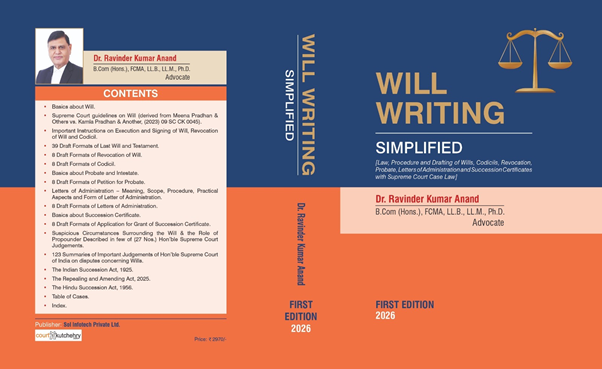
OUR RECOMMENDATION: Check out 123 Key Judgements, as highlighted in the book, WILL WRITING SIMPLIFIED, for the quick research and reference purposes. Click the link here: https://www.courtkutchehry.com/pages/blog/123-supreme-court-judgments-on-wills/
Keywords for Search Optimization
Sushila Devi v. Pandit Krishna Kumar Missir case, Supreme Court of India 1971 judgment, Civil Appeal No. 594 of 1967, Justice K.S. Hegde, Justice A.N. Grover, Will authenticity India, succession law precedent, forged Will dispute, testamentary freedom Supreme Court, Indian inheritance law.