

COURTKUTCHEHRY SPECIAL SERIES ON LANDMARKS JUDGEMENTS ON WILLS, CODICIL & PROBATE
Surendra Pal & Ors. v. Dr (Mrs) Saraswati Arora & Anr.: Supreme Court Upholds Will in Favor of Second Wife
No Presumption of Undue Influence in Marriage
Probate Granted, Children’s Challenge Dismissed
By Vishwas Kumar
New Delhi: March 28, 2026:
On 9 August 1974, the Supreme Court of India in Surendra Pal & Ors. v. Dr (Mrs) Saraswati Arora & Anr. (Civil Appeal No. 1153 of 1971) delivered a landmark judgment concerning the validity of a will executed by Bhim Sain Arora in favour of his second wife, Dr. Saraswati Arora. The Full Bench comprising Hon’ble Mr. Justice P. Jaganmohan Reddy, Hon’ble Mr. Justice M. Hameedullah Beg, and Hon’ble Mr. Justice A. Alagiriswami examined whether the will was procured through undue influence or coercion.
The children of Bhim Sain Arora contested the will, alleging that their stepmother had exercised undue influence over the testator. However, the Court categorically held that no presumption of undue influence arises merely from engagement or marital relations under Indian law. The judges emphasized that testamentary freedom allows a person to bequeath property according to their wishes, provided the will is executed voluntarily and with a sound mind.
The Court observed that Bhim Sain’s strained relations with his children provided a rational explanation for his decision to favour his second wife. The will was found to be executed out of his free will, without coercion or manipulation. Consequently, the Supreme Court upheld the High Court’s decision granting probate to Dr. Saraswati Arora and dismissed the appeal filed by the children.
This ruling is significant as it clarified the legal position on undue influence in marital contexts, reinforcing that mere proximity or relationship does not invalidate a will. It remains a guiding precedent in succession law, protecting testamentary autonomy while ensuring that allegations of coercion must be backed by substantive proof.
For More, Read Here the Summary of the Judgement from the Book: WILL WRITING SIMPLIFIED, read below or open page no 436, Chapter 14.1 in the book. (Online book purchase link available here on: Buy online: Amazon | Flipkart
|
|
Case Summary |
: |
Surendra Pal and Others v. Dr (Mrs) Saraswati Arora and Another. |
|
|
Court |
: |
Supreme Court of India |
|
|
Citations |
: |
(1974) 08 SC CK 0018: Civil Appeal No. 1153 of 1971. |
|
|
Link |
: |
|
|
|
Decided on |
: |
9 August 1974 |
|
|
Coram |
: |
Hon’ble Mr. Justice P. Jaganmohan Reddy, Hon’ble Mr. Justice M. Hameedullah Beg and Hon’ble Mr. Justice A. Alagiriswami. |
|
|
Relevant Paragraphs |
: |
Para Nos. 7–17 |
1. Facts of the Case:
Bhim Sain Arora, a wealthy merchant of Calcutta, lost his first wife in 1959. Seeking companionship, he advertised for marriage and married Dr. Saraswati on 7 February 1961. The following day, he executed a Will in her favour. He died in 1964 leaving behind four daughters and a son from his first marriage. The son, Surendra Pal, and others contested the Will’s genuineness, alleging undue influence, fraud, and coercion.
2. Law Points Involved:
Testamentary capacity, undue influence, suspicious circumstances surrounding execution of Wills, burden of proof of undue influence, validity of Will executed after marriage.
3. Acts / Provisions / Articles Referred:
(i). Indian Evidence Act, 1872 — Sections 103, 111, 114
(ii). Indian Penal Code, 1860 — Sections 302, 350
4. Judgements Referred:
(i). H. Venkatachala Iyengar v. B.N. Thimmajamma, (1958) 11 SC CK 0008.
(ii). Rani Purnima Debi v. Kumar Khagendra Narayan Deb, (1961) 08 SC CK 0021.
(iii). Motibai Hormusjee Kanga v. Jamsetjee Hormusjee Kanga., (1923) 11 PRI CK 0006.
(iv). Jagmohan Singh v. State of U.P., (1972) 10 SC CK 0011.
(v). Smt. Kamla Anwar v. Ratan Lal, (1969) 12 AHC CK 0022.
5. Obiter Dicta:
The Court observed that foreign legal presumptions, such as those in English law regarding undue influence between parties engaged to marry, are inapplicable to Indian social conditions. Presumptions must arise strictly within the framework of the Indian Evidence Act.
6. Ratio Decidendi:
Where the Will is duly executed, attested, and the testator is of sound mind acting voluntarily, the burden of proving undue influence or fraud lies on the caveator. Suspicious circumstances must be removed by satisfactory explanation, but mere exclusion of heirs or presence of the legatee at execution does not invalidate the Will if testamentary intent and free volition are established.
7. Final Ruling:
The Supreme Court upheld the concurrent findings of the Trial and Appellate Courts that the Will dated 8 February 1961 was genuine, duly executed, and free from undue influence. The appeal was dismissed with costs.
8. Gist Highlighting Dispute with Final Decision:
The dispute centered on whether the Will executed by Bhim Sain Arora in favour of his second wife, Dr. Saraswati, was procured by undue influence or coercion. The Court held that no presumption of undue influence arises from engagement or marital relations under Indian law, and that the Will was executed out of Bhim Sain’s free will considering strained relations with his children. Probate granted; appeal dismissed.
Read full Judgement Here:
Surendra Pal and Others v. Dr (Mrs) Saraswati Arora and Another.
Supreme Court of India
(1974) 08 SC CK 0018: Civil Appeal No. 1153 of 1971.
You Can Also Purchase the Book from here on: Buy online: Amazon | Flipkart
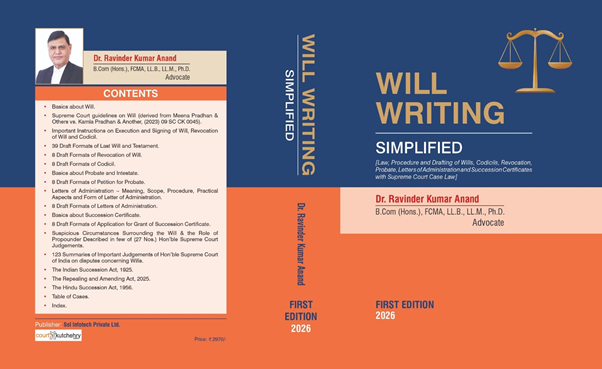
OUR RECOMMENDATION: Check out 123 Key Judgements, as highlighted in the book, WILL WRITING SIMPLIFIED, for the quick research and reference purposes. Click the link here: https://www.courtkutchehry.com/pages/blog/123-supreme-court-judgments-on-wills/
Keywords for SEO & Quick Search
- Surendra Pal v. Saraswati Arora Supreme Court case
- 1974 Indian Supreme Court will dispute judgment
- Bhim Sain Arora will validity case
- Undue influence in will execution India
- Justice Jaganmohan Reddy succession ruling
- Civil Appeal No. 1153 of 1971 Supreme Court
- Apex Court probate granted second wife India