

COURTKUTCHEHRY SPECIAL SERIES ON LANDMARKS JUDGEMENTS ON WILLS, CODICIL & PROBATE
Suraj Lamp & Industries Pvt. Ltd. v. State of Haryana & Another: Supreme Court Declares GPA Sales Invalid, Mandates Registered Deeds for Property Ownership
Landmark Ruling Ends Practice of GPA-Based Transfers
Only Genuine Family or Development Arrangements Preserved
By Vishwas Kumar
New Delhi: March 23, 2026:
On 11 October 2011, the Supreme Court of India delivered a landmark ruling in Suraj Lamp & Industries Pvt. Ltd. v. State of Haryana & Another (SLP (C) No. 13917 of 2009), fundamentally reshaping property transaction practices across the country. The case addressed the widespread use of Agreement to Sell, General Power of Attorney (GPA), and Will combinations—popularly known as “GPA Sales”—employed to bypass stamp duty and registration requirements.
landmark rulings on inheritance and testamentary law on Suraj Lamp Industries
A Full Bench comprising Justice R.V. Raveendran, Justice A.K. Patnaik, and Justice H.L. Gokhale examined whether such arrangements conferred ownership rights. The Court categorically held that GPA Sales do not amount to sale or transfer of property, do not create ownership, and cannot substitute a registered deed of conveyance. The ruling clarified that only a registered sale deed executed under the Registration Act can transfer ownership of immovable property.
The judgment further emphasized that while genuine transactions involving family arrangements, development agreements, or powers of attorney executed for lawful purposes remain valid, the misuse of GPA instruments to evade legal obligations was impermissible. By striking down the legitimacy of GPA-based transfers, the Court sought to curb fraudulent practices, protect buyers, and ensure compliance with statutory requirements.
This decision marked a turning point in Indian property law, closing loopholes that had enabled informal and often risky transactions. It reinforced the principle that ownership of immovable property must be secured through proper registration, thereby enhancing transparency and safeguarding the interests of both buyers and sellers.
The ruling in Suraj Lamp & Industries Pvt. Ltd. continues to serve as a cornerstone precedent, ensuring that property transactions adhere to the rule of law and discouraging practices that undermine the integrity of the real estate market.
For More, Read Here the Summary of the Judgement from the Book: WILL WRITING SIMPLIFIED, read below or open page no 436, Chapter 14.1 in the book. (Online book purchase link available here on: Buy online: Amazon | Flipkart
|
|
Case Summary |
: |
Suraj Lamp & Industries Pvt. Ltd. v. State of Haryana & Another. |
|
|
Court |
: |
Supreme Court of India |
|
|
Citations |
: |
(2011) 10 SC CK 0059: SLP (C) No. 13917 of 2009. |
|
|
Link |
: |
|
|
|
Decided on |
: |
11 October 2011 |
|
|
Coram |
: |
Hon’ble Mr. Justice R.V. Raveendran, Hon’ble Mr. Justice A.K. Patnaik and Hon’ble Mr. Justice H.L. Gokhale. (Full Bench) |
|
|
Relevant Paragraphs |
: |
Para Nos. 1 to 21 |
1. Facts of the Case
The Court, following its earlier decision dated 15 May 2009 in Suraj Lamp & Industries Pvt. Ltd. v. State of Haryana & Anr., addressed the legality of property transactions popularly known as General Power of Attorney (GPA) Sales and SA/GPA/Will transactions. These transactions, involving an Agreement to Sell, Power of Attorney, and Will executed together, were used as substitutes for conveyance deeds to evade stamp duty, registration, and taxes. They were also means of investing unaccounted money and avoiding “unearned increase” payable to Development Authorities. The Court took note of their ill-effects — black money generation, land mafia growth, and criminalization of civil disputes.
2. Law Points Involved
(i). Whether a transfer of immovable property can be effected through a combination of Sale Agreement/General Power of Attorney/Will instead of a registered conveyance deed.
(ii). Whether such SA/GPA/Will transactions confer ownership or any right, title, or interest in the immovable property.
(iii). Whether such transactions can be treated as valid for mutation or transfer of property rights in municipal/revenue records.
3. Acts / Provisions / Articles Referred
(i). Transfer of Property Act, 1882: Sections 5, 40, 53A, 54, 55
(ii). Specific Relief Act, 1963: Section 3
(iii). Indian Trusts Act, 1882: Section 91
(iv). Powers of Attorney Act, 1882: Sections 1A, 2
(v). Indian Succession Act, 1925: Sections 69, 70
(vi). Registration Act, 1908: Sections 17, 49
(vii). Indian Stamp Act, 1899: Sections 27, Article 23
4. Judgments Referred
(i). Suraj Lamp & Industries Pvt. Ltd. v. State of Haryana & Anr., (2009) 05 SC CK 0089.
(ii). Narandas Karsondas v. S.A. Kamtam, (1976) 12 SC CK 0012.
(iii). Rambaran Prosad v. Ram Mohit Hazra, (1966) 09 SC CK 0008.
(iv). Rambhau Namdeo Gajre v. Narayan Bapuji Dhotra, (2004) 08 SC CK 0031.
(v). State of Rajasthan v. Basant Nehata, (2005) 09 SC CK 0056. https://www.courtkutchehry.com/judgements/657378/state-of-rajasthan-and-others-appellant-hash-basant-nahata-respondent]
(vi). Asha M. Jain v. Canara Bank, (2001) 10 DEL CK 0053.
5. Obiter Dicta
(i). The Court appreciated the State of Haryana’s reduction of stamp duty to 5%, observing that a realistic rate encourages transparency, reduces under-valuation, and curbs black money.
(ii). The Court noted that high stamp duty leads to undervaluation and promotes unregistered transactions, while realistic rates promote registration and revenue generation.
(iii). Directions were also given that existing SA/GPA/Will transactions accepted by authorities need not be disturbed to avoid hardship.
6. Ratio Decidendi
(i). SA/GPA/Will transactions do not convey ownership or create any right, title, or interest in immovable property.
(ii). Only a registered deed of conveyance can legally transfer immovable property under Section 54 of the Transfer of Property Act and Section 17 of the Registration Act.
(iii). GPA or Will are not instruments of transfer; they cannot be treated as substitutes for a sale deed.
(iv). Observations of the Delhi High Court in Asha M. Jain v. Canara Bank that such transactions constitute a recognized mode of transfer were held to be bad law.
(v). The ruling applies prospectively; genuine transactions (family, management, or development agreements) are unaffected.
7. Final Ruling
The Court held that:
(i). SA/GPA/Will transactions do not convey title or constitute valid transfers.
(ii). Immovable property can be transferred only by a registered conveyance deed.
(iii). Such documents cannot be the basis for mutation in revenue or municipal records.
(iv). Existing transactions accepted by authorities may continue but should be regularized by proper conveyance.
(v). Genuine powers of attorney (family or development purposes) are not affected. The appeal was disposed of, reiterating the legal position and listing the matter for final disposal on merits.
8. Gist Highlighting Dispute with Final Decision
(i). The dispute concerned whether property transactions executed through a combination of Agreement to Sell, GPA, and Will commonly practiced to avoid stamp duty and registration confer ownership rights.
(ii). The Supreme Court conclusively held that such transactions do not amount to sale or transfer, do not create ownership, and cannot substitute a registered deed of conveyance.
(iii). This landmark ruling put an end to the practice of “GPA Sales”, preserving only genuine transactions involving family or development arrangements.
Read full Judgement Here:
Suraj Lamp & Industries Pvt. Ltd. v. State of Haryana & Another.
Supreme Court of India
(2011) 10 SC CK 0059: SLP (C) No. 13917 of 2009.
You Can Also Purchase the Book from here on: Buy online: Amazon | Flipkart
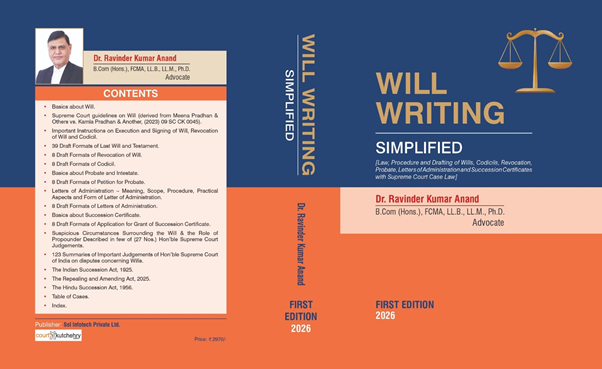
OUR RECOMMENDATION: Check out 123 Key Judgements, as highlighted in the book, WILL WRITING SIMPLIFIED, for the quick research and reference purposes. Click the link here: https://www.courtkutchehry.com/pages/blog/123-supreme-court-judgments-on-wills/
Keywords for SEO & Faster Searches
- Suraj Lamp v. State of Haryana Supreme Court
- GPA Sales invalid India judgment 2011
- Registered deed property ownership India
- Supreme Court property transfer ruling
- Agreement to Sell GPA Will property law
- Landmark real estate judgment India