
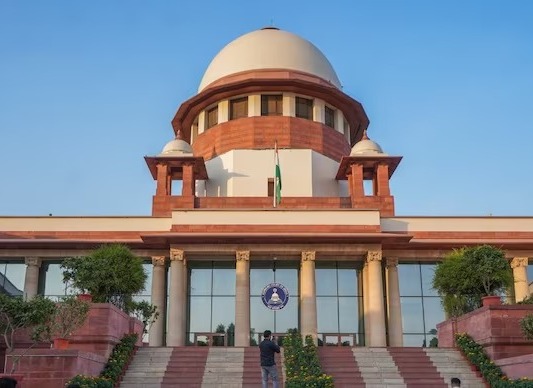
Supreme Court Draws Clear Lines in Succession Law
High Courts barred from re-appreciating facts in will disputes
Widow’s life estate clarified under Hindu Succession Act
By Vishwas Kumar
New Delhi: April 25, 2026:
The most cited and legally significant cases are Gurdev Kaur v. Kaki (2006), Gumpha v. Jaibai (1994), and Ganesan v. Kalanjiam (2019). These rulings shaped Indian succession law by clarifying proof of wills, limiting appellate interference under Section 100 CPC, and defining women’s property rights under the Hindu Succession Act.
Disputes over testamentary documents often depend on proving genuine intent and proper execution—this ruling provides clear judicial direction: Supreme Court judgment on proof of wills and testamentary intent in India
Case Contexts
1. Gurdev Kaur v. Kaki (2006)
- Issue: Scope of High Court’s jurisdiction in second appeals under Section 100 CPC in a will dispute.
- Facts: Chanan Singh executed a will in favor of his second wife. Trial and first appellate courts upheld its validity. The Punjab & Haryana High Court reversed, holding “no father would disinherit his daughters.”
- Ruling: The Supreme Court held that High Courts cannot re-appreciate facts in second appeals unless a substantial question of law arises. It restored the concurrent findings of the lower courts.
- Significance: Reinforced judicial discipline, ensuring that valid wills upheld by trial courts cannot be unsettled by unwarranted interference. This case is widely cited for limiting appellate overreach. Indian Kanoon nearlaw.com Court Kutchehry
2. Gumpha v. Jaibai (1994)
- Issue: Whether a widow’s life estate created by a will after 1956 becomes absolute under Section 14(1) of the Hindu Succession Act.
- Facts: A 1941 will gave two wives life estates, with remainder to the daughter. One widow later attempted to bequeath her share to a stranger.
- Ruling: The Supreme Court held that life estates created by wills remain restricted under Section 14(2). The widow could not convert her limited interest into absolute ownership.
- Significance: Clarified that Section 14(1) enlarges women’s property rights only where they have pre-existing rights, not when a will expressly limits them. This remains a cornerstone in balancing testamentary freedom with women’s rights. Casemine Court Kutchehry Indian Kanoon
3. Ganesan v. Kalanjiam (2019)
- Issue: Validity of attestation under Section 63(c) of the Indian Succession Act.
- Facts: Dispute over whether attesting witnesses must see the testator sign the will simultaneously.
- Ruling: The Supreme Court clarified that acknowledgment of execution by the testator is sufficient; witnesses need not see him sign together.
- Significance: Simplified proof of wills, reducing technical objections. It reaffirmed that acknowledgment plus attestation suffices for validity. Supreme Court Cases mylegacybox.in Casemine
Analytical Significance
- Judicial Discipline (Gurdev Kaur): Prevents High Courts from turning second appeals into “third trials.”
- Women’s Rights (Gumpha): Balanced empowerment with respect for testamentary restrictions.
- Proof of Wills (Ganesan): Reduced procedural hurdles, ensuring genuine wills are not invalidated on technical grounds.
Together, these rulings fortify succession law in India, ensuring fairness, clarity, and respect for both legislative intent and individual rights.
[RESEARCH RESOURCES]
EXTRACTS FROM BOOK, WILL WRITING SIMPLIFIED, By Dr Ravinder Kumar Anand. [📘 Buy Will Writing Simplified online: Amazon | Flipkart ]
|
Ganesan (Dead) through Legal Representatives v. Kalanjiam and Others, (2019) 07 SC CK 0166: (2020) 11 SCC 715: AIR 2019 SC 5682: Civil Appeal Nos. 5901-5902 of 2009. |
|
Gopal Krishan & Others v. Daulat Ram & Others, (2025) 01 SC CK 0047: (2025) 2 SCC 804: AIR 2025 SC 540: Civil Appeal No.13192 of 2024. |
|
Gopal Swaroop v. Krishna Murari Mangal & Ors., (2010) 11 SC CK 0020: (2010) 14 SCC 266; Civil Appeal No. 6801 of 2003. |
|
Govindbhai Chhotabhai Patel & Others v. Patel Ramanbhai Mathurbhai, (2019) 09 SC CK 0069: (2020) 16 SCC 255: AIR 2019 SC 4822: JT (2019) 9 SC 580, Civil Appeal No. 7528 of 2019. |
|
Gowri v. Shanthi & Anr., (2014) 03 SC CK 0065: (2014) 11 SCC 664: AIR 2014 SC 2863: Civil Appeal No. 4245 of 2014. |
|
Gumpha (Smt) & Ors. v. Jaibai., (1994) 02 SC CK 0021: (1994) 2 SCC 511; Civil Appeal No. 1361 of 1986. |
|
Gurcharan Singh and Others v. Angrez Kaur and Another, (2020) 03 SC CK 0086: (2020) 10 SCC 250; AIR 2020 SC 2912, Civil Appeal No. 6835 of 2009. |
|
Gurdev Kaur & Others v. Kaki & Others., (2006) 04 SC CK 0079: (2007) 1 SCC 546; AIR 2006 SC 1975, Civil Appeal No. 2083 of 2006. |
|
Gurdial Kaur & Ors. v. Kartar Kaur & Ors., (1998) 03 SC CK 0042: (1998) 4 SCC 384; AIR 1998 SC 2861: Civil Appeal No. 2944 of 1985. |
|
Gurdial Singh (Dead) through LRs v. Jagir Kaur (Dead) & Anr. etc., (2025) 07 SC CK 0105: Civil Appeal Nos. 3509–3510 of 2010. |
|
Guro (Smt) v. Atma Singh & Others., (1992) 03 SC CK 0011: (1992) 2 SCC 507; Civil Appeal No. 3163 of 1983. |
FAQs
Q1: What did Gurdev Kaur v. Kaki establish?
That High Courts cannot re-examine facts in second appeals unless a substantial question of law arises.
Q2: Why is Gumpha v. Jaibai important?
It clarified that life estates created by wills remain restricted under Section 14(2) of the Hindu Succession Act.
Q3: What did Ganesan v. Kalanjiam decide about wills?
That acknowledgment of execution by the testator suffices; simultaneous signing by witnesses is not mandatory.
Q4: Do these rulings apply across communities?
Yes, they shape general succession law, though contexts differ under Hindu and Indian Succession Acts.
Q5: What is the common thread among these cases?
They all strengthen certainty in succession law—by clarifying proof, limiting appellate interference, and balancing gender rights.
In essence, these judgments remain pillars of Indian succession law—ensuring wills are respected, women’s rights are clarified, and appellate discipline is maintained.