
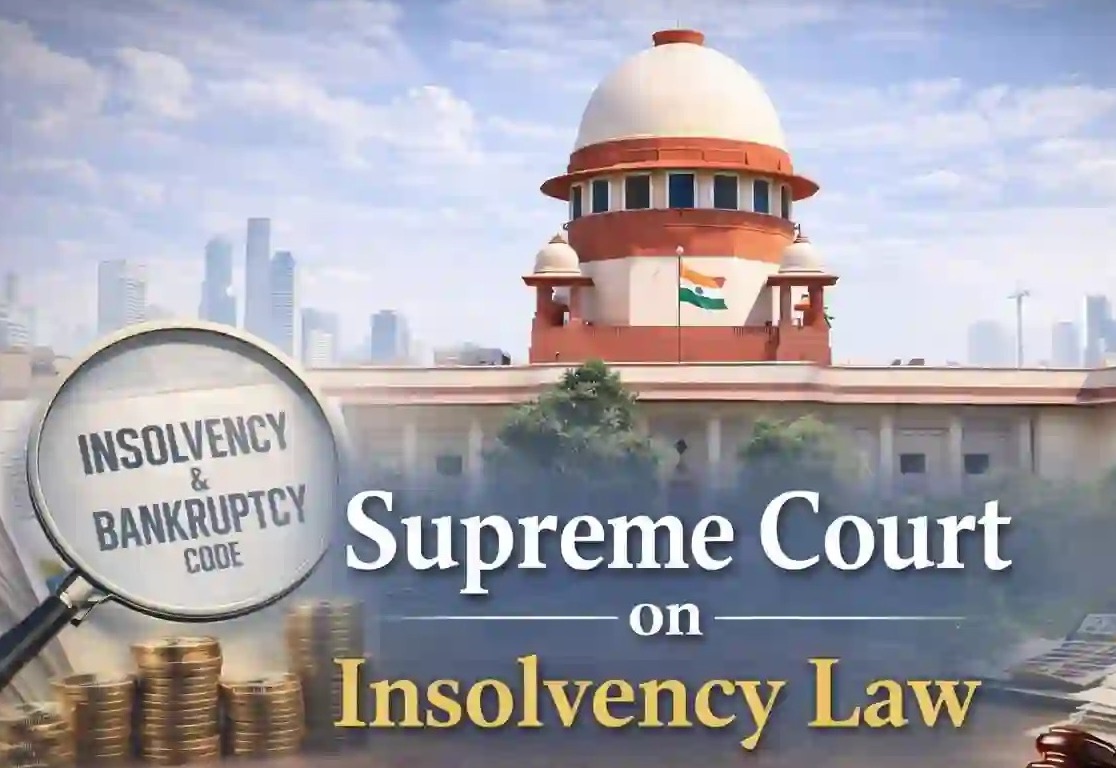
Sacred Remedies and Statutory Boundaries: Supreme Court Reaffirms Appellate Primacy of NCLT and NCLAT Under the IBC
Apex Court Cracks Down on High Court Interdictions Under Constitutional Writ Provisions
Preserving Time-Bound Corporate Insolvency Resolution by Enforcing Exclusive Statutory Appellate Hierarchies
By Legal Editor
New Delhi: August 16, 2026:
The jurisprudence governing economic distress, debt restructuring, and corporate revival in India hinges upon a singular, foundational premise: speed. When Parliament enacted the Insolvency and Bankruptcy Code, 2016 (IBC), it sought to dismantle a fragmented, dilatory regime characterized by parallel legal forums and indefinite litigation stays. Central to this legislative architecture was the creation of dedicated, specialized tribunals—the National Company Law Tribunal (NCLT) as the Adjudicating Authority, and the National Company Law Appellate Tribunal (NCLAT) as the primary appellate body.
However, a persistent operational friction point in Indian commercial law has been the frequent recourse taken by aggrieved litigants to the extraordinary writ jurisdiction of High Courts under Articles 226 and 227 of the Constitution of India. By challenging interlocutory or final procedural orders of the NCLT before High Courts, litigants have repeatedly managed to obtain interim stays and interdictions, effectively freezing Corporate Insolvency Resolution Processes (CIRP) and liquidation proceedings.
In a decisive judgment aimed at curbing this practice, a Division Bench of the Supreme Court of India, comprising Justice Manoj Misra and Justice Vijay Bishnoi, delivered a resounding reassertion of statutory discipline. The apex court held that High Courts must, as a matter of judicial discipline and self-restraint, refrain from entertaining writ petitions against orders passed by the NCLT under the IBC when an effective, comprehensive statutory appeal mechanism is explicitly provided by the law.
The Factual and Procedural Context: A Case of High Court Intervention
The immediate genesis of the Supreme Court’s ruling traces back to liquidation proceedings conducted under Part II of the IBC. During the course of these proceedings, an order passed by the Adjudicating Authority (NCLT) was challenged directly before the High Court of Kerala via a writ petition under Article 226 of the Constitution.
On April 21, 2026, the High Court of Kerala entertained the writ petition, issued notice to the opposing parties, and granted interim relief that effectively stalled the enforcement of the NCLT’s order. Aggrieved by this judicial interdiction, the matter was carried to the Supreme Court. Recognizing the systemic disruption caused to liquidation timelines, the Supreme Court stayed the operation of the Kerala High Court's interim order on May 26, 2026.
In its final adjudication, the Supreme Court set aside the Kerala High Court’s order of April 21, 2026, and formally dismissed the writ petition. The court held that the petition ought not to have been entertained in the first place due to the clear availability of an adequate alternative statutory remedy before the NCLAT under Section 61 of the Code.
Harmonizing Constitutional Writs with Self-Contained Statutory Schemes
A central pillar of the Supreme Court's reasoning involves the delicate balance between non-derogable constitutional powers and statutory appellate mechanisms. The bench explicitly acknowledged that the plenary constitutional powers vested in High Courts under Articles 226 and 227 of the Constitution cannot be curtailed, restricted, or extinguished by mere ordinary legislation.
However, the Supreme Court reiterated a well-established principle of administrative and constitutional law: while the existence of an alternative remedy does not operate as an absolute legal bar to the exercise of writ jurisdiction, it serves as a crucial rule of self-imposed judicial discretion. Where Parliament creates a self-contained, comprehensive legal code equipped with specialized tribunals, technical expertise, and detailed procedural safeguards, constitutional courts must defer to that statutory machinery.
│ IBC STATUTORY APPEAL HIERARCHY │
─────────────────┤
│ National Company Law Tribunal (NCLT) - Adjudicating Auth. │
│ │ │
│ ▼ │
│ National Company Law Appellate Tribunal (NCLAT) - Sec. 61 │
│ │ │
│ ▼ │
│ Supreme Court of India - Appeals under Section 62 │
The court emphasized that bypassing this specialized hierarchy disrupts the uniform administration of insolvency laws across the nation. When High Courts routinely intervene in NCLT matters, they create parallel forums of dispute resolution, leading to jurisdictional overlap, conflicting interim orders, and severe procedural delays that undermine the core objective of the IBC.
Analysis of Statutory Provisions: Section 61 and Section 62 of the IBC
To illustrate the comprehensiveness of the IBC framework, the Supreme Court carefully scrutinized Section 61 of the Code. Section 61(1) stipulates that any "person aggrieved" by an order of the Adjudicating Authority (NCLT) under Part II of the Code may prefer an appeal to the NCLAT.
The bench highlighted two critical structural aspects of Section 61:
Unrestricted Scope of "Order": The statute uses the term "order" without qualification, restriction, or limitation. It does not differentiate between interlocutory orders, procedural directions, administrative instructions, or final adjudications. Consequently, every order passed by the NCLT during CIRP, or liquidation falls within the statutory jurisdiction of the NCLAT.
Comprehensive Locus Standi: By extending the right of appeal to "any person aggrieved," the statute ensures that corporate debtors, financial creditors, operational creditors, resolution applicants, personal guarantors, and liquidation stakeholders have a clear forum to seek redressal.
Furthermore, Section 62 of the Code provides a secondary statutory appeal route from decisions of the NCLAT directly to the Supreme Court on questions of law. Thus, the IBC provides a complete three-tier adjudication framework (NCLT NCLAT Supreme Court), rendering High Court writ intervention redundant and counterproductive.
Judicial Precedents and the Doctrine of Legal Discipline
In reinforcing its directives, the Division Bench anchored its conclusions upon established jurisprudence, citing two major recent rulings of the Supreme Court:
1. Committee of Creditors of KSK Mahanadi Power Company Ltd. v. Uttar Pradesh Power Corporation Ltd. (2024)
In this landmark decision, the Supreme Court categorically ruled that High Courts have no justification or legal basis to interdict, stay, or defer CIRP proceedings by exercising powers under Article 226. The court held that interferences of this nature cripple the resolution timelines mandated by Parliament and devalue corporate assets.
2. Mohammed Enterprises (Tanzania) Ltd. v. Farooq Ali Khan & Ors. (2025)
In Mohammed Enterprises, the apex court reiterated that the IBC is an exhaustive, self-contained statute. The court cautioned that litigants who actively participate in proceedings before the NCLT or NCLAT cannot be permitted to engage in forum shopping or bypass statutory appellate remedies by filing writ petitions in High Courts when interim outcomes do not suit their preferences.
By citing these cases, the Supreme Court signalled to all High Courts that judicial discipline requires strict adherence to statutory frameworks, particularly in commercial and insolvency matters where economic value decays rapidly with procedural delay.
Balancing Equity and Limitation: Statutory Relief Under Section 14 of the Limitation Act
A major practical hurdle faced by litigants whose writ petitions are dismissed due to the availability of an alternative statutory remedy is the strict period of limitation prescribed under the IBC.
Under Section 61(2) of the IBC:
An appeal to the NCLAT must be filed within 30 days from the date of the NCLT order.
The NCLAT possesses discretionary power to extend this period by a maximum of 15 additional days if the appellant shows sufficient cause for the delay.
The IBC contains no provision empowering the NCLAT to condone delays beyond this absolute 45-day window.
To address this issue equity-wise, the writ petitioners expressed concern that their statutory appeal before the NCLAT would be time-barred because of the time consumed in pursuing writ litigation before the Kerala High Court and the Supreme Court.
│ CONDONATION & EXCLUSION OF LIMITATION │
─────────────────┤
│ Statutory Window: 30 Days Standard + 15 Days Extension │
│ │ │
│ ▼ │
│ Section 14 Application: Excludes Time Spent in High Court │
│ │ │
│ ▼ │
│ Result: Appeal Handled on Merits Without Limitation Bar │
The Supreme Court provided a harmonious procedural solution by invoking Section 14 of the Limitation Act, 1963. The bench directed that if the writ petitioners approach the NCLAT by filing a formal appeal within 15 days of the Supreme Court’s judgment, accompanied by an application under Section 14 of the Limitation Act seeking exclusion of the time spent in bona fide prosecution of the writ proceedings before the High Court and Supreme Court, the NCLAT shall consider the application and adjudicate the appeal on its merits in accordance with law.
Strategic Implications for India’s Corporate Distress Resolution Sector
The Supreme Court’s ruling carries widespread implications for corporate debtors, institutional financial creditors, operational creditors, resolution professionals, and potential resolution applicants across India:
Elimination of Procedural Bottlenecks: By closing off writ petitions as a tool for interlocutory delay, the ruling prevents recalcitrant promoters or disgruntled operational creditors from dragging straightforward commercial disputes into prolonged constitutional litigation.
Preservation of Asset Value: Delays in corporate insolvency resolution directly correlate with the erosion of business value. Strict adherence to time-bound appeals before the NCLAT ensures that resolution plans and liquidation actions move forward predictably.
Reinforcement of Tribunal Specialization: Commercial disputes under the IBC require specialized financial and legal acumen. Deferring entirely to the NCLT and NCLAT ensures that technical commercial determinations remain in the hands of expert bodies designed specifically for that purpose.
Predictability for Domestic and Foreign Investors: Global investors and distress debt funds demand legal certainty and predictable timelines. The Supreme Court's firm mandate against High Court intervention bolsters confidence in India’s credit market infrastructure.
Detailed FAQ Index: Quick Legal Reference Guide
1. Fundamental Constitutional & Statutory Jurisdictions
Q1: What did the Supreme Court rule regarding High Courts entertaining writ petitions against NCLT orders?
A: The Supreme Court held that High Courts must, as a rule of judicial discipline, refrain from entertaining writ petitions under Articles 226 and 227 of the Constitution against orders passed by the NCLT under the IBC, provided that an effective alternative statutory appeal mechanism is available before the NCLAT.
Q2: Does this ruling completely abolish the writ jurisdiction of High Courts over NCLT orders?
A: No. A statutory enactment like the IBC cannot curtail or abolish powers conferred on High Courts by the Constitution of India under Articles 226 and 227. However, High Courts must exercise self-imposed judicial restraint and decline to entertain writ petitions except under extraordinary circumstances, such as a complete lack of jurisdiction or gross violation of the principles of natural justice.
Q3: What were the facts of the case that led to this Supreme Court decision?
A: The matter arose from an interim order dated April 21, 2026, passed by the Kerala High Court, which admitted a writ petition against an NCLT order issued during corporate liquidation proceedings and granted interim relief. The Supreme Court initially stayed the High Court’s order on May 26, 2026, and eventually set aside the High Court’s judgment, dismissing the writ petition on the ground of alternative remedy.
2. Appeals, Procedures, and Limitations Under the IBC
Q4: What is the specialized statutory appellate remedy available against an NCLT order under the IBC?
A: The primary remedy is filing a statutory appeal before the National Company Law Appellate Tribunal (NCLAT) pursuant to Section 61 of the Insolvency and Bankruptcy Code, 2016.
Q5: Can interlocutory or procedural orders of the NCLT be appealed under Section 61 of the IBC?
A: Yes. Section 61 of the IBC uses the word "order" without any qualification or limitation. Therefore, interlocutory orders, procedural directions, and final adjudications are all appealable before the NCLAT.
Q6: Who can file an appeal under Section 61 of the IBC?
A: Section 61(1) permits "any person aggrieved" by an order of the Adjudicating Authority (NCLT) to file an appeal before the NCLAT, offering broad standing to financial creditors, operational creditors, corporate debtors, resolution applicants, and liquidation stakeholders.
Q7: What are the strict limitation periods for filing an appeal before the NCLAT under Section 61?
A: Under Section 61(2) of the IBC, an appeal must be filed within 30 days of the NCLT order. The NCLAT may grant an extension of up to 15 additional days if the appellant shows sufficient cause for the delay. The NCLAT cannot condone delays beyond this total 45-day window.
Q8: How can a litigant whose writ petition was dismissed seek relief if the limitation period for an IBC appeal has expired?
A: The litigant can file an appeal before the NCLAT accompanied by an application under Section 14 of the Limitation Act, 1963. Section 14 permits the exclusion of the time during which the litigant was prosecuting a bona fide writ proceeding before the High Court or Supreme Court in good faith.
3. Key Precedents and Commercial Impact
Q9: What precedent was established in Committee of Creditors of KSK Mahanadi Power Company Ltd. v. Uttar Pradesh Power Corporation Ltd. (2024)?
A: The Supreme Court held that High Courts have no legal justification to interdict, stay, or defer Corporate Insolvency Resolution Process (CIRP) proceedings under Article 226 of the Constitution, as doing so violates the statutory discipline and timeline of the IBC.
Q10: What principle was affirmed in Mohammed Enterprises (Tanzania) Ltd. v. Farooq Ali Khan & Ors. (2025)?
A: The Supreme Court affirmed that the IBC is an exhaustive, self-contained legal code. Parties actively involved in NCLT or NCLAT proceedings cannot file writ petitions in High Courts to circumvent unfavourable orders or bypass statutory appellate hierarchies.
Q11: What is the broader impact of this Supreme Court judgment on India's business environment?
A: The ruling minimizes procedural delays, eliminates forum shopping, protects distressed asset values from prolonged litigation decay, reinforces tribunal specialization, and provides predictability for foreign and domestic lenders operating in India.
Analytical Synthesis and Legal Conclusions
The Supreme Court’s definitive stance against High Court writ intervention in NCLT proceedings reinforces the integrity of India's insolvency ecosystem. By insisting that parties exhaust statutory remedies under Section 61 of the IBC before seeking constitutional remedies, the apex court has upheld the legislative intent of the Parliament of India.
While constitutional writ jurisdictions remain an ultimate safeguard against arbitrariness, their unbridled application in commercial matters threatens economic efficiency. The guidance provided by the Supreme Court—granting liberty to file NCLAT appeals while utilizing Section 14 of the Limitation Act—demonstrates a balanced approach that combines procedural rigor with equitable fairness. Corporate litigants and legal practitioners must now recognize that the appellate hierarchy of the NCLT and NCLAT is sacrosanct, and statutory remedies under the IBC must be pursued directly within its specialized framework.
Statutory Provision / Principle — Primary Legal Function — Impact on Insolvency Proceedings
Section 61, IBC, 2016 — Grants appellate remedy to NCLAT against any NCLT order within 30 (+15) days. — Primary legal channel for resolving grievances arising from NCLT orders.
Section 62, IBC, 2016 — Appeals to the Supreme Court from NCLAT orders on questions of law within 45 days. — Final statutory forum within the self-contained insolvency framework.
Article 226/227, Constitution — Extraordinary writ jurisdiction of High Courts for constitutional enforcement. — Restricted self-restraint applied; cannot be used routinely against NCLT orders.
Section 14, Limitation Act, 1963 — Excludes time spent in good faith in a court lacking jurisdiction. — Protects litigants against limitation expiry caused by pursuing misdirected writs.