
COURTKUTCHEHRY SPECIAL SERIES ON LANDMARKS JUDGEMENTS ON WILLS, CODICIL & PROBATE
Dondapati Narayana Reddy v. Duggireddy Venkatanarayana Reddy & Others — Supreme Court Favors Substantive Justice Over Procedural Rigidity
Apex Court Allows Amendment and Additional Evidence for Fair Trial
Restrictive High Court Approach Set Aside to Uphold Equity
By Vishwas Kumar
New Delhi: March 26, 2026:
In Dondapati Narayana Reddy v. Duggireddy Venkatanarayana Reddy & Others (SLP (C) No. 14429 of 2001, decided on 29 August 2001), the Supreme Court of India delivered a pivotal ruling that reinforced the principle of substantive justice over procedural technicalities. The Division Bench comprising Hon’ble Justice M.B. Shah and Hon’ble Justice R.P. Sethi examined whether procedural permissions to amend pleadings and produce additional evidence could be granted in a dispute revolving around the validity of a Will.
important Indian judgments on will disputes of Dondapati Narayan Reddy Case
The High Court had earlier adopted a restrictive view, disallowing amendments and additional evidence, thereby limiting the scope of fair adjudication. The Supreme Court, however, took a broader and more equitable approach. It held that the right to amend pleadings and the right to produce additional evidence must coexist, as both are essential to ensure that justice is not sacrificed at the altar of technicalities. The Bench emphasized that courts must prioritize substantive justice, especially in matters involving contested Wills where the truth can only be unearthed through a complete and fair trial.
By setting aside the High Court’s order, the Supreme Court reaffirmed its commitment to fairness and equity. The ruling ensures that litigants are not prejudiced by rigid procedural interpretations and that genuine disputes receive a full and fair hearing. This judgment stands as a reminder that procedural law is meant to serve justice, not obstruct it.
For More, Read Here the Summary of the Judgement from the Book: WILL WRITING SIMPLIFIED, read below or open page no 436, Chapter 14.1 in the book. (Online book purchase link available here on: Buy online: Amazon | Flipkart
|
|
Case Summary |
: |
Dondapati Narayana Reddy v. Duggireddy Venkatanarayana Reddy & Others. |
|
|
Court |
: |
Supreme Court of India |
|
|
Citations |
: |
(2001) 08 SC CK 0138: SLP (C) No.14429 of 2001 (arising out of CC No.5441/2001). |
|
|
Link |
: |
|
|
|
Decided on |
: |
29 August 2001 |
|
|
Coram |
: |
Hon’ble Mr. Justice M.B. Shah and Hon’ble Mr. Justice R.P. Sethi. (Division Bench) |
|
|
Relevant Paragraphs |
: |
Para Nos. 2–10 |
1. Facts of the Case:
The appellant, Dondapati Narayana Reddy, filed Suit No.214 of 1997 seeking partition and separate possession of two-third share in the plaint schedule property jointly purchased with his father and brother. He relied on a registered Will dated 20.08.1994 executed by his grandfather Donapati Tirumala Ramareddy, bequeathing his entire estate to the appellant. The Will was not initially disputed in the written statement. Later, during the suit, the plaintiff sought to adduce additional evidence by producing the registered Will. The trial court allowed it. The defendant challenged this before the High Court, which set aside that order. Meanwhile, the defendant sought amendment of his written statement to challenge the Will as fabricated and invalid, which the trial court rejected; the High Court upheld the rejection. Both orders were appealed before the Supreme Court.
2. Law Points Involved:
(i). Principles governing amendment of pleadings and adducing additional evidence.
(ii). Judicial discretion under Order VI Rule 17 CPC (amendment of pleadings).
(iii). Permissibility of producing additional evidence to establish testamentary succession.
(iv). Importance of procedural rules being applied to advance justice, not to thwart it.
3. Acts / Provisions / Articles Referred:
(i). Code of Civil Procedure, 1908- Order VI Rule 17 (Amendment of Pleadings).
(ii). General principles relating to evidence and testamentary proof (Succession Act, 1925-Sections 63 and 68, though not expressly cited).
4. Judgments Referred:
The judgment discusses settled principles from prior Supreme Court rulings that amendment should generally be allowed unless prejudice or limitation issues arise; though specific citations are not enumerated, the reasoning follows precedents on liberal construction of procedural law.
5. Obiter Dicta:
The Court observed that procedural rules exist to advance the cause of justice and avoid multiplicity of litigation. Hyper-technical objections should not defeat substantive justice. Even if the amendment had not been allowed, the trial court would still be required to decide the validity of the Will showing that both amendment and additional evidence were integral to a fair trial.
6. Ratio Decidendi:
When the foundation of a suit is a Will, both parties must be given full opportunity to prove or dispute its genuineness. The right to amend the written statement to challenge the Will and the right to adduce additional evidence to support it must both be granted if justice so requires. Courts should adopt a liberal and pragmatic approach in procedural matters, not a rigid or technical one.
7. Final Ruling:
The Supreme Court allowed both appeals, set aside the High Court’s orders, and directed the trial court to permit:
(i). the defendant to amend his written statement incorporating the plea challenging the Will; and
(ii). the plaintiff to adduce additional evidence to prove testamentary succession by producing the registered Will dated 20.08.1994.
(iii). Costs made easy.
8. Gist Highlighting Dispute with Final Decision:
The core dispute centered on the validity of the Will and whether procedural permissions to amend pleadings and produce additional evidence could be granted. The Supreme Court held that both rights must coexist to ensure fair adjudication, setting aside the High Court’s restrictive and technical approach, thereby upholding substantive justice over procedural rigidity.
Read full Judgement Here:
Dondapati Narayana Reddy v. Duggireddy Venkatanarayana Reddy & Others.
Supreme Court of India
(2001) 08 SC CK 0138: SLP (C) No.14429 of 2001 (arising out of CC No.5441/2001).
You Can Also Purchase the Book from here on: Buy online: Amazon | Flipkart
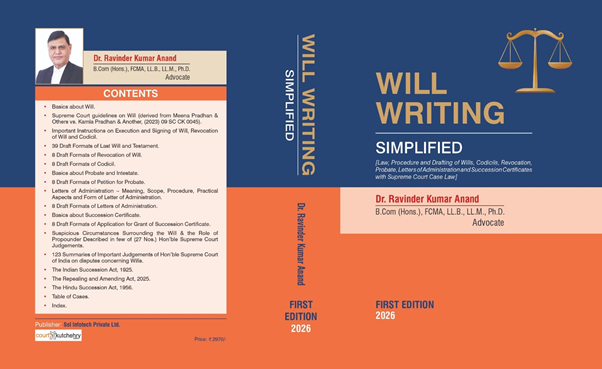
OUR RECOMMENDATION: Check out 123 Key Judgements, as highlighted in the book, WILL WRITING SIMPLIFIED, for the quick research and reference purposes. Click the link here: https://www.courtkutchehry.com/pages/blog/123-supreme-court-judgments-on-wills/
Keywords for SEO & Faster Searches
- Dondapati Narayana Reddy case 2001
- Duggireddy Venkatanarayana Reddy Supreme Court judgment
- Will dispute procedural justice India
- Amendment of pleadings Supreme Court ruling
- Additional evidence in civil suits India
- Justice M.B. Shah R.P. Sethi decision
- SLP (C) No. 14429 of 2001 inheritance law