
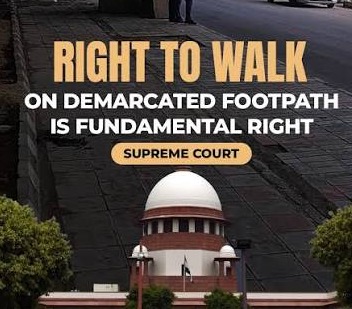
Right to Walk: India’s Supreme Court Elevates Pedestrian Safety to a Fundamental Right
Footpaths Take Priority Over Vehicles in Landmark Ruling
Comparative Lessons from Global Pedestrian Rights Movements
By Vishwas Kumar
New Delhi: June 22, 2026:
India’s Supreme Court’s June 2026 ruling that the right to walk on demarcated footpaths is a fundamental right mark a turning point in constitutional jurisprudence and urban governance. Delivered by Justices P.S. Narasimha and A.S. Chandurkar, the judgment arose from a tragic accident in which a five-year-old boy was killed by a tanker while walking to school with his father in an area without proper pedestrian infrastructure. The Court not only enhanced compensation for the family but also elevated pedestrian safety to the level of constitutional entitlement, grounding it in Articles 19(1)(d) and 21 of the Constitution. This recognition reframes walking not as a mere convenience but as a protected liberty central to life, dignity, and democratic participation.
The ruling is significant because it challenges decades of urban planning that prioritized motorized transport over human mobility. The Motor Vehicles Act, 1988, while regulating traffic, has often sidelined pedestrian concerns. The Court’s observation that vehicles—once a luxury—have come to dominate roads, reducing walkers to “nuisances,” is a sharp critique of civic neglect. By declaring footpaths a constitutional necessity, the judgment imposes enforceable duties on municipalities, corporations, and panchayats to construct, maintain, and safeguard pedestrian pathways. Citizens can now seek remedies directly under constitutional law, independent of statutory frameworks, making pedestrian rights actionable in courts.
Globally, India’s move is pioneering. While countries like the U.S. adopt “Complete Streets” policies and European cities embed pedestrian priority into urban design, few jurisdictions elevate walking to constitutional status. South Africa links mobility to dignity, and Japan enforces pedestrian priority through strict zoning, but India’s ruling uniquely constitutionalizes the act of walking. This positions India as a leader in rights-based urbanism, potentially inspiring similar frameworks elsewhere.
The human dimension of this ruling cannot be overstated. For millions of Indians—children walking to school, elderly citizens navigating crowded streets, differently-abled individuals seeking accessibility—safe footpaths are not luxuries but lifelines. The tragedy that prompted this case underscores the stakes: unsafe pedestrian conditions are not inconveniences but matters of life and death. By recognizing walking as a fundamental right, the Court has restored dignity to everyday acts of mobility and reminded the nation that democracy begins on the footpath. This ruling is not just about infrastructure; it is about reclaiming the streets for people, ensuring that every step taken in India is backed by constitutional assurance.
The Judgment: A Constitutional Milestone
Bench: Justices P.S. Narasimha and A.S. Chandurkar.
Core Holding: The right to walk on demarcated footpaths is a fundamental right under Article 19(1)(d) (freedom of movement), read with Articles 19(1)(a), 19(1)(b), 19(1)(c), and Article 21 (life and liberty).
Priority: Pedestrian rights are primary and override the privilege of motorized transport.
Duty: Urban development authorities, municipal corporations, municipalities, and panchayats must construct, maintain, and safeguard footpaths.
Remedies: Citizens may seek constitutional restitution and compensation, independent of the Motor Vehicles Act.
Judicial Reasoning
Civilizational critique: The Court noted that walking, once central to India’s freedom struggle and social reform, has been marginalized by motorized transport.
Elitism & neglect: Vehicles, once a luxury, now dominate roads, relegating walkers to “nuisances.”
Legal gap: The Motor Vehicles Act, 1988, has undermined pedestrian rights rather than protecting them.
Directive: The judgment was forwarded to ministries and the Law Commission for a dedicated statutory framework.
Comparative Perspectives
United States: “Complete Streets” policies mandate pedestrian-friendly infrastructure, though not framed as constitutional rights.
European Union: Cities like Copenhagen and Amsterdam prioritize walking and cycling, embedding pedestrian rights in urban planning.
South Africa: Constitutional jurisprudence links safe mobility to dignity and equality, influencing pedestrian safety laws.
Japan: Strict zoning and urban design ensure pedestrian priority, with legal remedies for violations.
Case Study: The Tragedy Behind the Ruling
The case arose from the death of a five-year-old boy, struck by a tanker while walking to school with his father in an area lacking footpath. The Supreme Court enhanced compensation to ₹11.44 lakh and simultaneously elevated pedestrian rights to constitutional status.
Humanizing the Issue
Urban India: In cities like Delhi and Mumbai, pedestrians often walk on roads due to encroached or absent footpaths.
Rural India: Villagers face unsafe highways without pedestrian crossings.
Everyday reality: Parents escorting children, elderly citizens, and differently abled individuals are disproportionately vulnerable.
FAQ
Constitutional Basis
What constitutional article guarantees the right to walk? Article 19(1)(d) guarantees the freedom of movement, which the Supreme Court has interpreted to include walking on footpaths.
How does Article 19(1)(d) apply to pedestrians? It ensures citizens can move freely throughout India, and walking is the most basic form of movement.
Is Article 21 linked to pedestrian safety? Yes, Article 21 protects life and liberty, and safe footpaths are essential to preserving life.
Can freedom of assembly (Article 19(1)(b)) extend to walking? Yes, peaceful marches or processions rely on safe pedestrian spaces.
How does freedom of association (Article 19(1)(c)) relate to walking groups? Walking clubs or protest groups exercising collective rights depend on safe footpaths.
Judicial Precedents
Which Supreme Court case recognized walking as a fundamental right? The June 2026 ruling explicitly recognized walking on demarcated footpaths as a fundamental right.
What role did the tragic accident case play? The case involved a child’s death due to lack of footpaths, prompting the Court to elevate pedestrian rights.
How has the Motor Vehicles Act undermined pedestrian rights? It prioritizes vehicular regulation, often sidelining pedestrian safety.
Are remedies under constitutional law independent of statutory law? Yes, constitutional remedies exist even if statutory frameworks are inadequate.
Can High Courts enforce pedestrian rights under Article 226? Yes, High Courts can issue writs to enforce fundamental rights, including pedestrian rights.
Duties of Authorities
Who must construct footpaths? Municipal corporations, municipalities, and panchayats are responsible.
What is the role of municipal corporations? They must design, build, and maintain pedestrian infrastructure.
Can panchayats be sued for failing to provide footpaths? Yes, as local authorities, they are accountable under constitutional obligations.
Is there a duty to maintain footpaths? Yes, authorities must ensure footpaths remain safe and usable.
What happens if footpaths are encroached? Encroachments are illegal, and authorities must remove them to protect pedestrian rights.
Remedies
Can citizens seek compensation for unsafe footpaths? Yes, compensation claims can be filed for injuries or deaths caused by unsafe conditions.
Is restitution available under constitutional law? Yes, courts can order restitution for violation of fundamental rights.
How does the Specific Relief Act apply? It allows injunctions compelling authorities to provide or maintain footpaths.
Can PILs be filed for pedestrian rights? Yes, public interest litigations are a common way to enforce pedestrian safety.
Are remedies under the Motor Vehicles Act sufficient? No, they focus on vehicles, not pedestrian rights, hence constitutional remedies are vital.
Comparative Law
Do other countries recognize walking as a right? Few do constitutionally, but many embed pedestrian safety in urban policy.
How does the U.S. approach pedestrian safety? Through “Complete Streets” policies that mandate safe infrastructure.
What lessons can India learn from Europe? European cities prioritize walking and cycling, integrating them into urban design.
Is pedestrian safety linked to dignity in South Africa? Yes, courts have tied mobility rights to dignity and equality.
How does Japan enforce pedestrian priority? Strict zoning laws and urban planning ensure pedestrian-first infrastructure.
Practical Concerns
What if footpaths are absent in rural areas? Authorities must provide safe walking paths along highways and village roads.
Can citizens demand new footpaths? Yes, they can petition civic bodies or file PILs.
How should urban planning change post-ruling? Cities must prioritize pedestrian zones, crossings, and accessible pathways.
Are encroachments by vendors illegal? Yes, they violate pedestrian rights and must be regulated.
Can police enforce pedestrian rights? Yes, police can act against encroachments and unsafe practices.
Future Directions
Will Parliament enact a pedestrian rights law? Likely, as the Court has urged legislative action.
Can a regulatory body be established? Yes, a dedicated authority could oversee pedestrian infrastructure.
How will compensation claims evolve? They may expand beyond motor accidents to unsafe civic infrastructure.
Will urban design prioritize walkers? Yes, the ruling mandates a shift toward pedestrian-centric planning.
Can technology (apps, sensors) aid pedestrian safety? Yes, smart sensors and apps can monitor and report unsafe conditions.
How will this ruling affect smart cities? Smart cities must integrate pedestrian rights into design and technology.
Can NGOs litigate for pedestrian rights? Yes, NGOs can file PILs and advocate for enforcement.
Will insurance policies adapt? Policies may expand to cover pedestrian accidents and civic negligence.
How does this ruling affect school safety? Schools must ensure safe pedestrian zones for children.
Can citizens sue for damages if injured on unsafe footpaths? Yes, they can seek damages under constitutional and tort law.
Op-Ed Closing Vision
The Supreme Court’s declaration of the right to walk on demarcated footpaths as a fundamental right is not merely a legal pronouncement—it is a civilizational correction. For decades, India’s urban imagination has been dominated by motorized transport, relegating pedestrians to the margins. This ruling reclaims walking as a constitutional guarantee, restoring dignity to millions who traverse India’s streets daily.
Walking is more than locomotion; it is a democratic act. The freedom struggle was powered by marches, satyagrahas, and processions. Social reformers walked to villages, bridging divides. Yet, in modern India, walkers are treated as obstacles. The Court’s recognition of walking as a fundamental right reasserts that democracy begins on the footpath.
The ruling also reshapes civic accountability. By imposing enforceable duties on municipalities and panchayats, the Court has shifted responsibility from abstract policy to concrete obligation. Citizens can now demand safe footpaths not as charity but as constitutional entitlement. This transforms urban governance, compelling authorities to prioritize pedestrian infrastructure alongside roads and flyovers.
Globally, India’s move is pioneering. While many jurisdictions protect pedestrian safety through policy, few elevate it to constitutional status. By doing so, India positions itself as a leader in rights-based urbanism. This could inspire other nations grappling with motor dominance to rethink their legal frameworks.
Yet challenges remain. Footpaths in India are often encroached by vendors, parked vehicles, or construction debris. Enforcement is weak, and civic apathy is entrenched. The Court’s directive must be followed by legislative action—a dedicated Pedestrian Rights Act, regulatory authority, and budgetary allocations. Without institutional backing, the ruling risks becoming symbolic.
The ruling also intersects with climate justice. Encouraging walking reduces carbon emissions, aligns with sustainable development goals, and promotes public health. Safe footpaths can catalyze a shift towards non-motorized transport, easing congestion and pollution. Thus, pedestrian rights are not only constitutional but ecological.
Humanizing this issue is vital. The father who lost his child in the tragic accident embodies the stakes. For him, the ruling is bittersweet—justice for his son, but too late to save him. His story reminds us that pedestrian rights are not abstract—they are about lives cut short, families shattered, futures stolen. Every unsafe footpath is a potential tragedy.
The editorial vision must therefore be bold: India must walk into its constitutional promise. Cities must be redesigned with walkers at the center. Schools must have safe pedestrian zones. Elderly citizens must walk without fear. Differently abled individuals must find accessible footpaths. Vendors must coexist without encroachment. Police must enforce pedestrian rights with seriousness. And citizens must reclaim their streets, asserting their right to walk as a collective demand.
In conclusion, the Supreme Court has opened a path—literally and metaphorically. It is now up to Parliament, state legislatures, civic bodies, and citizens to walk that path. The ruling is a reminder that democracy is not only about voting in polling booths but also about walking safely on the streets. The footpath is the first step of freedom, and India has finally recognized it as such. The challenge ahead is to ensure that this recognition translates into reality, so that every child walking to school, every worker walking to the bus stop, and every elder walking to the temple can do so with dignity, safety, and constitutional assurance.