
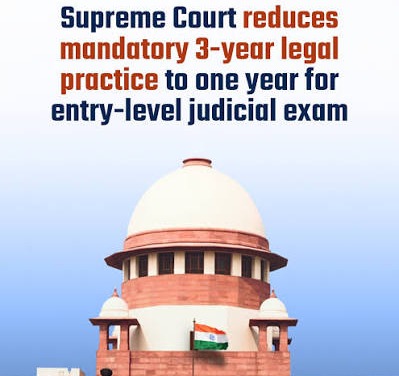
REDEFINING BENCH-READY JUDGES: SUPREME COURT RESTRUCTURES ENTRY CRITERIA FOR LOWER JUDICIARY
Apex Court Replaces Mandatory Three-Year Bar Standing with One-Year Active Practice and Integrated Clerkship
Transition Window Waives Practice Bar Until 2027 to Protect Meritorious Fresh Law Graduates
By Legal Editor
New Delhi: August 21, 2026:
In a seminal intervention that balances professional experience with institutional training, the Supreme Court of India rendered its verdict in Bhumika Trust v. Union of India (2026). Pronounced by a Bench comprising Chief Justice of India Surya Kant, Justice August George Masih, and Justice K. Vinod Chandran (dissenting), the judgment recalibrates the eligibility landscape for entry-level judicial officers. While refusing to entirely abandon the foundational premise established in its May 2025 decision in All India Judges Association v. Union of India (2025 SCC OnLine SC 1184)—which reinstated mandatory litigation experience prior to entering the Junior Civil Judiciary—the majority bench modified the framework to mitigate systemic hardship on fresh law graduates, persons with disabilities, and women.
Historical Precedents and Legal Evolution of Judicial Eligibility
The debate surrounding entry criteria for Civil Judges (Junior Division) has historically oscillated between institutional academic qualification and courtroom exposure.
The 14th Law Commission Report (1958): Originally recommended a three-year practice mandate at a time when the LL.B. was primarily a two-year post-graduate degree lacking systematic practical training modules.
All India Judges Association (I) v. Union of India (1993): The Supreme Court formally operationalized the requirement, holding that three years' standing at the Bar was necessary for candidates to gain courtroom decorum and procedural competence.
First National Judicial Pay Commission / Shetty Commission (1999): Exhaustively reviewed the entry framework following the emergence of the five-year integrated LL.B. degree. The Commission noted that formal clinical legal education and NLU models produced graduates far better equipped than junior practitioners navigating unstructured junior practice.
All India Judges Association (II) v. Union of India (2002): Accepting the Shetty Commission's findings, the Supreme Court abolished the mandatory three-year Bar practice condition, allowing fresh law graduates to sit for judicial examinations immediately upon graduation.
All India Judges Association (2025 Reversion): The Supreme Court reinstated the three-year litigation rule in May 2025, triggering widespread review petitions by law universities, student bodies, and civil rights groups asserting that the sudden imposition caused severe prejudice to aspiring jurists.
Core Judicial Directions and Dual-Phase Structure
Addressing the review petitions, the Supreme Court fashioned a structured compromise that divides judicial recruitment into two distinct phases: a transitional relief window and a post-2027 permanent framework.
┌─────────────────────────────────────────┐
│ Supreme Court Verdict (Bhumika Trust) │
┌───────────────────────────────┐ ┌───────────────────────────────┐
│ TRANSITIONAL PHASE │ │ PERMANENT FRAMEWORK │
│ (May 20, 2025 - Mar 31, 2027)│ │ (On/After April 1, 2027) │
└───────────────┬───────────────┘ └───────────────┬───────────────┘
│ │
├─ Practice Requirement Waived ├─ 1 Year Active Verified Practice
├─ Deemed 1 Year Practice Credit ├─ Practice Certificate Required
├─ 1 Year Academy Training ├─ 1 Year Academy Training
└─ 1 Year Structured Clerkship └─ 1 Year Structured Clerkship
1. The Transitional Regime (May 20, 2025 – March 31, 2027)
To resolve hardship caused by the abrupt May 2025 judgment, all judicial recruitment notifications issued up to March 31, 2027, will grant a complete waiver of prior litigation experience:
Exemption & Practice Credit: Applicants are deemed to have completed one year of active practice automatically without needing to submit a formal certificate of practice from a local Bar Council.
Trainee Judicial Officer Designation: Successful candidates will not assume immediate judicial charge; instead, they will be inducted as "Trainee Judicial Officers".
Academy & Clerkship Track: Trainees must complete one full year of intensive training at their respective State Judicial Academies followed by a mandatory one-year structured clerkship.
Stipend Allocation: During training and clerkship, trainees receive emoluments equivalent to 50% of the gross remuneration of a Judicial Magistrate First Class (JMFC) along with standard academy amenities.
2. The Permanent Framework (On or After April 1, 2027)
For all recruitment advertisements issued after April 1, 2027, the Supreme Court permanently reduces the prior practice bar from three years to one year:
Active Practice Certificate: Candidates must present a verified certificate demonstrating one year of active court presence in effective proceedings.
Post-Selection Training: Selected officers must undergo two complete years of institutional preparation prior to regular bench appointment:
Year 1: Intensive training at the State Judicial Academy.
Year 2 (First 6 Months): Structured clerkship under the Principal District & Sessions Judge or a Higher Judicial Service (HJS) officer.
Year 2 (Second 6 Months): Structured clerkship under a sitting High Court Judge.
Performance Evaluation: Full appointment into the regular judicial cadre and entitlement to the regular pay scale are contingent upon a satisfactory evaluation report submitted by the supervising High Court Judge.
Institutional Impact Analysis
Searchable Index & Detailed Legal FAQ
=================================================================================
SEARCHABLE INDEX OF LEGAL QUESTIONS
=================================================================================
[FAQ-01] What is the status of the 3-year practice rule after the 2026 judgment?
[FAQ-02] Who is eligible for the transitional relaxation until March 31, 2027?
[FAQ-03] How does the Court verify "active practice" for post-2027 exams?
[FAQ-04] What are the stipend and compensation rules during the trainee phase?
[FAQ-05] How is the two-year post-selection training structured?
[FAQ-06] What was the dissent note by Justice K. Vinod Chandran?
=================================================================================
[FAQ-01] What is the status of the 3-year practice rule after the 2026 judgment?
Answer: The Supreme Court has modified its May 2025 judgment. The requirement of three years' active Bar practice has been permanently reduced to one year for recruitment notifications published on or after April 1, 2027. Candidates who pass the exam will complete an additional two years of combined academy training and judicial clerkships.
[FAQ-02] Who is eligible for the transitional relaxation until March 31, 2027?
Answer: Any law graduate appearing for Civil Judge (Junior Division) recruitment exams advertised between May 20, 2025, and March 31, 2027, is completely exempt from showing prior practice at the Bar. Candidates in this window receive a legal deeming credit for one year of practice and are not required to furnish practice certificates from local Bar Councils.
[FAQ-03] How does the Court verify "active practice" for post-2027 exams?
Answer: Practice will no longer be satisfied by mere enrollment with a State Bar Council. Candidates must submit a formal Certificate of Practice verifying active presence and participation in effective court proceedings in accordance with evaluation rules framed by High Courts and the Apex Court.
[FAQ-04] What are the stipend and compensation rules during the trainee phase?
Answer: During both the one-year State Judicial Academy training and the subsequent one-year judicial clerkship, Trainee Judicial Officers will draw monthly emoluments equal to 50% of the gross remuneration of a Judicial Magistrate First Class (JMFC), alongside academy hostel and training facilities. Regular pay scales attach upon full confirmation.
[FAQ-05] How is the two-year post-selection training structured?
Answer: Selection is followed by a mandatory 24-month preparation track:
Months 1–12: Intensive academic and procedural training at the State Judicial Academy.
Months 13–18: Field clerkship mentored by the Principal District Judge or a Higher Judicial Service officer.
Months 19–24: Higher clerkship under the direct supervision of a sitting High Court Judge.
[FAQ-06] What was the dissent note by Justice K. Vinod Chandran?
Answer: Justice K. Vinod Chandran dissented from the majority verdict. He declined to concur with modifying the 2025 judgment or substituting practice requirements with academy training, holding that the review petitions ought to be dismissed in their entirety.
Parameter — 2025 Framework — 2026 Modified Framework — Institutional Rationale
Bar Experience — 3 Years Mandatory — 1 Year Mandatory (Post-April 2027) — Reduces financial entry barriers while maintaining foundational procedural exposure.
Transitional Rights — None (Immediate cutoff) — Complete practice waiver until March 31, 2027 — Prevents legitimate expectation losses for students graduating between 2025–2027.
Supervised Clerkship — Minimal / Unstructured — 1 Year (6 Months District / 6 Months High Court) — Imparts real-time judicial decision-making skills under senior judicial mentorship.
Review Schedule — Permanent — Mandatory 3-year Institutional Review — Allows the court to evaluate empirical indicators before fixing permanent criteria.