
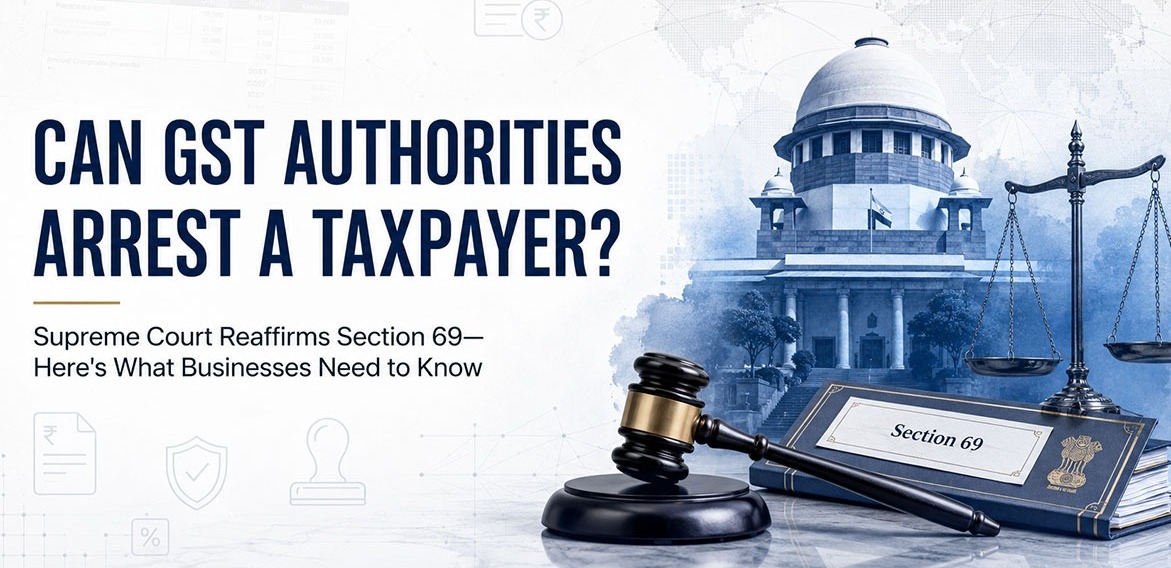
Liberty Before Handcuffs: Supreme Court Mandates Prior Communication of 'Reasons to Believe' Under Section 69 CGST Act
A Landmark Victory for Personal Liberty in Tax Offenses
Balancing Investigatory Powers with Constitutional Protections Against Arbitrary Arrests
By Legal Editor
New Delhi: August 13, 2026:
In a ruling that profoundly reshapes the landscape of white-collar and tax jurisprudence in India, a Supreme Court bench comprising Justice Dipankar Datta and Justice Sheel Nagu held in Union of India v. Sunil Biyani (2026 LiveLaw (SC) 797) that no arrest can lawfully take place under Section 69 of the Central Goods and Services Tax (CGST) Act, 2017, unless the written order containing the Commissioner’s "reasons to believe" is mandatorily communicated to the assessee prior to the apprehension.
By reading the requirement of prior communication directly into Section 69 of the CGST Act, the apex court harmonized revenue protection with personal liberty under Article 21 of the Constitution of India. This decision addresses a long-standing procedural anomaly wherein taxpayers faced immediate custodial detention without having access to the specific grounds or reasons driving the Commissioner’s statutory belief.
+-------------------------------------------------------------------------------+
| SECTION 69 ARREST FLOWCHART |
+-------------------------------------------------------------------------------+
| 1. Commissioner forms "Reasons to Believe" (Major Tax Evasion / Fraud) |
| │ |
| ▼ |
| 2. Order passed under Section 69 authorizing central tax officer to arrest |
| │ |
| ▼ |
| 3. MANDATORY COMMUNICATION of Section 69 Order (Physical / Electronic / BNSS) |
| │ |
| ▼ |
| 4. Assessee acquires actionable locus standi to seek Pre-Arrest (Anticipatory) |
| Bail under Section 482 BNSS / Section 438 CrPC |
+-------------------------------------------------------------------------------+
The Genesis of the Dispute: Union of India v. Sunil Biyani
The matter reached the Supreme Court via an appeal filed by the Union of India challenging a judgment of the Bombay High Court. The respondent-assessee, apprehending arrest during a GST investigation following a summons under Section 70, had approached the High Court seeking quashing of proceedings and anticipatory bail.
While the High Court noted that no formal order authorising arrest under Section 69 had yet been issued—rendering the anticipatory bail application technically premature—it nevertheless granted a conditional interim protection. It directed that in the event a Section 69 order were passed in the future; it would remain in abeyance for one week to allow the assessee to approach the competent forum.
The Union of India assailed this direction before the Supreme Court, arguing that High Courts cannot grant prospective blanket protection or stay non-existent arrest orders.
While agreeing with the Revenue that interim protection cannot survive if an application is premature, the Supreme Court addressed the fundamental underlying dilemma: How can a citizen exercise the statutory right to seek pre-arrest bail if the executive order triggering the power of arrest is deliberately kept secret until the moment of detention?
Core Statutory & Constitutional Framework
The decision navigates the intersection of tax enforcement, criminal procedure, and constitutional rights. The principal statutes and provisions analyzed include:
Key Judicial Findings & Ratio Decidendi
1. Mandatory Communication as a Condition Precedent
The Court observed that reading Section 69 without a mandatory requirement of communicating the "reasons to believe" would result in drastic consequences for individual liberty. Consequently, the bench declared that communicating the Section 69 order to the target person before arrest is mandatory.
"The requirement of communication of the order passed under Section 69 of the CGST Act to the accused before he is arrested, has to be read into the statute and communication of such an order to the person sought to be arrested must be held to be mandatory."
2. Activating the "Alarm" for Anticipatory Bail
The Court emphasized that an order under Section 69 is a sine qua non (an indispensable condition) to maintain an application for anticipatory bail. Once the Commissioner records reasons and issues the order, the "alarm is activated". Withholding these reasons renders the constitutional and statutory remedy of pre-arrest bail under Sushila Aggarwal v. State (NCT of Delhi) illusory and unworkable.
3. Permissibility of Electronic Service
Addressing practical concerns regarding potential evasion by tax offenders, the Supreme Court clarified that communication need not be restricted to traditional personal delivery. The Revenue is explicitly permitted to transmit Section 69 orders via:
Electronic means (Email, GST Portal, Messaging platforms)
Modes authorized under the Bharatiya Nagarik Suraksha Sanhita (BNSS), 2023
Any other legally recognized mode of official communication.
Searchable Legal Index: Frequently Asked Questions (FAQs)
Category A: Section 69 CGST Act & Arrest Mechanics
Q1: What is Section 69 of the CGST Act, 2017?
Answer: Section 69 empowers the Commissioner of Central Tax to authorize any central tax officer to arrest a person if the Commissioner has "reasons to believe" that the person has committed specific offences listed under Section 132 of the CGST Act.
Q2: What does "reasons to believe" signify in GST arrest matters?
Answer: "Reasons to believe" requires objective, credible material demonstrating a direct nexus to the alleged tax fraud or evasion. It cannot be based on mere suspicion, subjective satisfaction, or routine administrative routine.
Q3: Can GST officers execute an arrest immediately after issuing summons under Section 70?
Answer: No. A summons under Section 70 is merely an investigatory directive to record statements or produce documents. An arrest requires a distinct, formal order passed by the Commissioner under Section 69, which must now be communicated prior to execution.
Category B: Pre-Arrest Bail & Procedural Remedies
Q4: Why is prior communication of the Section 69 order critical for seeking pre-arrest bail?
Answer: Courts generally consider anticipatory bail applications premature if there is no concrete apprehension or official order of arrest. Communicating the Section 69 order provides the assessee with concrete proof of imminent arrest and the legal grounds to invoke anticipatory bail remedies under the BNSS / CrPC.
Q5: Can a High Court grant protective interim relief if it finds the anticipatory bail plea premature?
Answer: No. The Supreme Court reiterated that interim protection is parasitic on the main petition's maintainability. If a court finds an anticipatory bail petition premature because no Section 69 order exists, it cannot issue prospective protection orders.
Q6: How can GST authorities communicate the Section 69 order to the target assessee?
Answer: The order can be served physically or electronically (e.g., via registered email or GST portal) in addition to modes permitted under the BNSS. Once communicated electronically, the legal requirement is fulfilled, and the authorities may proceed in accordance with law.
Category C: Judicial Precedents & Constitutional Alignment
Q7: Which landmark precedent on anticipatory bail was relied upon by the Supreme Court?
Answer: The Court relied on the Constitutional Bench ruling in Sushila Aggarwal v. State (NCT of Delhi) (2020), which affirmed that anticipatory bail protection should not be arbitrarily restricted without statutory warrant and must remain accessible when a real apprehension of arrest arises.
Q8: Does this ruling impede the power of GST authorities to investigate complex tax frauds?
Answer: No. The Supreme Court explicitly observed that communicating the order containing reasons to believe does not obstruct ongoing investigations. It simply ensures procedural compliance and protects fundamental rights under Article 21.
Comparative Matrix: Pre-Ruling vs. Post-Ruling Practice
Strategic Implications for Tax Administration & Assessees
The Sunil Biyani ruling strikes a delicate balance:
For Revenue Authorities: GST departments must now ensure meticulous administrative discipline. The "reasons to believe" recorded in the file under Section 69 must be robust, legally sustainable, and served promptly via electronic or physical channels before attempting physical detention.
For Assessees & Practitioners: Taxpayers facing aggressive GST inquiries gain transparent access to the legal grounds of arrest. This eliminates secretive arrests and empowers legal counsel to approach competent courts for pre-arrest bail with concrete, documented pleadings.
By affirming that executive powers of arrest under special tax laws remain subject to basic constitutional guarantees, the Supreme Court has re-anchored economic offense administration within the rule of law.
Provision — Act / Code — Core Mandate / Context
Section 69 — CGST Act, 2017 — Empowers the Commissioner to authorize an officer to arrest a person if there is "reason to believe" specified offences have been committed.
Section 132 — CGST Act, 2017 — Details cognizable and non-bailable tax offences (e.g., fraudulent Input Tax Credit, fake invoicing exceeding specified thresholds).
Section 70 — CGST Act, 2017 — Power to summon persons to give evidence and produce documents during investigations.
Section 482 — Bharatiya Nagarik Suraksha Sanhita (BNSS), 2023 (formerly Sec 438 CrPC) — Direction for grant of bail to a person apprehending arrest (Anticipatory / Pre-Arrest Bail).
Article 21 — Constitution of India — Protection of life and personal liberty; mandates that liberty cannot be deprived except according to procedure established by law.
Article 22(1) — Constitution of India — Fundamental right to be informed, as soon as may be, of the grounds for such arrest.
Procedural Aspect — Practice Prior to Sunil Biyani Ruling — Mandated Practice Post-Sunil Biyani Ruling
Knowledge of Order — Section 69 order often shown or served only at the exact moment of physical arrest. — Order containing "reasons to believe" must be communicated before arrest occurs.
Pre-Arrest Bail Locus — Applications frequently dismissed as premature or speculative prior to arrest. — Receipt of communicated order establishes clear cause of action for anticipatory bail.
Service Channels — Physical presentation during enforcement raids or arrests. — Physical, BNSS modes, and modern electronic channels (Email/Portal).
Judicial Discretion — High Courts occasionally issued prospective stays on future arrest orders. — High Courts must not grant interim protection on premature petitions lacking a passed order.