
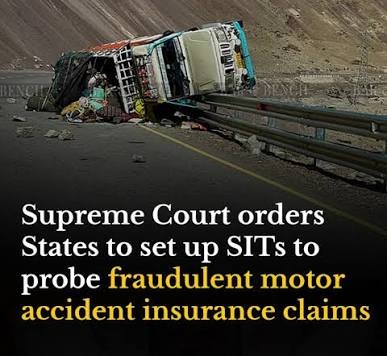
Supreme Court Mandates State-Level SITs to Dismantle Pan-India Motor Accident Insurance Fraud Rackets
Bench Warns Insurers Against Selective Escalation while Calling for Integration of VAHAN, SARATHI, and e-DAR Databases
Comprehensive Judicial Intervention Seeks Strict Accountability of Insurance Executives and Urgent Structural Reforms
By Legal Reporter
New Delhi: August 26, 2026:
The Supreme Court of India has issued a landmark directive ordering all states and Union Territories to establish dedicated Special Investigation Teams (SITs) to investigate widespread motor accident claim fraud. A Division Bench comprising Justice Ahsanuddin Amanullah and Justice Prasanna B. Varale observed that fraudulent motor accident claims are being engineered across the country through recurring operational patterns. The judicial intervention began as a narrow dispute concerning the identity of a single vehicle allegedly involved in a road mishap. However, as evidentiary disclosures exposed a broader pattern of collusion—where identical vehicles were repeatedly cited in multiple disparate accident claims—the apex court widened the scope of the proceedings to address a systemic crisis that threatens the financial viability of India’s insurance sector.
The Supreme Court emphasized that fraudulent insurance litigation inflicts acute financial distress on insurance companies, draining capital reserves and ultimately inflating premium rates for bona fide policyholders. Fraudulent motor accident claims erode public faith in statutory compensation mechanisms established under welfare legislation. By establishing specialized investigative frameworks across states, the court aims to break the nexus of corrupt claimants, legal representatives, medical personnel, and complicit insurance officials who systematically siphon funds from the public exchequer and private insurers alike.
Statutory and Regulatory Framework under Judicial Scrutiny
The Supreme Court’s directions operate within the framework of Indian motor vehicles law, criminal procedure, and financial regulation. The proceedings highlight key provisions across statutory bodies and legal codes:
The Motor Vehicles Act, 1988 (MVA):
Section 166: Regulates applications for compensation arising out of motor accidents causing death or bodily injury. Fraudulent syndicates often exploit Section 166 by fabricating accident circumstances, inflating injury severity, or introducing fictitious witnesses to claim high compensation amounts from Motor Accident Claims Tribunals (MACTs).
Section 168: Directs Motor Accident Claims Tribunals to conduct inquiries and make awards that appear "just." The Supreme Court noted that when Tribunals dismiss compensation petitions upon detecting fraud or collusion, such rulings must immediately trigger criminal investigations rather than remaining passive civil rejections.
Section 149 & Section 163A (Historical/Amended provisions): Mandate statutory liability of insurers to satisfy judgments and awards against third-party risks. Exploitation of strict third-party liability norms has incentivized deliberate misrepresentation.
Bharatiya Nagarik Suraksha Sanhita, 2023 (BNSS) / Code of Criminal Procedure, 1973 (CrPC):
Section 173 BNSS (Section 154 CrPC): Governs the registration of First Information Reports (FIRs) upon receiving information regarding cognizable offenses. The apex court mandated that state SITs must process all formal complaints lodged by insurance companies and promptly register FIRs against suspects without delay.
Section 310 BNSS (Section 279 CrPC) & Allied Criminal Laws: Enforces penal sanctions for criminal conspiracy, forgery, cheating, and fabrication of false evidence.
Regulatory Supervision & Institutional Mandates:
Insurance Regulatory and Development Authority of India (IRDAI) Act, 1999: Section 14 mandates IRDAI to protect the interests of policyholders and regulate insurance operations. The court formally impleaded IRDAI, the Ministry of Finance, the Ministry of Road Transport and Highways (MoRTH), and the General Insurance Council (GIC) to establish standard operational protocols for fraud detection and risk mitigation.
Accountability of Insurers and Digital Systemic Reforms
A key element of the Supreme Court's ruling is the explicit warning issued to the senior management of insurance companies. The bench instructed insurers to refrain from a "pick-and-choose" approach when forwarding suspicious claims to state SITs. The court emphasized that corporate management will be held directly accountable if insurers selectively report fraudulent cases while shielding favoured entities or covering up internal malfeasance.
Furthermore, the court ordered that whenever an SIT report or an FIR reveals internal involvement, insurance companies must immediately initiate departmental disciplinary proceedings against their employees. Insurers are required to submit detailed affidavits detailing the number of cases referred to state SITs alongside disciplinary actions initiated against internal staff found aiding fraudulent activities.
To eliminate data silos, the court discussed integrating state investigative mechanisms with national digital infrastructure:
Judicial Precedents and State Implementation Benchmarks
During the proceedings, the state of Uttar Pradesh presented operational data demonstrating the impact of a dedicated Special Investigation Team. Following an earlier Supreme Court directive, Uttar Pradesh established a specialized SIT to investigate fake motor accident claims. State counsel reported that out of 2,188 complaints received from insurers, the state SIT investigated over 1,029 cases, resulting in the registration of 231 FIRs naming 533 accused individuals.
The court noted that Uttar Pradesh's enforcement model provides a functional template for other states. By centralizing investigative authority under specialized police units, states can overcome local jurisdictional hurdles, identify inter-state criminal networks, and ensure high conviction rates. The matter has been listed for further hearing on September 23, 2026, by which date all parties—including state governments, IRDAI, MoRTH, and the General Insurance Council—must file comprehensive affidavits accompanied by single-page executive summaries outlining their regulatory progress and compliance mechanisms.
Comprehensive FAQ: Key Legal Points and Regulatory Guidelines
General Overview & Judicial Mandates
Q1: Why did the Supreme Court order the creation of Special Investigation Teams across all states?
The Supreme Court ordered state-level SITs after detecting widespread patterns of fraudulent motor accident claims, such as using the same vehicle in multiple accident cases. The court observed that organized insurance fraud causes financial distress to insurance providers, inflates premium rates for genuine consumers, and strains judicial resources.
Q2: Which judicial bench issued these directives, and what is the next scheduled hearing date?
The directives were issued by a Division Bench comprising Justice Ahsanuddin Amanullah and Justice Prasanna B. Varale. The matter is listed for further monitoring and compliance review on September 23, 2026.
Q3: What institutional bodies were newly added as parties to the Supreme Court proceedings?
The court impleaded the Insurance Regulatory and Development Authority of India (IRDAI), the Ministry of Finance, the Ministry of Road Transport and Highways (MoRTH), and the General Insurance Council (GIC). These entities must file affidavits outlining their current regulatory duties and proposed anti-fraud measures.
Enforcement & Corporate Accountability
Q4: What specific obligations are placed on insurance companies regarding reporting fraud?
Insurance companies are required to forward all claims indicating fraud to state SITs without using a "pick-and-choose" approach. The Supreme Court explicitly stated that senior executive management will be held directly accountable if insurers selectively forward cases or fail to report suspicious claims.
Q5: What actions must insurers take against internal employees involved in fraudulent claims?
Insurers must immediately initiate internal departmental disciplinary actions against officials implicated by SIT investigations, FIRs, or internal audits. Companies must file sworn affidavits detailing internal actions taken against employees acting against company interests or facilitating fraud.
Q6: What happens when a Motor Accident Claims Tribunal (MACT) rejects a claim due to fraud?
If a MACT rejects a compensation petition on grounds of fraud, fabrication, or collusion, the insurer must immediately transmit the case details to the concerned state SIT and initiate an internal inquiry into the potential involvement of its own representatives or assessors.
Statutory Provisions & Technical Integration
Q7: Which core provisions of the Motor Vehicles Act, 1988 are impacted by this ruling?
The ruling primarily impacts Section 166 (application for compensation) and Section 168 (award of the Claims Tribunal) by enforcing strict criminal scrutiny over claims rejected due to collusion or misrepresentation.
Q8: How will digital platforms be integrated to combat motor insurance fraud?
The court accepted proposals to establish a centralized claim data portal integrating the VAHAN registration system, the SARATHI licensing portal, and the e-DAR (e-Detailed Accident Report) system. This integration allows automated cross-referencing of vehicles, drivers, and accident locations to flag duplicate or suspicious compensation filings nationwide.
Q9: What benchmark performance was cited regarding Uttar Pradesh’s existing SIT model?
Uttar Pradesh reported receiving 2,188 complaints from insurance providers. The state SIT investigated over 1,029 complaints, resulting in 231 registered FIRs and criminal charges against 533 accused individuals.
Q10: What are the key compliance requirements for the upcoming September 23, 2026 hearing?
All respondent states, central ministries, statutory authorities, and insurance bodies must submit detailed compliance affidavits accompanied by standardized one-page executive summaries detailing their administrative actions, SIT personnel allocation, and anti-fraud protocols.
Infrastructure Platform — Primary Institutional Function — Judicial Reform Directive
VAHAN Database — National central repository for motor vehicle registration records under MoRTH. — Cross-referencing vehicle history to detect multiple fraudulent claims linked to a single vehicle registration number.
SARATHI Portal — Centralized driver licensing database managing driver profiles nationwide. — Verification of driver credentials, licensing validity, and tracking repeat offenders involved in staged accidents.
e-DAR (e-Detailed Accident Report) — Specialized portal managed by MoRTH to streamline accident reporting and claim settlement. — Real-time digital synchronization between law enforcement, MACTs, and insurers to prevent duplicate claim filings.