

Supreme Court Makes Disclosure of Criminal Antecedents Mandatory in Bail Pleas
Accused must reveal past cases and prior bail applications
Court cancels bail in forged degree case, sets nationwide precedent
By Legal Reporter
New Delhi: February 12, 2026:
In a landmark judgment, the Supreme Court of India has ruled that all accused persons seeking bail must make a full and honest disclosure of their criminal antecedents. The ruling, delivered by a bench comprising Justice Ahsanuddin Amanullah and Justice R. Mahadevan, came while cancelling bail granted to an accused involved in a forged degree racket. The Court emphasized that suppression of criminal history undermines the integrity of the justice system and directed High Courts to incorporate mandatory disclosure requirements in their rules.
Also Read: Patna High Court Rules PwD Vacancies Must Follow RPwD Act, Not State Resolutions
Background of the Case
- Case origin: The matter arose from bail granted by the Allahabad High Court to Mazahar Khan, accused of issuing forged law degrees to lawyers and others.
- Supreme Court’s intervention: The apex court found that Khan had deliberately concealed his criminal antecedents in his bail application.
- Court’s observation: The judges described this concealment as part of a “growing and disturbing trend” where accused persons attempt to mislead courts by selective disclosure.
- Outcome: The Supreme Court set aside the High Court’s order, calling it “legally unsustainable” and “vitiated by non-application of mind.”
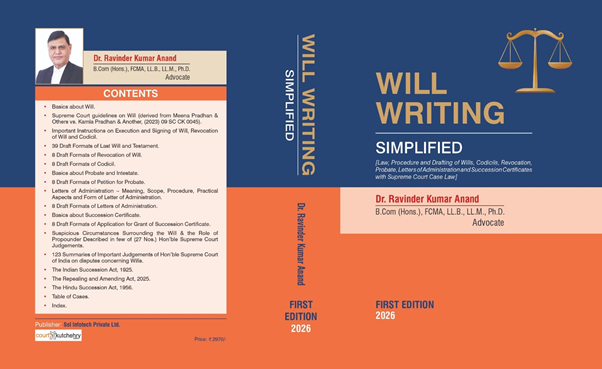
[Suggested Legal Resource]
If you want practical guidance on drafting wills, codicils, and probate procedures, Will Writing Simplified is an invaluable resource.
🔹BUY HERE: Amazon
🔹 BUY HERE: Flipkart
Key Guidelines Issued by the Supreme Court
The Court directed that bail applications must include:
- Case details: FIR number, charges, and court jurisdiction.
- Custody and compliance: Duration of custody and compliance with procedural requirements.
- Status of trial: Whether charges have been framed, witnesses examined, or trial concluded.
- Criminal antecedents: Disclosure of all prior criminal cases, supported by affidavit.
- Previous bail applications: Details of earlier bail pleas and their outcomes.
- Coercive processes: Information on warrants or summons issued against the accused.
Also Read: Supreme Court Criticizes RERA: Says Authority Only Helps Builders, Not Homebuyers
Why This Ruling Matters
- Transparency: Ensures courts have complete information before granting bail.
- Uniformity: Promotes consistency across High Courts by standardizing bail application requirements.
- Accountability: Prevents accused from hiding past criminal conduct.
- Judicial efficiency: Reduces delays caused by incomplete or misleading bail applications.
Wider Legal Context
The ruling was delivered by the Supreme Court stressed that every High Court should amend its rules to mandate disclosure of prior criminal cases. This judgment builds on earlier efforts to strengthen bail jurisprudence in India, balancing the rights of the accused with the need to protect society.
Conclusion
The Supreme Court’s directive marks a turning point in bail law. By mandating disclosure of criminal antecedents, the Court has reinforced the principle that justice must be based on transparency and fairness. This ruling will likely shape bail proceedings across India, ensuring that concealment of facts no longer undermines judicial discretion.
Also Read: Madras High Court Directs MS Dhoni to Deposit ₹10 Lakh in Defamation Case
GEO Keywords
- Supreme Court bail guidelines India
- Criminal antecedents disclosure bail plea
- SC ruling forged degree case bail
- Bail application mandatory details India
- Supreme Court transparency in bail orders
- Kaushal Singh vs State of Rajasthan bail case
- SC cancels bail Allahabad High Court forged degree
- Bail law reforms India 2026
Also Read: Supreme Court Rejects Jairam Ramesh’s Plea Against Retrospective Environmental Clearances