
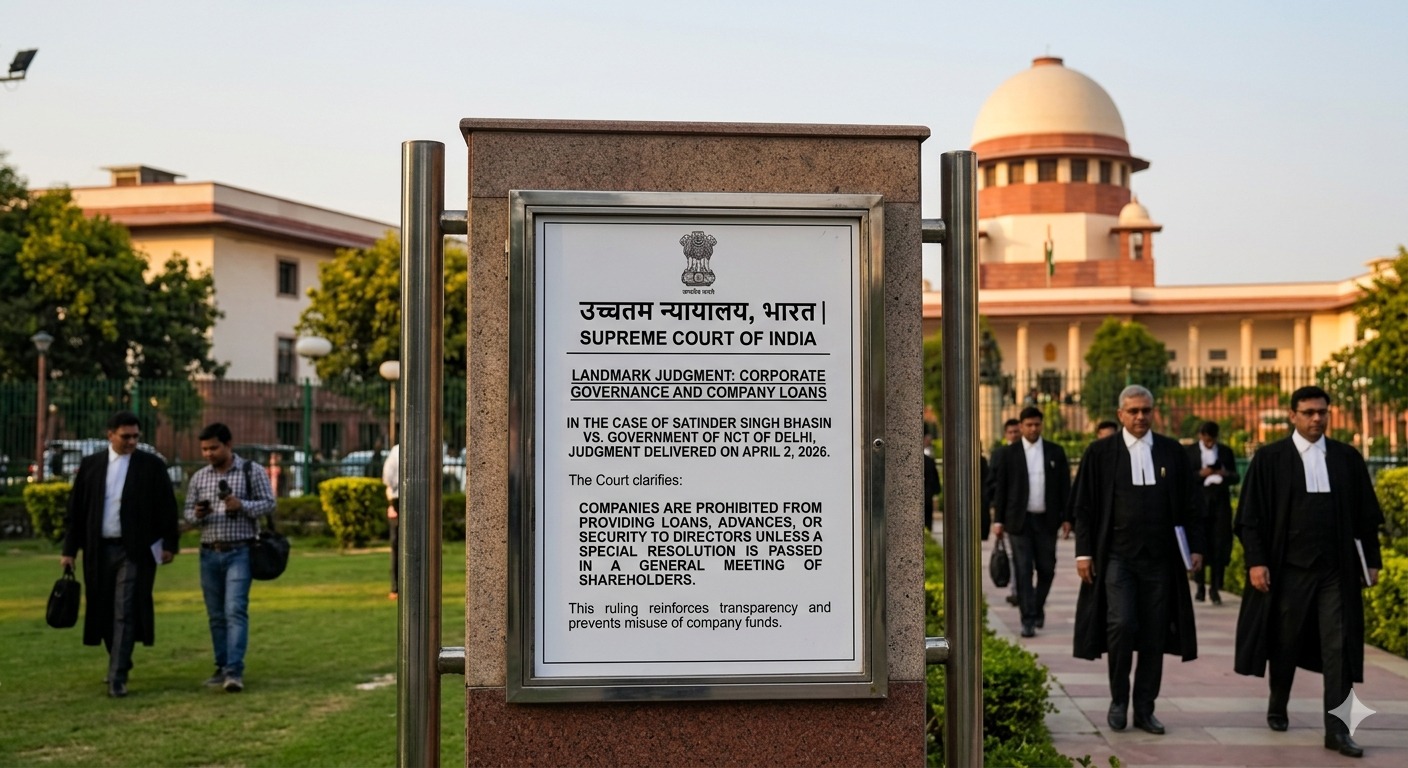
Supreme Court Bars Loans to Directors Without Shareholder Approval
Corporate governance strengthened under Companies Act, 2013
Case highlights misuse of company funds by directors
By Legal Reporter
New Delhi: April 2026:
In a significant ruling, the Supreme Court of India has clarified that companies cannot provide loans to their directors unless a special resolution is passed in a general meeting of shareholders. The judgment, delivered on April 2, 2026, came in the case of Satinder Singh Bhasin vs Government of NCT of Delhi, where allegations of misuse of company funds were raised.
For detailed analysis, check this detailed list of probate judgments and Supreme Court cases on wills in India , covering validity, proof, and inheritance disputes.
The Court emphasized that directors hold fiduciary responsibilities and must not use company resources for personal obligations. This ruling is expected to have far-reaching implications for corporate governance in India.
Background of the Case
- The case involved businessman Satinder Singh Bhasin, who was accused of siphoning off funds from his company, Bhasin Infotech and Infrastructure Private Limited (BIIPL).
- The funds were allegedly diverted to meet bail conditions imposed by the Supreme Court, including a deposit of ₹50 crores.
- The Court found that such diversion violated Section 185 of the Companies Act, 2013, which restricts loans to directors without shareholder approval.
- As a result, the Court cancelled Bhasin’s bail, reinforcing that company finances cannot be misused for personal matters.
📘 Legal professionals and students alike will benefit from Will Writing Simplified, which covers procedure and case law in detail.
🔹 Buy on Amazon
🔹 Buy on Flipkart
Key Highlights of the Judgment
- Special resolution mandatory: Any loan to a director must be approved by shareholders in a general meeting.
- Corporate accountability: Directors cannot use company funds for personal obligations, bail deposits, or unrelated expenses.
- Fiduciary duty reinforced: The ruling underscores that directors must act in the best interest of the company.
- Legal safeguard: Section 185 of the Companies Act, 2013, serves as a statutory protection against misuse of corporate funds.
Implications for Corporate Governance
- Companies: Must ensure strict compliance with shareholder approval requirements before extending loans.
- Directors: Cannot bypass governance norms; personal obligations must be met independently.
- Shareholders: Gain stronger oversight powers, ensuring transparency in financial decisions.
- Regulators: The ruling strengthens enforcement of corporate law and deters financial misconduct.
Broader Context
This judgment aligns with global corporate governance practices, where directors are prohibited from misusing company resources. Similar safeguards exist in jurisdictions like the UK and US, where shareholder approval is required for related-party transactions.
The ruling also comes at a time when India is tightening corporate compliance norms to prevent fraud, protect investors, and enhance transparency in business operations.
Conclusion
The Supreme Court’s decision is a milestone in corporate law, ensuring that directors remain accountable to shareholders and cannot misuse company funds for personal gain. By mandating shareholder approval for loans, the Court has reinforced the principles of transparency, accountability, and fiduciary responsibility in India’s corporate governance framework.