
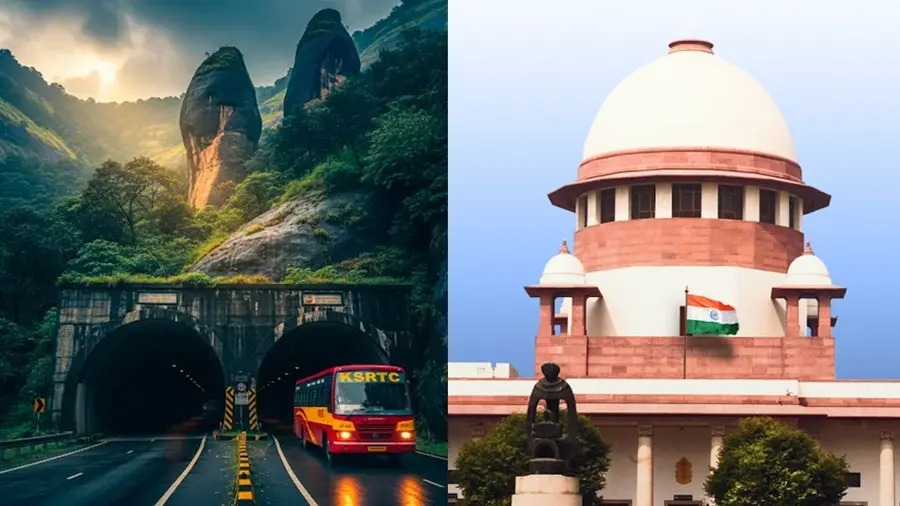
Supreme Court Backs Kerala’s Western Ghats Tunnel Project to Ease Traffic Congestion
Court dismisses plea against environmental clearance, terms project of “national importance”
Twin-tunnel corridor expected to reduce accidents and improve connectivity between Kozhikode and Wayanad
By Legal Reporter
New Delhi: April 06, 2026:
Kerala’s long-pending demand for better connectivity between Kozhikode and Wayanad has received a major boost. On April 6, 2026, the Supreme Court dismissed petitions challenging the environmental clearance for the twin-tunnel corridor project through the Western Ghats, stating that the initiative is vital for easing traffic congestion and ensuring safer travel.
To better understand how courts analyze attestation and suspicious circumstances in wills, refer to this landmark Supreme Court judgment on attestation and proof of wills (Shashi Kumar Banerjee and Others vs Subodh Kumar Banerjee and Others) .
The ruling comes after years of debate over balancing development with ecological concerns in one of India’s most fragile biodiversity zones.
Project Details
- Location: Connecting Kozhikode district with Wayanad district.
- Structure: Twin-tube tunnel corridor.
- Purpose: To reduce traffic congestion, cut travel time, and provide safer passage through landslide-prone areas.
- Background: A devastating landslide in 2024 killed over 420 people in Wayanad, highlighting the urgent need for safer infrastructure.
Supreme Court’s Observations
- Environmental clearance upheld: The Court noted that the Central Empowered Appraisal Committee (CEAC) had approved the project subject to strict safety and structural conditions.
- National importance: The project was termed a “lifeline” for Kerala, essential for public safety and economic growth.
- Judicial restraint: The Court refused to reopen concurrent factual findings, emphasizing that specialized bodies had already examined environmental concerns.
- Petition dismissed: The plea by Wayanad Prakrithi Samrakshana Samithi was rejected, though petitioners were allowed to approach the National Green Tribunal (NGT) for any violations.
Legal Context
- Indian Succession Act & Environmental Law: While succession law governs wills, infrastructure projects fall under the Environment Protection Act, 1986.
- Judicial conscience test: Courts often balance ecological concerns with public interest, applying the principle of proportionality.
- Article 136: Supreme Court’s supervisory jurisdiction ensures fairness but avoids interfering unless findings are perverse.
Case Study Example
Imagine a family living in Wayanad that must travel daily to Kozhikode for work. Currently, they face long delays and risks of landslides. With the tunnel, travel time will reduce drastically, and safety will improve. This mirrors the Court’s reasoning that the project is not just about convenience but about saving lives.
Historical and Comparative Context
- Kerala’s geography: Limited land availability and fragile terrain make tunnels a practical solution.
- Global parallels: Countries like Switzerland and Japan have built extensive tunnel networks through mountains to balance ecology and connectivity.
- India’s precedent: Similar projects in Himachal Pradesh and Jammu & Kashmir have improved connectivity while adhering to environmental safeguards.
Implications for Society, Families, and Courts
- Families: Safer travel and reduced risk of landslides.
- Society: Boost to tourism and trade in Wayanad and Kozhikode.
- Courts: Reinforces judicial support for infrastructure projects of national importance.
- Environment: Strict monitoring needed to ensure ecological safeguards are not compromised.
FAQ Section
1. What is the Western Ghats tunnel project?
A twin-tube tunnel connecting Kozhikode and Wayanad to ease traffic congestion.
2. Why is it important?
It reduces travel time, prevents accidents, and provides safer passage in landslide-prone areas.
3. Did the Supreme Court approve it?
Yes, the Court upheld environmental clearance and dismissed petitions against it.
4. Can the project still be challenged?
Yes, petitioners can approach the National Green Tribunal (NGT) if violations occur.
5. What about environmental concerns?
The CEAC has imposed strict safety and structural conditions to protect ecology.
6. When will construction begin?
Work is expected to start after final clearances and tendering, with timelines set by the Kerala government.
7. How will it benefit Kerala?
It will improve connectivity, boost tourism, and reduce risks of landslides.
Conclusion
The Supreme Court’s backing of Kerala’s Western Ghats tunnel project marks a turning point in balancing development with environmental concerns. By terming it a project of “national importance,” the Court has prioritized public safety and connectivity while ensuring ecological safeguards.
For Kerala, the tunnel is more than infrastructure—it is a lifeline for families, businesses, and the state’s future growth.
Suggested Keywords for SEO
- Supreme Court Kerala tunnel project
- Western Ghats twin-tube corridor
- Kozhikode Wayanad traffic congestion
- Kerala infrastructure Supreme Court ruling
- Wayanad landslide tunnel solution
- National importance tunnel project India
Book Reference
Legal professionals and students alike will benefit from Will Writing Simplified, which covers procedure and case law in detail. Amazon.
📘 Buy Will Writing Simplified online: 🔹 Flipkart