
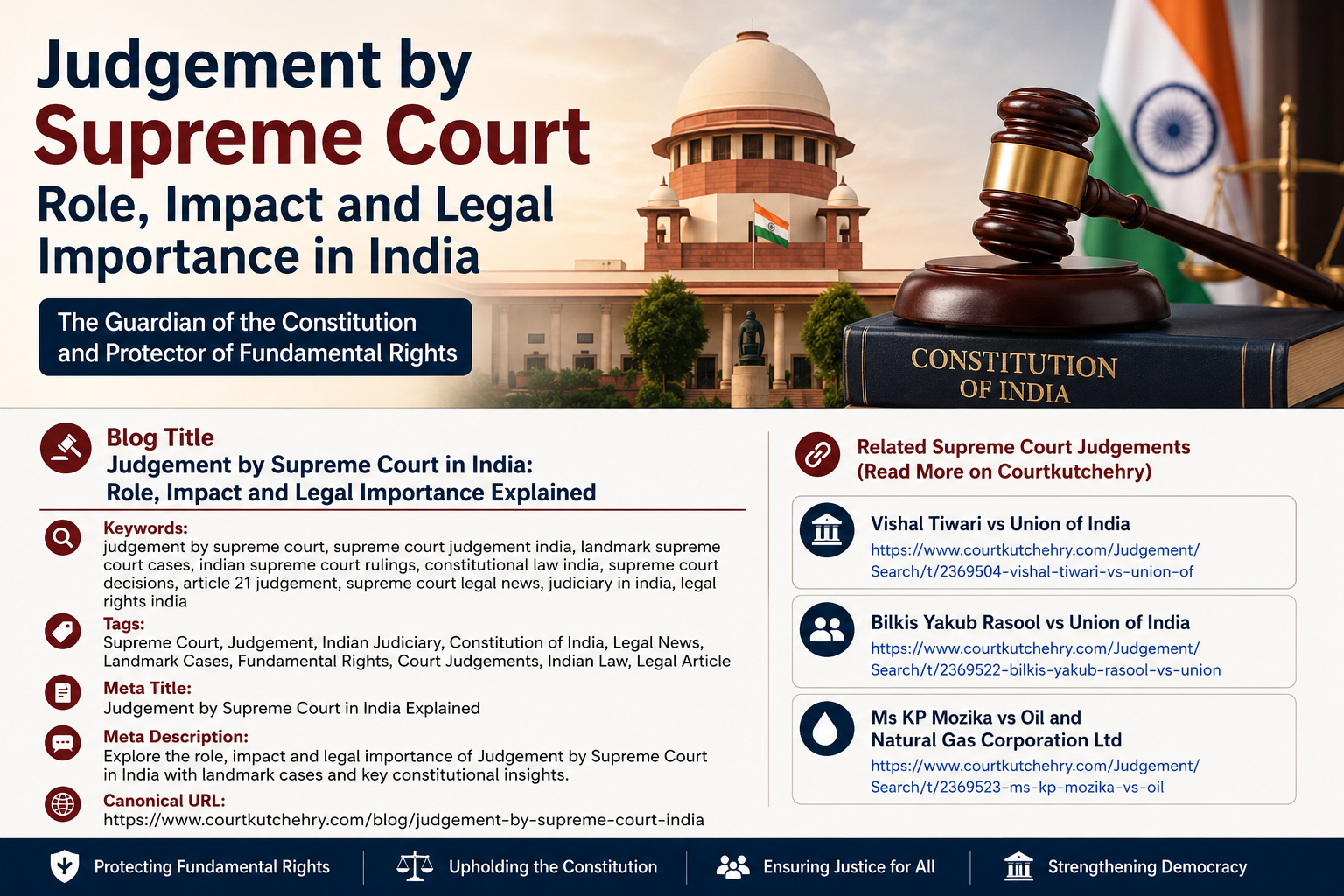
Judgement by Supreme Court: Landmark Rulings Shaping India’s Democracy
Introduction
The Judgement by Supreme Court plays a vital role in shaping India’s constitutional framework, democratic values, and legal system. The Supreme Court of India is the apex judicial authority and acts as the guardian of the Constitution. Every major Supreme Court judgement impacts citizens, governments, businesses, institutions, and future judicial interpretation across the country.
From protecting fundamental rights to interpreting constitutional provisions, Supreme Court judgements influence every aspect of Indian society. These rulings establish legal precedents that guide High Courts, lower courts, and tribunals throughout India. In modern India, landmark Supreme Court decisions continue to shape governance, public policy, digital rights, criminal law, taxation, property disputes, and human rights.
For deeper legal reading on important Supreme Court matters, readers can also explore Vishal Tiwari vs Union of India, which highlights constitutional questions and public interest issues before the Supreme Court. You may also read Bilkis Yakub Rasool vs Union, a significant case connected with justice, victims’ rights, and rule of law. Another relevant judgement is Ms KP Mozika vs Oil, which can help readers understand how Supreme Court judgements shape legal interpretation, accountability, and constitutional governance in India.
Understanding the Role of the Supreme Court of India
Establishment of the Supreme Court
The Supreme Court of India was established on January 26, 1950, under the Constitution of India. It functions as the highest judicial authority in the country and has the power to hear appeals from High Courts and tribunals.
The court also has original jurisdiction in disputes involving:
- States and the Central Government
- Constitutional interpretation
- Protection of fundamental rights
- Public Interest Litigation (PIL)
Under Article 32 of the Constitution, citizens can directly approach the Supreme Court for enforcement of fundamental rights.
Constitutional Authority of the Supreme Court
The Supreme Court acts as:
- Guardian of the Constitution
- Protector of Fundamental Rights
- Final Court of Appeal
- Interpreter of Constitutional Provisions
- Authority for Judicial Review
Whenever legal ambiguities or constitutional disputes arise, the Supreme Court delivers landmark judgements that strengthen democratic governance and constitutional morality.
Why Supreme Court Judgements Are Important in India
Binding Nature Under Article 141
A Judgement by Supreme Court becomes binding on all courts in India under Article 141 of the Constitution. This ensures consistency in legal interpretation across the country.
Supreme Court rulings:
- Create legal precedents
- Guide future judicial decisions
- Clarify constitutional provisions
- Protect citizens against arbitrary actions
- Strengthen rule of law
Impact on Governance and Society
Supreme Court decisions directly affect:
- Constitutional rights
- Criminal justice
- Property disputes
- Corporate law
- Taxation
- Environmental protection
- Digital privacy
- Gender equality
- Electoral reforms
These judgements influence both public policy and social transformation.
Landmark Judgements by Supreme Court in India
Kesavananda Bharati vs State of Kerala (1973)
Basic Structure Doctrine
One of the most important Supreme Court judgements in Indian history was Kesavananda Bharati vs State of Kerala.
The court introduced the Basic Structure Doctrine, holding that Parliament cannot alter the basic structure of the Constitution.
Importance of the Judgement
This ruling:
- Limited constitutional amendment powers
- Protected democratic values
- Preserved judicial independence
- Strengthened constitutional supremacy
The judgement remains a cornerstone of constitutional law in India.
Maneka Gandhi vs Union of India (1978)
Expansion of Article 21
In this historic case, the Supreme Court expanded the interpretation of Article 21 and ruled that:
The right to life and personal liberty includes the right to live with dignity.
Impact on Indian Law
This judgement transformed constitutional jurisprudence by:
- Expanding fundamental rights
- Strengthening due process
- Protecting personal liberty
- Influencing future human rights cases
Vishaka vs State of Rajasthan (1997)
Workplace Sexual Harassment Guidelines
Before this judgement, India lacked a comprehensive law dealing with workplace harassment.
The Supreme Court framed the famous Vishaka Guidelines to protect women at workplaces.
Legal Significance
The judgement later became the foundation for:
- Sexual Harassment of Women at Workplace Act, 2013
- Gender justice reforms
- Workplace safety standards
Navtej Singh Johar vs Union of India (2018)
Decriminalization of Section 377
The Supreme Court partially struck down Section 377 of the Indian Penal Code and decriminalized consensual same-sex relationships.
Importance of the Judgement
The ruling promoted:
- Equality
- Privacy rights
- Human dignity
- LGBTQ+ rights
This became one of the most progressive constitutional judgements in modern India.
Ayodhya Judgement (2019)
Resolution of Historic Property Dispute
The Ayodhya judgement resolved one of India’s longest-running religious and property disputes.
The Supreme Court:
- Allowed construction of Ram Mandir
- Directed allocation of alternate land for a mosque
- Balanced constitutional and religious considerations
This judgement had major social, political, and constitutional significance.
Constitutional Interpretation and Judicial Review
What is Judicial Review?
Judicial review allows the Supreme Court to examine whether laws or executive actions violate constitutional provisions.
This power helps:
- Prevent misuse of authority
- Protect democratic governance
- Ensure constitutional accountability
- Maintain separation of powers
Importance of Constitutional Morality
The Supreme Court has repeatedly emphasized:
- Rule of law
- Constitutional morality
- Judicial independence
- Democratic accountability
These principles form the foundation of constitutional governance in India.
Impact of Supreme Court Judgements on Society
Protection of Fundamental Rights
A Judgement by Supreme Court often strengthens:
- Freedom of speech
- Right to privacy
- Equality before law
- Religious freedom
- Right to dignity
Justice K.S. Puttaswamy vs Union of India (2017)
Privacy as a Fundamental Right
The Supreme Court declared privacy a fundamental right under Article 21.
Impact on Digital India
This landmark judgement influenced:
- Data protection laws
- Digital governance
- Online privacy rights
- Surveillance regulations
The ruling continues to impact India’s digital and technology ecosystem.
Role of Public Interest Litigation (PIL)
Expansion of Access to Justice
Public Interest Litigation (PIL) transformed Indian constitutional jurisprudence by allowing citizens and organizations to approach the court for public causes.
PIL cases addressed:
- Environmental protection
- Bonded labor
- Prison reforms
- Pollution control
- Women’s rights
- Human rights violations
Judicial Activism Through PIL
The PIL mechanism expanded the judiciary’s role in:
- Social justice
- Constitutional protection
- Public welfare
- Administrative accountability
The Supreme Court became an active protector of disadvantaged communities.
Digital Era and Modern Supreme Court Judgements
Technology and Constitutional Challenges
Modern Supreme Court cases increasingly involve:
- Artificial Intelligence
- Cryptocurrency regulation
- Social media accountability
- Cybercrime
- Data privacy
- Online speech
- Digital surveillance
Future of Digital Rights in India
Recent Supreme Court rulings continue shaping:
- Internet governance
- Digital freedom
- Technology regulation
- Constitutional protections in cyberspace
Businesses, startups, and citizens closely monitor these decisions.
Business and Economic Impact of Supreme Court Judgements
Influence on Corporate and Economic Laws
A Judgement by Supreme Court directly impacts:
- Taxation
- Banking
- Insolvency
- Arbitration
- Environmental compliance
- Telecom regulation
- Corporate governance
Importance for Investors and Businesses
Stable judicial interpretation:
- Encourages investment
- Improves business confidence
- Creates legal certainty
- Strengthens economic governance
Several GST and insolvency rulings have significantly shaped India’s business ecosystem.
Criminal Justice and Human Rights
Protection Against Misuse of Power
The Supreme Court has repeatedly safeguarded citizens against:
- Arbitrary arrest
- Custodial violence
- Abuse of authority
- Procedural injustice
The judiciary ensures fair investigation and constitutional safeguards.
Death Penalty Jurisprudence
The court developed the famous:
“Rarest of Rare” Doctrine
This principle ensures careful balancing between:
- Justice
- Proportionality
- Constitutional morality
- Human rights
Challenges Faced by the Supreme Court of India
Increasing Pendency of Cases
The Supreme Court currently faces:
- Huge backlog of cases
- Judicial workload pressure
- Delayed hearings
- Infrastructure limitations
Need for Judicial Reforms
Experts often recommend:
- Increasing judicial strength
- Better technology integration
- Faster case management
- Improved digital infrastructure
Virtual hearings and e-filing systems have improved accessibility after the COVID-19 pandemic.
Judicial Independence and Public Trust
Importance of Independent Judiciary
Public trust in the judiciary depends on judicial independence.
The Supreme Court acts as:
- Final constitutional guardian
- Check on executive power
- Protector of democracy
Transparency and Accountability
Reasoned judgements and transparent judicial functioning strengthen:
- Institutional legitimacy
- Democratic governance
- Constitutional accountability
The judiciary becomes even more important during periods of political uncertainty.
Future of Supreme Court Judgements in India
Emerging Legal Challenges
Future Supreme Court jurisprudence will likely involve:
- Artificial Intelligence regulation
- Climate change litigation
- Data governance
- Global commerce
- Digital constitutional rights
Expanding Role of Constitutional Courts
As India evolves socially and technologically, Supreme Court decisions will continue shaping:
- Public policy
- Governance
- Business laws
- Individual rights
- Technology regulation
The intersection of technology and constitutional law will become increasingly significant.
Conclusion
A Judgement by Supreme Court remains one of the strongest pillars of India’s democratic and constitutional system. The Supreme Court not only resolves legal disputes but also protects constitutional values, safeguards fundamental rights, and strengthens rule of law.
From landmark constitutional cases to modern digital governance disputes, Supreme Court judgements influence every aspect of Indian society. These rulings establish legal precedents, guide future judicial interpretation, and maintain accountability within democratic institutions.
As India continues progressing through rapid social, technological, and economic transformation, the importance of Supreme Court judgements will continue growing. The judiciary’s commitment to constitutional morality, justice, and democratic governance remains central to protecting citizens’ rights and preserving India’s constitutional framework.