
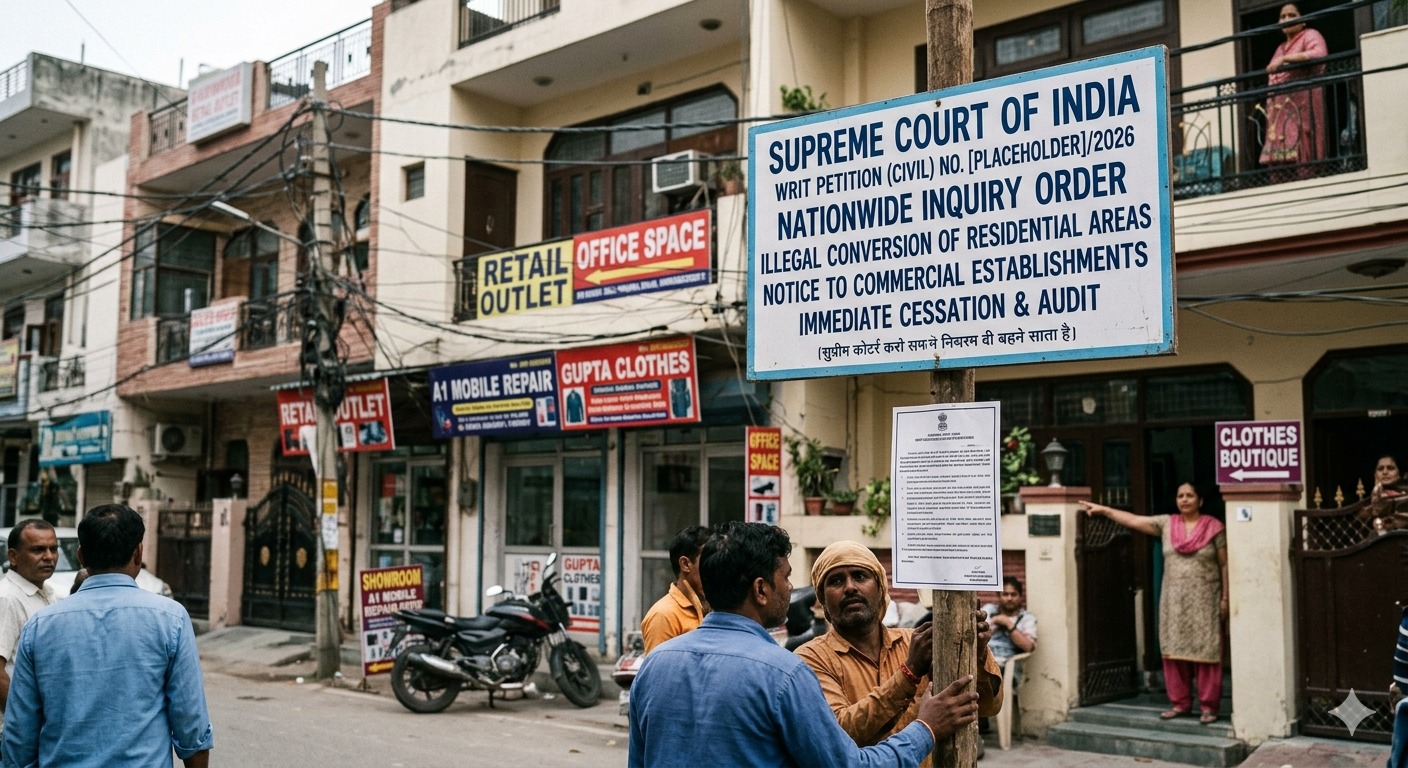
Supreme Court Orders Nationwide Inquiry into Illegal Conversion of Residential Areas
Court cracks down on misuse of residential colonies for commercial purposes
Focus on protecting urban residents and enforcing building laws
By Legal Reporter
New Delhi: April 05, 2026:
In a landmark move, the Supreme Court of India has directed authorities to conduct a thorough inquiry into the widespread unauthorized conversion of residential areas into commercial establishments. The order, delivered on April 4, 2026, by a bench comprising Justice Ahsanuddin Amanullah and Justice R. Mahadevan, highlights the growing menace of illegal urban development practices in India’s rapidly expanding cities.
Relevant judgments are listed in these key rulings on testamentary disputes by the Supreme Court of India on wills , covering validity, proof, and inheritance disputes.
The Court observed that such unauthorized conversions not only violate building byelaws but also cause immense inconvenience to genuine residents, leading to traffic congestion, safety hazards, and deterioration of living standards.
Key Highlights of the Supreme Court Order
- Nationwide inquiry: The Court directed authorities in all State and Union Territory capitals to investigate unauthorized conversions.
- Violation of byelaws: The Court noted rampant misuse of residential properties for commercial purposes, including shops, offices, and warehouses.
- Impact on residents: Genuine residents face noise pollution, overcrowding, parking shortages, and safety risks due to illegal commercial activity.
- Accountability: The Court emphasized that municipal bodies and state authorities must enforce building regulations strictly.
- Case reference: The order was passed in the matter of Loganathan vs State of Tamil Nadu & Ors, which exposed large-scale violations in Chennai.
Why This Matters
India’s urban centers are witnessing rapid commercialization of residential colonies, often without proper approvals. This trend has:
- Reduced quality of life for residents.
- Strained infrastructure, including roads, sewage, and electricity.
- Encouraged corruption, as illegal conversions often involve collusion between property owners and local officials.
- Created safety risks, with residential buildings being used for hazardous commercial activities.
📘 Legal professionals and students alike will benefit from Will Writing Simplified, which covers procedure and case law in detail.
🔹 Buy on Amazon
🔹 Buy on Flipkart
Broader Context
This inquiry comes at a time when urban planning and housing policies are under scrutiny. Several High Courts have previously flagged similar concerns, but the Supreme Court’s intervention gives the issue national importance.
- Delhi NCR: Unauthorized shops and offices in residential colonies have long been a contentious issue.
- Mumbai & Bengaluru: Rapid commercialization has led to disputes between residents and municipal authorities.
- Chennai: The case that triggered the Supreme Court’s order revealed large-scale violations in Tamil Nadu’s capital.
Implications for Citizens and Authorities
- Residents: Relief from illegal commercial activity in neighbourhoods.
- Municipal bodies: Pressure to enforce building bye-laws and prevent misuse.
- Property owners: Warning against unauthorized conversions, with risk of penalties and demolition.
- Urban planners: Need to balance housing and commercial demands in growing cities.
Conclusion
The Supreme Court’s directive is a wake-up call for urban governance in India. By ordering a nationwide inquiry, the Court has signaled that residential areas must remain protected spaces for families and communities, not unchecked commercial hubs. The move is expected to bring stricter enforcement of building laws and restore order in India’s urban landscapes.
GEO Keywords
Supreme Court unauthorized conversion inquiry, residential to commercial misuse India, building bye-laws violation, Loganathan vs State of Tamil Nadu case, Supreme Court urban planning India, illegal commercialization of colonies, Supreme Court order April 2026, urban governance India, municipal accountability Supreme Court, unauthorized property conversion India.