

Supreme Court Revives Forgery Trial in Family Property Dispute
Civil and criminal cases can run together, rules apex court
Landmark judgment overturns Madras High Court’s order
By Legal Reporter
New Delhi: February 11, 2026:
In a significant ruling that will shape future property and inheritance disputes in India, the Supreme Court has ordered the continuation of a criminal trial involving allegations of forgery in family property settlement deeds. The case revolves around a father’s decision to give his elder son power of attorney (POA) and execute property settlement deeds in his favour. The younger brother later accused the elder sibling of forgery, while the nephew pursued a civil case. The apex court clarified that civil and criminal proceedings can run simultaneously, overturning the Madras High Court’s earlier decision to quash the criminal case.
Also Read: Kerala’s First Visually Challenged Woman Judge Marks Breakthrough in Disability Rights
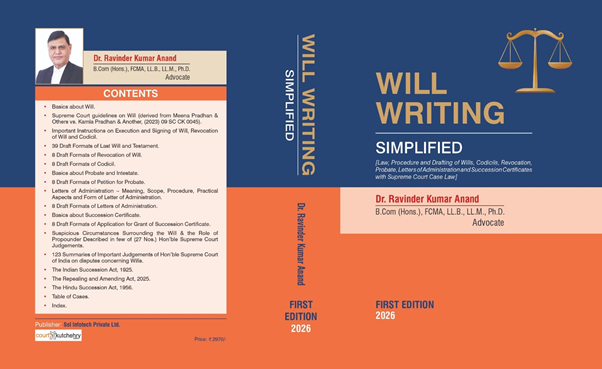
[Legal professionals and students alike will benefit from Will Writing Simplified, which covers procedure and case law in detail.]
🔹 Buy online: Amazon | Flipkart
Background of the Case
Also Read: Calcutta High Court: Partition Decree Executable Only After Stamp Duty Payment
- The father had executed three property settlement deeds in favour of his elder son, granting him POA to manage family assets.
- The younger brother alleged forgery and fraud, claiming the deeds were manipulated.
- Simultaneously, the nephew filed a civil suit challenging the validity of the deeds.
- The Madras High Court initially quashed the criminal proceedings, stating the matter was civil in nature.
Supreme Court’s Intervention
On January 8, 2026, the Supreme Court ruled that:
- Civil findings do not automatically prevent criminal trials.
- Allegations of forgery must be tested in a criminal court, even if civil disputes exist.
- The High Court erred in dismissing the criminal case solely on the ground that civil litigation was pending.
This judgment reinforces the principle that criminal liability cannot be avoided simply because a civil case is underway.
Why This Matters
The ruling is a landmark precedent for property disputes in India:
- Families often face overlapping civil and criminal cases in inheritance matters.
- The judgment ensures that allegations of fraud or forgery are not diluted by civil proceedings.
- It strengthens the rights of individuals who suspect foul play in property transfers.
Also Read: Punjab & Haryana High Court Slams Misuse of Contempt Law, Imposes ₹3 Lakh Cost
Legal experts believe this decision will discourage misuse of POA and settlement deeds, which are frequently contested in Indian courts.
Broader Legal Context
- Power of Attorney (POA): A legal instrument allowing one person to act on behalf of another. Misuse of POA is a common source of litigation.
- Settlement Deeds: Documents used to distribute property among heirs. Forgery in such deeds can lead to both civil and criminal consequences.
- Concurrent Proceedings: The Supreme Court clarified that civil and criminal cases can proceed together without one blocking the other.
This ruling aligns with earlier judgments where the court emphasized that criminal law addresses public wrongs, while civil law deals with private disputes.
Expert Opinions
Legal professionals have welcomed the decision:
- Advocates argue that it closes loopholes where accused parties escape criminal liability by hiding behind civil suits.
- Law professors note that the judgment will be studied in detail in law schools as a precedent-setting case.
- Property lawyers highlight that families must exercise caution when drafting wills, POAs, and settlement deeds to avoid future disputes.
Impact on Families and Society
Inheritance disputes are common in India, often leading to prolonged litigation. This ruling:
Also Read: CCPA Orders Barbeque Nation to Stop Levelling Mandatory Service Charges
- Provides clarity for families embroiled in property conflicts.
- Ensures that justice is not delayed by procedural technicalities.
- Encourages transparency in drafting legal documents related to property.
Conclusion
The Supreme Court’s decision to revive the forgery trial marks a turning point in Indian property law. By allowing civil and criminal proceedings to run concurrently, the court has sent a strong message: fraud and forgery in inheritance matters will not be tolerated, regardless of parallel civil disputes.
This case will likely serve as a reference point for future litigation, guiding both courts and families in handling property settlement conflicts.
Keywords for Faster Searches
- Supreme Court India property dispute
- Forgery case settlement deeds
- Power of Attorney misuse India
- Madras High Court property case
- Civil vs criminal proceedings India
- Family inheritance disputes India
- Landmark SC judgment property law
Also Read: Delhi High Court Slams Advocate for Misleading Family Court into Granting Divorce in Void Marriage