
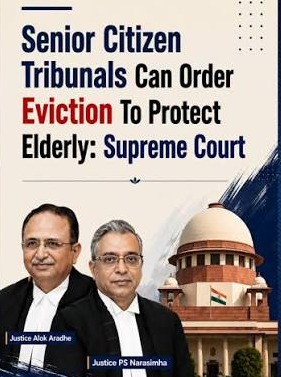
Dignity Over Dominance: Supreme Court Reaffirms Eviction Powers Under Senior Citizens Act to Safeguard Elderly Rights
Overruling High Court Restraints, the Apex Court Establishes Eviction as an Implied Power Essential for Ensuring Senior Citizen Protection and Residential Peace
Tracing the Intersection of Constitutional Mandates, Statutory Interpretation, and Precedental Evolution in Family Property Disputes
By Legal Editor
New Delhi: August 27, 2026:
The jurisprudence surrounding elder rights in India reached a definitive milestone through the Supreme Court’s landmark ruling in . Addressing the perpetual tension between parental protection and family property disputes, a Division Bench comprising Justice Pamidighantam Sri Narasimha and Justice Alok Aradhe settled a vital question of administrative power: whether statutory tribunals constituted under the Maintenance and Welfare of Parents and Senior Citizens Act, 2007 possess the legal jurisdiction to direct the eviction of adult children or other occupants from a senior citizen's residential property. The apex court answered this question with an unequivocal affirmative, reversing a restrictive stance adopted by the Allahabad High Court and establishing that summary eviction is an implicit, necessary power within the statutory framework designed to guarantee the safety, dignity, and maintenance of elderly citizens across India. This ruling provides long-awaited statutory clarity for aging parents seeking refuge from intra-familial abuse.
Section 2: Factual Matrix of Ravi Kant Gupta v. State of Uttar Pradesh
The factual background of the dispute highlights the distressing domestic realities often endured by aging parents within multi-generational households. The subject matter pertained to residential property bearing No. 8/331 in Vikas Nagar, Lucknow, which was self-acquired by the appellant, Ravi Kant Gupta. The appellant’s mother, aged approximately 81 years, was allegedly forced out of her residential home due to severe family friction, harassment, and continuous disturbance caused by the appellant’s son and daughter-in-law, ultimately compelling the elderly woman to seek shelter in an old-age care facility. Seeking legal intervention under the Senior Citizens Act of 2007, the appellant approached administrative authorities seeking the eviction of his son and daughter-in-law to restore peaceful living conditions for his mother.
Upon conducting inquiries, the Sub-Divisional Magistrate (SDM), Lucknow, established that the premises were self-acquired by the appellant, that the son had unlawfully denied his elderly grandmother residence, and that his ongoing presence created an intolerable nuisance. By an administrative order dated November 15, 2022, the SDM ordered the immediate eviction of the son. The son and his wife challenged this decision before the District Magistrate under Section 16 of the Act. On August 9, 2023, the District Magistrate, acting as the appellate authority, affirmed the SDM's order and directed the surrender of vacant possession to the appellant. However, when the son filed a writ petition before the Allahabad High Court, a Division Bench quashed both administrative orders. Relying on its earlier judgment in Abhishek Tiwari v. State of U.P. (2022), the High Court held that statutory authorities under the 2007 Act lacked express eviction powers. The High Court subsequently rejected a review application on January 29, 2024, prompting the father to appeal to the Supreme Court.
Section 3: Statutory Architecture of the Senior Citizens Act, 2007
To determine whether eviction falls within the jurisdiction of administrative tribunals, the Supreme Court analyzed the overall structure of the Maintenance and Welfare of Parents and Senior Citizens Act, 2007. The statute was enacted by Parliament to provide a speedy, inexpensive, and efficient mechanism for parents and senior citizens who are unable to maintain themselves out of their own earnings or property. The statutory framework establishes Maintenance Tribunals under Section 7, headed by Sub-Divisional Officers. Section 8 empowers tribunals to adopt summary procedures during inquiries, clothing them with the powers of a Civil Court for enforcing witness attendance, compelling document production, and taking evidence under oath. Section 27 explicitly bars the jurisdiction of Civil Courts regarding matters covered by the Act, ensuring that senior citizens are spared from protracted civil litigation. Section 23 further enables tribunals to declare conditional property transfers void if children fail to provide basic amenities and care.
Section 4: The Doctrine of Implied Powers and Jurisdictional Efficacy
The primary legal issue before the Supreme Court was whether a statutory tribunal could order eviction in the absence of an explicit provision titled "Eviction" within the Act. The High Court had adopted a literalist construction, concluding that because the word "eviction" was absent in the statutory text, tribunals could not exercise such authority. Rejecting this narrow reading, the Supreme Court applied the administrative law principle known as the "Doctrine of Implied Powers". Citing Income Tax Officer, Cannanore v. M.K. Mohammed Kunhi (1968), the Supreme Court reiterated that where an Act confers specific jurisdiction upon an authority, it impliedly grants the power to carry out all acts essential to execute that jurisdiction effectively. The Court held that denying eviction powers would render the tribunal’s mandate toothless when abusive occupants physically exclude elderly parents from their own homes.
Section 5: Constitutional Underpinnings: Articles 21 and 41
The Supreme Court grounded its statutory interpretation in constitutional mandates, observing that the measure of a civilized society lies in the dignity, respect, and security afforded to its elderly. The Bench emphasized Article 21 of the Constitution, which guarantees the right to life and personal liberty, long interpreted by Indian courts to encompass the right to live with human dignity, peace, and physical safety. The Bench also highlighted Article 41 of the Directive Principles of State Policy, which commands the State to make effective provision for securing public assistance in cases of old age, sickness, and disablement. The Court noted that Parliament enacted the 2007 Act against this constitutional backdrop to prevent advancing age from becoming synonymous with neglect, insecurity, or indignity.
Section 6: Precedental Alignment and Overruling of Abhishek Tiwari
The Supreme Court situated its ruling within an established line of authoritative precedents. The Bench relied heavily on the landmark three-judge Bench judgment in , which recognized that eviction orders under the 2007 Act represent an incidental enforcement mechanism tied directly to the fundamental right to maintenance and protection. The Court also reaffirmed recent 2025 decisions, including Samtola Devi v. State of U.P. and Kamalakant Mishra v. Additional Collector, holding that summary eviction is permissible to protect senior citizens. Consequently, the Court held that the Allahabad High Court’s reliance on Abhishek Tiwari was misconceived, formally overruling the restrictive High Court precedent and establishing unified national jurisprudence across administrative bodies.
Section 7: Statutory Interplay Between Protection Orders and Property Ownership
A central dimension of the judgment involves clarifying how property ownership intersects with welfare remedies under the 2007 Act. The Supreme Court observed that while civil title disputes remain within traditional civil court jurisdiction, statutory rights under the Senior Citizens Act create an administrative protection shield. Where an elderly parent owns a residential property, the right to reside in that home without interference, fear, or mental torment is integral to their overall welfare under Section 4. Ordering eviction does not amount to deciding complex title ownership; rather, it constitutes an administrative remedy designed to restore physical possession to the rightful senior owner and eliminate domestic distress. This clarification ensures that senior citizens can swiftly reclaim their living spaces without suffering procedural delays.
Section 8: Procedural Mechanics and Summary Inquiry Standards
The Supreme Court highlighted the summary procedural design established under Section 8 of the 2007 Act, which distinguishes Maintenance Tribunals from traditional civil courts. Maintenance Tribunals are mandated to follow a summary inquiry procedure rather than lengthy trial proceedings. By equipping tribunals with Civil Court powers specifically for taking evidence, enforcing attendance, and issuing discovery orders, Parliament intended to create a fast-track forum capable of responding rapidly to elderly vulnerability. In Ravi Kant Gupta, the SDM followed this prescribed summary procedure by evaluating property ownership, verifying the forced exclusion of the 81-year-old grandmother, and recording continuous nuisance, providing a valid legal foundation for eviction.
Section 9: Calibrated Application: Protection vs. Property Disputes
Crucially, the Supreme Court entered a vital caution regarding the practical application of this power. The Bench emphasized that eviction under the Senior Citizens Act is not an automatic right, nor can it be transformed into a weapon for resolving routine property or inheritance disputes among family members. The Tribunal must carefully analyze the specific facts of each case to determine whether eviction is genuinely required to secure the maintenance, physical safety, mental peace, or dignity of the senior citizen. The 2007 Act is protective welfare legislation designed to shelter vulnerable parents from ill-treatment rather than serve as a summary shortcut for civil title adjudication.
Searchable Legal Index & Frequently Asked Questions (FAQ)
Quick Search Index
Topic 1: Core Judgment Overview & Parties Involved
Topic 2: Key Statutory Provisions (Senior Citizens Act, 2007)
Topic 3: Doctrine of Implied Powers & Administrative Law
Topic 4: Constitutional Mandates (Articles 21 & 41)
Topic 5: Judicial Precedents & Civil Court Jurisdiction
FAQ Breakdown
Topic 1: Core Judgment Overview & Parties Involved
Q1: What is the main ruling of the Supreme Court in Ravi Kant Gupta v. State of Uttar Pradesh (2026)?
The Supreme Court ruled that Maintenance Tribunals established under the Maintenance and Welfare of Parents and Senior Citizens Act, 2007 possess full legal authority to order the eviction of adult children or occupants from a senior citizen's property when such eviction is necessary to ensure the senior citizen's maintenance, protection, safety, or peaceful living.
Q2: What were the key facts in the Ravi Kant Gupta case?
The case involved an 81-year-old mother who was allegedly forced out of her self-acquired family home in Lucknow by her grandson and his wife, forcing her to live in an old-age home. The owner of the house (her son, Ravi Kant Gupta) applied to the Maintenance Tribunal for the eviction of his son and daughter-in-law to restore peaceful occupation for his mother.
Q3: Which judges delivered this landmark judgment?
The judgment was delivered by a Division Bench of the Supreme Court of India comprising Justice Pamidighantam Sri Narasimha and Justice Alok Aradhe on August 24, 2026.
Topic 2: Key Statutory Provisions (Senior Citizens Act, 2007)
Q4: Does the Maintenance and Welfare of Parents and Senior Citizens Act, 2007 explicitly mention "eviction"?
No, the word "eviction" is not explicitly written as a standalone section in the text of the 2007 Act. However, the Supreme Court held that eviction powers are implicit within the broad protection mandate of the statute.
Q5: What are the primary sections of the 2007 Act discussed in the judgment?
Section 7: Authorizes the State Government to constitute Maintenance Tribunals.
Section 8: Outlines the summary procedure of the Tribunal, granting powers of a Civil Court.
Section 16: Grants an appellate remedy to the District Magistrate against tribunal orders.
Section 23: Allows tribunals to declare conditional property transfers void if children neglect parents.
Section 27: Explicitly bars Civil Courts from exercising jurisdiction over matters under the Act.
Topic 3: Doctrine of Implied Powers & Administrative Law
Q6: What is the "Doctrine of Implied Powers" applied by the Supreme Court?
The Doctrine of Implied Powers is an administrative law rule stating that when a law grants specific statutory jurisdiction to a tribunal, it implicitly grants all necessary powers required to execute that duty effectively. Citing Income Tax Officer, Cannanore v. M.K. Mohammed Kunhi (1968), the Court held that eviction is an implied power necessary to enforce elder protection.
Q7: Why did the Supreme Court reject the Allahabad High Court's reasoning in Abhishek Tiwari?
The Allahabad High Court had ruled in Abhishek Tiwari that tribunals lacked eviction powers because the Act did not mention them explicitly. The Supreme Court rejected this literal reading, holding that denying eviction powers would render the 2007 Act completely ineffective in cases of severe harassment or exclusion.
Topic 4: Constitutional Mandates (Articles 21 & 41)
Q8: How does Article 21 of the Constitution support the eviction of abusive occupants?
Article 21 guarantees the fundamental right to life and personal liberty, which the Supreme Court has interpreted as the right to live with dignity, self-respect, and safety. Evicting abusive occupants ensures that elderly citizens can enjoy their residential property without fear, neglect, or indignity.
Q9: What role does Article 41 of the Constitution play in elder welfare laws?
Article 41 is a Directive Principle of State Policy directing the State to provide public assistance in cases of old age, sickness, and disablement. The Supreme Court emphasized that the Senior Citizens Act of 2007 was enacted by Parliament specifically to give effect to this constitutional goal.
Topic 5: Judicial Precedents & Civil Court Jurisdiction
Q10: What prior Supreme Court precedents were reaffirmed in this ruling?
The Court reaffirmed:
: Establishing eviction as an incident of senior citizen protection.
Samtola Devi v. State of U.P. (2025): Affirming tribunal powers to issue summary eviction orders.
Kamalakant Mishra v. Additional Collector (2025): Confirming eviction remedies under elder protection laws.
Q11: Can adult children use civil suits to stop an eviction order under the Senior Citizens Act?
No. Section 27 of the Act explicitly bars Civil Courts from taking jurisdiction over matters governed by the Senior Citizens Act, preventing children from delaying summary eviction proceedings through prolonged civil litigation.
Q12: Is an eviction order under the Senior Citizens Act automatic upon filing an application?
No. The Supreme Court emphasized that eviction is not automatic. Maintenance Tribunals must conduct summary inquiries to confirm that eviction is genuinely necessary to protect the safety, maintenance, or residential peace of the senior citizen, ensuring the Act is not misused in routine property disputes.