
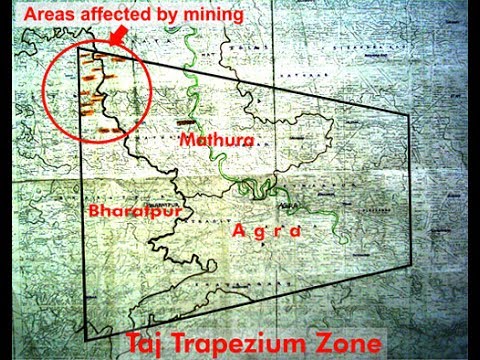
Balancing Heritage and Sustainable Growth: Supreme Court Directs Joint Expert Oversight to Process MSME Proposals in Taj Trapezium Zone
Apex Court Relaxes Blanket Freeze to Address Long-Pending Industrial Applications
Mandatory Scrutiny by NEERI and CEC Representatives Instituted to Preserve Ecological Safeguards
By Legal Editor
New Delhi: July 24, 2026:
In a significant judicial directive on environmental management, the Supreme Court of India, led by Chief Justice of India Surya Kant along with Justices Joymalya Bagchi and V. Mohana, modified its existing stance regarding industrial activities in the Taj Trapezium Zone (TTZ). The Court permitted the Taj Trapezium Zone Authority to evaluate and process approximately 400 pending industrial applications—primarily belonging to Micro, Small, and Medium Enterprises (MSMEs)—without requiring prior approval from the apex court in every instance, provided specific expert consensus conditions are met.
The Taj Trapezium Zone encompasses a defined 10,400-square-kilometer ecologically sensitive region across six districts in Uttar Pradesh and Rajasthan. Originally established to safeguard the Taj Mahal and surrounding heritage monuments from atmospheric industrial degradation, the zone has long operated under strict judicial supervision. The latest order balances environmental conservation under established jurisprudence with the socio-economic imperatives of local populations, recognizing that administrative delays in completing regional studies ought not to indefinitely freeze non-polluting economic growth.
─────────────────────────────────┐
│ TAJ TRAPEZIUM ZONE (TTZ) AREA │
─────────────────────────────────┤
│ Total Geographic Area: ~10,400 Square Kilometers │
│ Jurisdictional Reach: Six Districts (Agra, Firozabad, Mathura, Hathras, │
│ Etah in Uttar Pradesh & Bharatpur in Rajasthan) │
│ Key Mandate: Safeguard Cultural Monuments (e.g., Taj Mahal) from Air Pollution│
└────────────────────────────────────────────
Detailed Analytical Examination of Laws, Statutes, and Precedents
The regulatory governance of the Taj Trapezium Zone rests upon an intersection of constitutional mandates, statutory protections, judicial doctrines, and specialized administrative guidelines.
─────────────────────────────────┐
│ LEGAL & STATUTORY FRAMEWORK │
─────────────────────────────────┤
│ Constitutional Basis │ Primary Enactments │
│ • Article 21 (Life & Livelihood) │ • Environment (Protection) Act 1986 │
│ • Article 48A (State Obligation) │ • Air Act 1981 & Water Act 1974 │
│ • Article 51A(g) (Citizen Duty) │ • MSMED Act 2006 │
─────────────────────────────────┤
│ Operational Doctrines │
│ • Precautionary Principle | Public Trust Doctrine | Sustainable Development │
─────────────────────────────────┘
1. Constitutional Guarantees
Article 21 (Right to Life and Personal Liberty): The Supreme Court has consistently held that the right to life includes the right to a clean and wholesome environment. Simultaneously, the Court recognizes that Article 21 encompasses the right to livelihood. The current order seeks a balance between these two fundamental constitutional interests.
Article 48A (Directive Principles of State Policy): Directs the State to protect and improve the environment and safeguard the nation's forests and natural heritage.
Article 51A(g) (Fundamental Duties): Assigns a fundamental duty to every citizen to protect and improve the natural environment.
2. Statutory Enactments
The Environment (Protection) Act, 1986 (EPA): Forms the central statutory authority for environmental regulation in India. Under Section 3 of the EPA, the Central Government empowered the creation of the TTZ Authority to enforce restrictions on industrial processes within the designated perimeter.
The Air (Prevention and Control of Pollution) Act, 1981 & The Water (Prevention and Control of Pollution) Act, 1974: These laws establish emissions standards and consent requirements managed by Pollution Control Boards to regulate effluent discharge and industrial smoke.
Micro, Small and Medium Enterprises Development (MSMED) Act, 2006: Sets the legal parameters for MSMEs, which form the core of the 400 pending proposals. These units typically utilize cleaner power sources (e.g., electricity or natural gas) rather than heavy coal-fired systems.
3. Key Judicial Precedents and Principles
The Landmark M.C. Mehta v. Union of India (1996) Case: Often termed the Taj Trapezium Case, this landmark judgment established strict environmental regulations for industries operating near the monument, directing polluting foundries and glass works to either switch to natural gas or relocate.
The Precautionary Principle: A cornerstone of Indian environmental law, requiring regulatory bodies to anticipate, prevent, and address environmental damage. The Court reiterated that economic expansion must operate strictly within the limits prescribed by expert scientific evaluation.
Public Trust Doctrine: Establishes that national monuments and natural resources are held in public trust by the State, imposing strict compliance standards on all administrative approvals in ecologically sensitive areas.
III. The New Institutional Oversight Framework
To ensure that processing industrial applications does not lead to unchecked pollution, the Supreme Court mandated a procedural structure involving multiple expert authorities.
Application Processing Workflow
┌─────────────────────────────────────────┐
│ MSME Industrial Application Received │
└────────────────────┬────────────────────┘
│
▼
┌─────────────────────────────────────────┐
│ TTZ Authority Convenes Meeting │
│ (Presence of NEERI & CEC Experts Mandatory)│
┌───────────────────┴───────────────────┐
│ │
▼ ▼
[ Any Expert Dissents ] [ Unanimous Agreement ]
│ │
▼ ▼
Must Apply for Permission Publish Draft Decision on
from Supreme Court to Proceed CEC Portal for Public Objections
│
▼
Consider Public Input &
Issue Final Order
Mandatory Attendance: No meeting of the TTZ Authority to evaluate industrial proposals can take place without the presence of experts from both the National Environmental Engineering Research Institute (NEERI) and the Central Empowered Committee (CEC).
Unanimity Provision: If the TTZ Authority, NEERI expert, and CEC expert unanimously determine that an applicant unit is non-polluting, the TTZ Authority may proceed to finalize the decision without seeking Supreme Court intervention.
Dissent Mechanism: If either the NEERI or CEC expert considers an industry to be polluting, the application cannot be cleared without express permission from the Supreme Court.
Public Scrutiny: Every decision must be published on the official CEC website to invite public objections and suggestions, which must be considered before issuing final approval.
Evolving Definitions of "Non-Polluting" Industries
A central factor in the Supreme Court's ruling is the evolution of how "non-polluting" industries are defined within the zone. The Court highlighted an interim report submitted by NEERI in April 2025. NEERI advised against a rigid categorization relying exclusively on traditional Central Pollution Control Board (CPCB) color-coded standards.
NEERI noted that strict CPCB standard applications might unnecessarily constrain regional development. Instead, evaluations should take into account regional heritage, craft legacy, Geographical Indication (GI) status (such as traditional glasscraft or local cottage industries), and the adoption of clean fuels. This nuanced interpretation ensures protection for traditional artisanal livelihoods while strictly managing air quality standards.
V. Searchable Legal Index & Frequently Asked Questions (FAQ)
Searchable Index
Q1: What is the Taj Trapezium Zone (TTZ)?
Q2: Why did the Supreme Court modify its previous moratorium on industrial approvals?
Q3: Which primary laws govern environmental compliance in the TTZ?
Q4: What conditions allow an industrial application to be approved without court leave?
Q5: What happens if an expert objects to an industrial application?
Q6: How does the new approval mechanism ensure public transparency?
Questions & Answers
Q1: What is the Taj Trapezium Zone (TTZ)?
Answer: The Taj Trapezium Zone (TTZ) is a defined protected area covering roughly 10,400 square kilometers across six districts in Uttar Pradesh and Rajasthan. Established under Supreme Court directives and Environment Protection Act notifications, it aims to prevent industrial pollution from damaging the Taj Mahal and other heritage sites in the region.
Q2: Why did the Supreme Court modify its previous moratorium on industrial approvals?
Answer: The Supreme Court modified its moratorium because an absolute freeze was stalling nearly 400 MSME industrial applications that utilize clean energy. The Bench observed that delays in completing long-term regional studies should not indefinitely stall non-polluting economic activities that support local livelihoods.
Q3: Which primary laws govern environmental compliance in the TTZ?
Answer: Key statutory authorities include the Environment (Protection) Act, 1986, the Air (Prevention and Control of Pollution) Act, 1981, and the Water (Prevention and Control of Pollution) Act, 1974. Operations are also guided by constitutional rights under Article 21 and judicial principles such as the Precautionary Principle.
Q4: What conditions allow an industrial application to be approved without court leave?
Answer: An application can be approved directly by the TTZ Authority if:
Designated experts from both NEERI and the CEC attend the review meeting.
Both experts and the TTZ Authority unanimously confirm that the unit is non-polluting.
The proposed clearance is published on the CEC website for public feedback and objections are addressed.
Q5: What happens if an expert objects to an industrial application?
Answer: If either the NEERI representative or the CEC expert determines that a proposed enterprise is polluting or does not satisfy non-polluting criteria, the application cannot be cleared by the TTZ Authority alone. The applicant or authority must seek formal leave from the Supreme Court to proceed.
Q6: How does the new approval mechanism ensure public transparency?
Answer: Public transparency is built into the workflow by requiring that all proposed decisions be published on the official Central Empowered Committee (CEC) web portal. Members of the public can submit feedback or objections, which must be formally evaluated by the TTZ Authority and domain experts before issuing a final approval.
Regulatory Entity — Representative Requirement — Specific Role in Approval Process
TTZ Authority — Statutory Administrative Body — Convenes review sessions, processes applications, and issues final decisions.
NEERI Expert — Mandatory Nominated Representative — Evaluates industrial emissions, fuel compatibility, and environmental impact.
CEC Expert — Mandatory Nominated Representative — Assesses compliance with Supreme Court orders and uploads decisions for public review.