
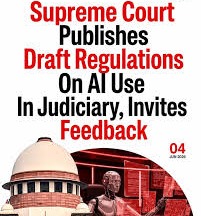
Supreme Court Issues Draft AI Regulations for Judiciary
Human judgment remains supreme in justice delivery
Public feedback invited before June 20 deadline
By Legal Reporter
New Delhi: June 05, 2026:
The Supreme Court of India has released draft regulations on the use of Artificial Intelligence (AI) in the judiciary, inviting public feedback until June 20, 2026. The proposed framework emphasizes human primacy, transparency, accountability, and judicial independence, strictly prohibiting AI from making judicial decisions or predicting outcomes.
Background
On June 3, 2026, the Supreme Court published the Draft Regulations for Use of Artificial Intelligence (AI) in Courts, 2026, prepared by its AI Committee. These regulations aim to establish a responsible framework for AI adoption across the Supreme Court, High Courts, tribunals, and statutory commissions. The Court clarified that AI will only serve as an assistive tool, never replacing judicial officers in determining questions of law, fact, or justice.
Key Legal Principles and Rules
1. Human Primacy in Judicial Decisions
- AI cannot adjudicate cases or determine judicial outcomes.
- Accountability for decisions rests solely with judicial officers.
2. Permitted Uses of AI
- Case management, scheduling, cause-list preparation.
- Transcription and translation of proceedings.
- Legal research, citation verification, document summarisation.
- Accessibility services for persons with disabilities.
- Anonymisation of judgments and administrative functions.
3. Absolute Prohibitions
- AI cannot be used for risk scoring (e.g., predicting recidivism, bail eligibility).
- No surveillance of judicial officers, litigants, or advocates.
- No use of opaque AI systems in matters affecting rights or liberty.
4. Disclosure Requirements
- Lawyers and parties must disclose AI-generated content used in pleadings or evidence.
- Courts may demand details of the AI system and verification measures.
5. Institutional Framework
- Creation of a permanent Apex Body at the Supreme Court with judges, technical experts, cybersecurity specialists, and finance experts.
- Establishment of AI Committees in each High Court.
- Mandatory audits, incident reporting, and cybersecurity safeguards.
Analytical Insights
Balancing Innovation and Judicial Independence
The draft regulations reflect a cautious approach: embracing AI for efficiency while safeguarding judicial independence. By prohibiting predictive or adjudicatory functions, the Court ensures that justice remains a human-led process.
Transparency and Accountability
Mandatory disclosure of AI use in pleadings prevents misuse of opaque systems and ensures accountability. This is crucial given recent concerns about fake AI-generated citations.
Institutional Oversight
The proposed Apex Body and AI Committees provide a governance structure, ensuring uniform standards and ethical audits across courts.
Global Context
Similar debates exist worldwide. For instance, the EU’s AI Act regulates high-risk AI systems, while U.S. courts are exploring guidelines for AI in legal practice. India’s draft regulations align with global best practices but emphasize judicial independence more strongly.
FAQs for Quick Understanding
Q1. What is the purpose of the draft AI regulations?
To establish a framework for responsible AI use in courts without compromising judicial independence.
Q2. Can AI decide cases under these regulations?
No. AI can only assist; human judges remain the sole decision-makers.
Q3. What functions can AI perform in courts?
Case management, transcription, translation, legal research, citation verification, and administrative tasks.
Q4. What uses of AI are prohibited?
Risk scoring, predicting outcomes, surveillance, and opaque systems affecting rights.
Q5. Who oversees AI adoption in courts?
A permanent Apex Body at the Supreme Court, supported by AI Committees in High Courts.
Q6. Do lawyers need to disclose AI use?
Yes. Any AI-generated content in pleadings or evidence must be disclosed.
Q7. How can the public give feedback?
By emailing suggestions to the Supreme Court’s AI Committee before June 20, 2026.
Conclusion
The Supreme Court’s draft regulations mark a pivotal step in integrating AI into India’s judiciary. By striking a balance between innovation and judicial independence, the framework ensures that AI enhances efficiency without undermining fairness. The emphasis on transparency, accountability, and human primacy sets a strong precedent for responsible AI governance in justice delivery.