
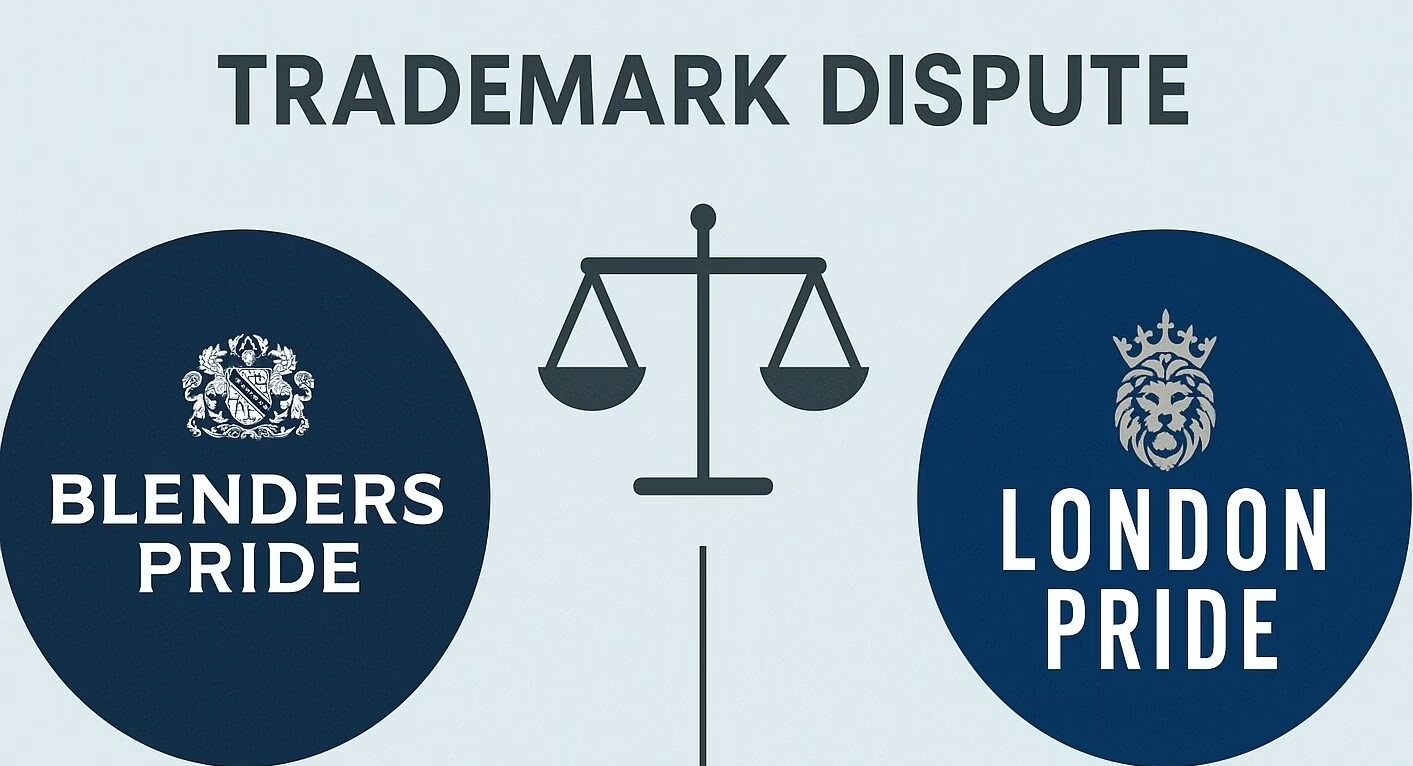
On the Rocks: Supreme Court Rejects Pernod Ricard’s Injunction Plea Against ‘London Pride’
Broad Anti-Dissection Rule Upheld as Apex Court Reaffirms That Generic Terms Cannot Be Monopolised in Composite Trademarks
Industry-Wide Implications for Premium Spirit Brands as Intellectual Property Thresholds Shift Toward Holistic Consumer Perception
By Legal Editor
New Delhi: July 13, 2026:
In a significant legal battle for brand protection within India's premium spirits industry, the Supreme Court of India delivered a definitive judgment in Pernod Ricard India Private Limited & Another v. Karanveer Singh Chhabra (). The division bench, comprising Justice R. Mahadevan and Justice J.B. Pardiwala, dismissed an appeal filed by global liquor giant Pernod Ricard, which sought an interim injunction against a regional distiller, Karanveer Singh Chhabra, for manufacturing and marketing a whisky brand named "LONDON PRIDE".
Pernod Ricard argued that "LONDON PRIDE" infringed its flagship trademarks, "BLENDERS PRIDE" and "IMPERIAL BLUE", by imitating distinct naming metrics and copying elements of its trade dress, visual graphics, and container structure. However, the Supreme Court upheld the concurrent findings of the Commercial Court of Indore and the High Court of Madhya Pradesh. The decision balances public commercial language and private intellectual property ownership, emphasizing that trademark law prevents unfair market extraction rather than facilitating the structural monopolisation of everyday descriptive terms.
[COMPOSITE TRADEMARK STRUCTURE]
│
┌───────────────────────┴───────────────────────┐
▼ ▼
[Dominant Feature] [Descriptive Element]
(e.g., "BLENDERS", "IMPERIAL") (e.g., "PRIDE", "BLUE")
│ │
▼ ▼
Inherently distinctive; Publici Juris; widely used;
Primary source identifier. Cannot be monopolised alone.
Core Statutory Landscape: The Trade Marks Act, 1999
The resolution of this corporate dispute depended on specific sections of the , which govern trademark infringement, partial registration rights, and publici juris elements:
Section 2(1)(h) ("Deceptive Similarity"): This provision describes a mark as deceptively similar if it nearly resembles a registered mark, making it likely to deceive or cause consumer confusion.
Section 17(1) ("Effect of Registration of Parts of a Mark"): This section establishes that when a trademark consists of several matters, its registration confers exclusive rights over the trademark taken as a whole.
Section 17(2) ("Statutory Dissection Limitations"): This section clarifies that registration does not confer exclusive rights over any part of a registered trademark that is not subject to a separate registration application, or that contains elements common to the trade or otherwise non-distinctive.
Section 29 ("Infringement Parameters"): This defines the structural, phonetic, or visual parameters under which an unauthorized mark violates an existing registration.
Judicial Precedents and the Anti-Dissection Canon
The Supreme Court based its analysis on a long line of Indian and international intellectual property precedents to evaluate composite trademarks:
1. Holistic Consumer Impression
The Court cited Amritdhara Pharmacy v. Satya Deo Gupta (AIR 1963 SC 449) and Parle Products (P) Ltd. v. J.P. & Co., Mysore ((1972) 1 SCC 618), confirming that trademarks must be evaluated as a whole. Under the anti-dissection rule, courts avoid breaking down a composite mark into its individual parts to find similarities in minor or generic components. An average purchaser with an imperfect recollection evaluates a product based on its overall commercial impression rather than an etymological dissection.
2. Publici Juris and Descriptive Language
The Court applied principles from the Privy Council decision in Coca-Cola Company of Canada Ltd v. Pepsi-Cola Company of Canada Ltd. (AIR 1942 PC 40). In that case, the word "Cola" was deemed a common descriptive term for the beverage industry, meaning the evaluation turned entirely on the distinctive features "Coca" and "Pepsi".
Similarly, the Supreme Court relied on Godfrey Philips India Ltd v. Girnar Food & Beverages Pvt. Ltd. ((2004) 5 SCC 257) to emphasize that laudatory and descriptive terms cannot be monopolised unless they have acquired a secondary meaning through long, exclusive use.
3. The Refined Consumer Standard
Applying Khoday Distilleries Limited v. Scotch Whisky Association ((2008) 10 SCC 723), the Court noted that the target consumer base matters. For premium and ultra-premium whiskies, buyers are typically discerning consumers who can read the labels. This profile makes them less likely to be confused by minor, isolated similarities than purchasers of mass-market, low-cost goods.
Explaining the Court's Logic
The Supreme Court's decision relied on four main legal principles that clarify how composite trademarks are protected under Indian law:
The Dominant Feature Rule and the "Milk and Water" Analogy
To evaluate composite trademarks, the Court used a clear structural analogy:
"If a small amount of milk is added to a half-glass of water, the mixture becomes cloudy, but the dominant character remains watery. Conversely, if water is added to a half-glass of milk, the result still appears to be milk."
In trademark law, consumer perception is shaped by the dominant, distinctive portion of a mark. In "BLENDERS PRIDE" and "IMPERIAL BLUE", the terms "BLENDERS" and "IMPERIAL" serve as the dominant brand identifiers because they are unique. The terms "PRIDE" and "BLUE" are generic elements common to the trade. The respondent's mark, "LONDON PRIDE", uses "LONDON" as a distinct geographical identifier, making it visually and conceptually separate from the appellants' dominant brand names.
[Fluid Perception Analogy]
Water (Generic) + Milk (Dominant Feature) ──► Milk Characteristics Rule
"PRIDE" (Common) + "BLENDERS" (Distinct) ──► Consumer identifies "BLENDERS"
The Concept of Publici Juris
The Court noted that the word "PRIDE" is used widely across Class 33 registrations. Brands such as McDowell’s Pride, Highland Pride, Rockford Pride, Royal Pride, and Oak Pride show that the word is public property within the liquor industry. Because the term is publici juris, it cannot be claimed exclusively by a single company.
Rejection of Hybrid Infringement Claims
The Court rejected Pernod Ricard's strategy of combining different features from two separate brands ("BLENDERS PRIDE" and "IMPERIAL BLUE") to build an infringement claim against "LONDON PRIDE". The Court ruled that hybrid claims are legally untenable. Each registered trademark must be evaluated on its own merits against the competing mark, rather than gathering generic elements from across a portfolio to fabricate a claim.
The Doctrine of Post-Sale Confusion
The judgment addressed a developing area of intellectual property law by reviewing the UK Supreme Court’s decision in Iconix Luxembourg Holdings SARL v Dream Pairs Europe Inc. ([2025] UKSC 25). This case examined post-sale confusion, where confusion occurs after a purchase when the product is seen in public use.
While acknowledging the doctrine's potential role in future Indian case law, the Supreme Court found it inapplicable here. Whisky is typically bought and consumed in private settings rather than displayed in public spaces, meaning it does not trigger post-sale association risks.
Procedural Issues and Litigious Estoppel
The Court also highlighted an inconsistency in the appellant's legal position. In previous registration filings before the Trademark Registry, Pernod Ricard argued that "PRIDE" was not independently distinctive and that its marks should be evaluated as a whole to secure registration. Under the principle of estoppel, the company could not now argue the opposite to claim an exclusive monopoly over that same word.
Additionally, the Court noted that Pernod Ricard had previously lost a similar case against United Spirits Limited’s mark, "Royal Challenge American Pride" (Pernod Ricard India (P) Ltd v. United Spirits Ltd, 2023 SCC OnLine P&H 477). On the issue of trade dress, the Court found no physical proof that the respondent used bottles embossed with "SEAGRAM’S QUALITY", as the evidence presented at trial did not support the claim.
Citing Wander Ltd v. Antox India (P) Ltd (1990 Supp SCC 727), the Supreme Court affirmed that appellate courts should not overturn a trial court's discretionary interim order unless it is arbitrary or legally flawed. The Supreme Court dismissed the civil appeal and directed the Commercial Court of Indore to resolve the main suit, Civil Suit No. 3 of 2020, within four months.
Searchable Index of Legal Points & FAQs
Section 1: Core Principles of Composite Marks
Q1: What is the anti-dissection rule in trademark law?
The anti-dissection rule requires that a composite trademark containing multiple words, symbols, or elements must be evaluated as a whole. Courts do not break a mark into individual components to compare them against matching parts of a competitor's mark. The correct standard is whether the overall commercial impression of the marks is confusingly similar.
Q2: How does the dominant feature test work alongside the anti-dissection rule?
While marks must be compared as a whole, the dominant feature test recognizes that consumers often focus on specific, distinctive parts of a composite mark. If a competitor copies the unique, dominant element of a trademark, it may constitute infringement. However, if the copied element is generic, descriptive, or laudatory, it does not qualify as infringement.
Q3: What does the term "publici juris" mean in trademark disputes?
Publici juris means "of public right." In trademark law, it describes words, phrases, or designs that are common to a specific trade or belong to the public domain. When a term is publici juris, no single trader can claim exclusive rights to it, even if it is part of a registered composite trademark.
Section 2: Statutory Interlock & Application
SEARCH INDEX: STATUTORY APPLICATION & CASE METRICS
[Topic Keyword] [Statutory/Case Anchor] [Legal Outcome]
Deceptive Similarity Section 2(1)(h) Requires total impression.
Dissection Restrictions Section 17(2) No monopoly on generic parts.
Estoppel Registry Filings Can't claim part is exclusive.
Refined Consumer Test Khoday Distilleries Discerning buyers reduce risk.
Q4: Can a company claim a trademark monopoly over an ordinary laudatory word?
No. Under Section 17(2) of the Trade Marks Act, 1999, common laudatory words like "Pride", "Super", "Premium", or "Choice" cannot be monopolised unless the owner provides clear proof that the word has acquired a secondary meaning. This requires demonstrating long, exclusive use that links the word directly to a single brand in the minds of consumers.
Q5: What is a hybrid infringement claim, and why did the Court reject it?
A hybrid infringement claim occurs when a plaintiff combines different elements from multiple distinct trademarks to argue that a competitor's single mark causes confusion. The Supreme Court rejected this approach, ruling that each trademark must be compared independently against the competing mark. Borrowing elements from across a portfolio to construct an infringement claim is not permitted.
Q6: What is the doctrine of post-sale confusion, and does it apply to all consumer products?
The post-sale confusion doctrine addresses situations where a consumer is not confused at the point of purchase, but third-party observers are misled later when they see the product in public use. The Supreme Court noted that this doctrine does not typically apply to products like spirits, which are generally bought and consumed privately rather than displayed in public.
Disclaimer: This analytical article is intended for educational and informational purposes only and does not constitute formal legal advice.