
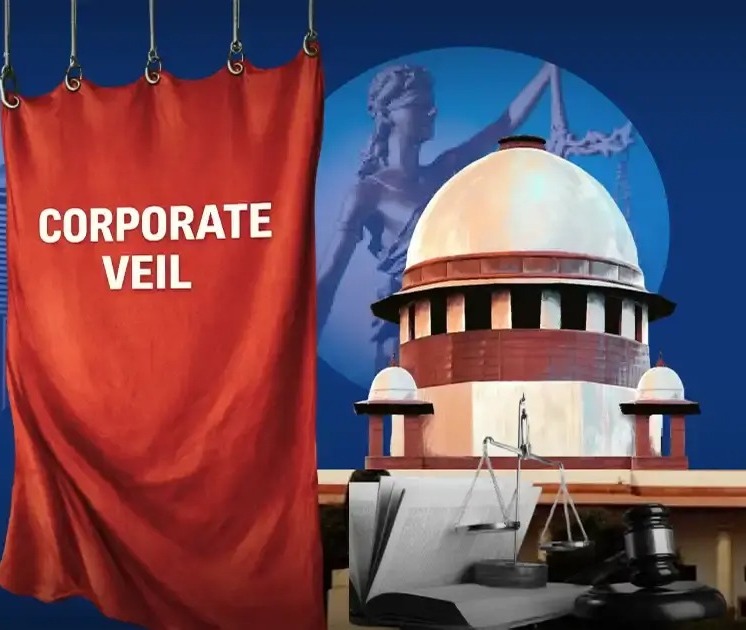
Supreme Court Lifts Corporate Veil in Insolvency: Subsidiary Assets Now Part of Holding Company’s CIRP
Relief for Homebuyers: Court ensures stalled real estate projects can move forward.
IBC Reinterpreted: Group companies’ assets can be merged into resolution plans.
By Legal Reporter
New Delhi: May 06, 2026:
The Supreme Court has ruled that during insolvency proceedings against a holding company, the corporate veil can be lifted to include assets of its subsidiaries, ensuring stalled housing projects are completed and homebuyers’ rights protected. This landmark judgment reshapes how group companies are treated under the Insolvency and Bankruptcy Code (IBC).
For readers researching inheritance disputes, partition of ancestral property, and succession rights among legal heirs, the Supreme Court judgment in Ajit Kaur & Surjit Kaur Vs Darshan Singh (Dead Through LRs) & Ors provides important legal guidance on ownership claims, family settlements, and evidentiary standards in civil property litigation. The ruling is highly relevant for understanding how Indian courts adjudicate succession disputes, co-sharer rights, and competing claims over ancestral assets.
Background
The Supreme Court’s decision in Alpha Corp Development Pvt. Ltd. v. Greater Noida Industrial Development Authority (GNIDA) marks a turning point in Indian insolvency jurisprudence. The case arose from the collapse of Earth Infrastructures Limited (EIL), a real estate developer whose projects stalled, leaving thousands of homebuyers stranded. EIL had structured its ventures through subsidiaries, each holding leasehold rights over land, while EIL remained the controlling entity.
Key Legal Issue
The central question was whether assets of subsidiary companies could be included in the Corporate Insolvency Resolution Process (CIRP) of the holding company. The National Company Law Appellate Tribunal (NCLAT) had earlier refused, holding that subsidiaries’ assets were distinct legal entities. The Supreme Court overturned this, emphasizing the doctrine of “lifting the corporate veil.”
Doctrine of Corporate Veil
- Traditional Rule: Companies are separate legal entities, shielding shareholders and related companies from liability.
- Exception: Courts may “lift the veil” when subsidiaries are mere fronts or when justice demands treating group companies as one economic unit.
- Application Here: The Court found EIL was the “main driving force” behind all projects, with subsidiaries acting only as shells. Hence, their assets could be merged into EIL’s CIRP.
Relevant Laws and Rules
- Insolvency and Bankruptcy Code, 2016 (IBC):
- Provides framework for CIRP.
- Section 5 defines “corporate debtor.”
- Section 30 allows resolution plans to be approved by the Committee of Creditors (CoC).
- The Court interpreted these provisions flexibly to include subsidiaries’ assets when necessary for resolution.
- Companies Act, 2013:
- Recognizes separate legal personality of companies.
- However, jurisprudence allows veil lifting in cases of fraud, sham, or group control.
- Judicial Precedents:
- Earlier cases like Life Insurance Corporation v. Escorts Ltd. and State of UP v. Renusagar Power Co. recognized veil lifting in exceptional circumstances.
- The present ruling extends this principle to insolvency, prioritizing creditor and consumer interests.
Court’s Reasoning
- Homebuyers’ Protection: The Court stressed that insolvency law must safeguard consumers, not just financial creditors.
- Economic Reality: Subsidiaries were not independent businesses but extensions of EIL.
- Resolution Plan Validity: By restoring NCLT’s approval of resolution plans, the Court ensured projects could be completed by Alpha Corp and Roma Unicon.
Implications
- For Real Estate: Homebuyers gain stronger protection; stalled projects may now be revived by including group assets.
- For Creditors: Secured creditors like GNIDA must act promptly; delayed claims may be overridden.
- For Corporate Groups: The ruling signals that structuring projects through subsidiaries will not shield assets in insolvency.
Critical Analysis
This judgment balances strict corporate law principles with practical realities of insolvency. While it risks diluting the doctrine of separate legal personality, it strengthens consumer confidence and aligns with the IBC’s objective of resolution over liquidation. It also sets a precedent for group insolvencies, an area previously underdeveloped in Indian law.
Detailed FAQ
Q1: What is the Corporate Insolvency Resolution Process (CIRP)?
A mechanism under the IBC where creditors attempt to resolve insolvency of a corporate debtor by approving a resolution plan instead of liquidating assets.
Q2: What does “lifting the corporate veil” mean?
It means disregarding the separate legal identity of a company to look at the reality of control and ownership, often to prevent misuse or fraud.
Q3: Why did the Supreme Court lift the veil in this case?
Because EIL controlled all projects, and subsidiaries were mere shells. Treating them separately would have left homebuyers without remedy.
Q4: How does this ruling affect homebuyers?
It ensures stalled projects can be completed by resolution applicants, protecting investments of thousands of buyers.
Q5: What happens to secured creditors like GNIDA?
The Court allowed resolution applicants to proceed while protecting GNIDA’s interests but emphasized creditors must file claims promptly.
Q6: Does this mean all subsidiaries’ assets will be included in CIRP?
Not automatically. The veil will be lifted only when subsidiaries are inextricably linked and act as fronts for the holding company.
Q7: What precedent does this set?
It establishes that group insolvencies can be resolved holistically, preventing fragmentation and ensuring practical outcomes.
In summary: The Supreme Court’s ruling redefines insolvency law by allowing group assets to be merged under CIRP, prioritizing consumer protection and practical resolution over rigid corporate separateness. This is a landmark step in India’s evolving insolvency jurisprudence.