
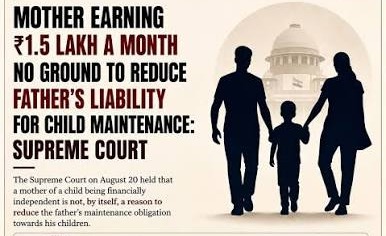
Beyond Arithmetic: Why Mothers’ Financial Independence Cannot Dilute Fathers’ Child Maintenance Obligations
Supreme Court Affirms Non-Monetary Caregiving as Equal Contribution in Family Law
Allahabad High Court’s Mathematical Reduction Overturned to Protect Minor Daughters’ Welfare
By Legal Editor
New Delhi: August 21, 2026:
The Supreme Court of India delivered a definitive jurisprudence on parental financial obligations, holding that a mother’s personal income or independent financial standing cannot serve as an automatic ground to reduce or halve a father’s liability toward maintaining his minor children. Overturning an order passed by the Allahabad High Court, a Division Bench comprising Justice Vikram Nath and Justice Sandeep Mehta reinstated an interim child maintenance award of ₹60,000 per month for two minor daughters. The Apex Court articulated a critical legal standard: child maintenance is a shared parental responsibility that cannot be determined by cold, mechanical arithmetic alone. By recognizing the immense legal and socio-economic value of non-monetary caregiving provided by custodial mothers, the decision establishes a pivotal precedent in Indian family law.
Factual Background and Lower Court Proceedings
The dispute originated from a matrimonial dispute where the mother, a qualified gynaecologist earning approximately ₹1.5 lakh per month, sought interim child maintenance for her two school-going daughters, aged eight and nine. The Family Court evaluated the financial capacity of both parents and directed the father—a medical doctor earning an admitted income of ₹2 lakh per month—to pay an interim maintenance of ₹30,000 per month for each daughter, amounting to a total monthly allowance of ₹60,000.
Aggrieved by the award, the father approached the High Court of Judicature at Allahabad. The High Court modified the Family Court's order and halved the father's maintenance liability from ₹60,000 to ₹30,000 per month (₹15,000 per child). The High Court reasoned that since the mother was independently employed as a healthcare professional and earned a substantial salary, she was equally capable of bearing half of the children's monetary expenses.
The mother, acting on behalf of herself and her two minor daughters, challenged the High Court's reduction before the Supreme Court of India. She argued that the High Court erred by treating child maintenance as a purely numerical balancing act, ignoring both the father's independent earning capacity and her non-monetary, daily physical labour in raising the children.
The Supreme Court’s Ratio Decidendi
Restoring the order of the Family Court, the Supreme Court unequivocally rejected the High Court's mathematical reduction. The Bench observed:
"That the appellant-wife earns is not, by itself, a reason to halve the father’s liability. The obligation to maintain the children is shared by both parents, but it cannot be divided by arithmetic alone. The daughters live with the appellant-wife, who looks after their daily needs and upbringing while also working. Such care cannot be measured in money, but it is a real contribution, and often the greater one."
The Court emphasized three core judicial determinations:
Caregiving as a Real, Non-Monetary Contribution: The Court formally recognized that a custodial parent’s daily supervision, emotional labour, healthcare management, and hands-on guidance constitute a tangible contribution to child rearing. This non-financial labour offsets strict mechanical divisions of monetary support.
Proportionality and Parental Status: The Bench observed that the father, being a qualified medical practitioner earning ₹2 lakh per month, had more than sufficient financial means to pay ₹60,000 per month. Given the socio-economic status of both parents and the rising costs of education and healthcare for two growing children, ₹60,000 was deemed entirely proportionate and reasonable.
Irrelevance of Wife’s Income in Absolute Terms: The Court noted that even if the wife’s independent income was excluded from consideration, the father's independent earning capacity justified the original maintenance figure. The mother’s employment does not absolve or diminish the father’s statutory responsibility to secure his children's standard of living.
Accordingly, the Supreme Court directed the father to clear all outstanding maintenance arrears within a strict timeframe of three months.
Statutory Analysis and Intersecting Maintenance Laws
The ruling operates within the broader matrix of statutory enactments governing child support and maintenance in India. Indian jurisprudence provides multiple concurrent remedies across secular and personal statutes to safeguard the economic rights of women and children.
1. Section 125 of the Code of Criminal Procedure, 1973 (CrPC) / Section 144 of the Bharatiya Nagarik Suraksha Sanhita, 2023 (BNSS)
Section 125 of the CrPC (now mirrored in Section 144 of the BNSS, 2023) is a social welfare provision designed to prevent destitution and vagrancy. Under this provision, any person having "sufficient means" who neglects or refuses to maintain his legitimate or illegitimate minor children who are "unable to maintain themselves" can be ordered by a First-Class Magistrate to pay a monthly allowance.
Courts have consistently held that the phrase "unable to maintain itself" refers specifically to the financial independence of the child, not the financial status of the custodial mother. A father cannot escape his statutory liability under Section 125 merely because the mother possesses independent means of income.
2. Section 20 of the Hindu Adoptions and Maintenance Act, 1956 (HAMA)
Under Hindu personal law, Section 20 of HAMA creates an absolute statutory obligation on Hindu parents to maintain their legitimate or illegitimate minor children. While Section 20(3) extends this liability to both the father and the mother, judicial interpretations emphasize that the obligation is joint and several, requiring an assessment of each parent's capacity rather than an automatic 50-50 financial split.
3. Section 26 of the Hindu Marriage Act, 1955 (HMA)
Section 26 of the HMA empowers Family Courts in ongoing matrimonial proceedings to pass interim orders regarding the custody, maintenance, and education of minor children. The primary statutory requirement under Section 26 is ensuring the "welfare and educational needs" of the children in a manner consistent with the standard of living they would have enjoyed had the marriage remained intact.
4. Protection of Women from Domestic Violence Act, 2005 (PWDVA)
Section 20 of the PWDVA empowers the Magistrate to direct the respondent to pay monetary relief to meet expenses incurred and losses suffered by the aggrieved person and any child of the aggrieved person as a result of domestic violence, supplementing rights available under general maintenance statutes.
Broader Judicial Precedents and Evolving Jurisprudence
This Supreme Court ruling builds upon a growing body of progressive family law jurisprudence in India that seeks to dismantle rigid, formalistic approaches to financial support in matrimonial disputes.
┌────────────────────────────────────────┐
│ Child Maintenance Jurisprudence │
▼ ▼
┌─────────────────────────────────┐ ┌─────────────────────────────────┐
│ Financial Assessment │ │ Qualitative / Caregiving │
├─────────────────────────────────┤ ├─────────────────────────────────┤
│ • Income Affidavits (Rajnesh) │ │ • Non-Monetary Labor Recognized │
│ • Absolute Means vs Net Surplus │ │ • Custodial Parent Contribution │
│ • Standard of Living Standards │ │ • Welfare of Child Primacy │
└─────────────────────────────────┘
The Paradigm Shift: Rajnesh v. Neha (2021)
In the landmark judgment of , the Supreme Court laid down comprehensive guidelines to standardize the adjudication of maintenance claims across India. The Court introduced mandatory Affidavits of Disclosure of Assets and Liabilities to be filed by both parties to ensure full transparency. Crucially, Rajnesh v. Neha established that while the income of the applicant spouse is a relevant factor, it cannot act as a complete bar or an automatic mathematical discount against the obligor spouse's liability.
Rejection of Strict Mathematical Formulas
In earlier decisions, such as Chaturbhuj v. Sita Bai (2008) and Kalyan Dey Chowdhury v. Rita Dey Chowdhury (2017), the Judiciary routinely held that maintenance provisions are intended to achieve substantive justice. The Supreme Court has repeatedly clarified that formulas allocating a fixed percentage (e.g., 25% of net salary) are merely indicative guidelines rather than statutory ceilings. Adjudication must remain flexible to accommodate the specific needs of children, such as schooling, extracurricular activities, housing, and medical inflation.
Valuation of Unpaid Care Work
The Supreme Court's explicit recognition of non-monetary caregiving reflects a modern understanding of domestic economics. By acknowledging that looking after children's daily needs while managing professional duties constitutes a "real contribution, and often the greater one," the Apex Court aligned Indian maintenance law with broader constitutional principles of gender equity under Article 15(3) of the Constitution of India.
Searchable Legal Index & Frequently Asked Questions (FAQ)
┌─────────────────────────────────────────────────────────────────────────────────┐
│ SEARCHABLE INDEX OF FAQ TOPICS │
├───────────────────────────────────┬─────────────────────────────────────────────┤
│ Topic Code │ Subject Matter / Legal Question │
├───────────────────────────────────┼─────────────────────────────────────────────┤
│ [FAQ-01: MAT-INC] │ Impact of Mother's Earning on Maintenance │
│ [FAQ-02: CARE-VAL] │ Legal Valuation of Non-Monetary Caregiving │
│ [FAQ-03: STAT-FRAME] │ Applicable Indian Maintenance Statutes │
│ [FAQ-04: CALC-STD] │ Mathematical Formulas vs Judicial Discretion│
│ [FAQ-05: RAJ-GUIDE] │ Application of Rajnesh v. Neha Guidelines │
│ [FAQ-06: ENF-ARREARS] │ Timelines and Enforcement of Maintenance │
└───────────────────────────────────┴─────────────────────────────────────────────┘
[FAQ-01: MAT-INC] Does a mother's income automatically halve or reduce a father's child maintenance liability?
Answer: No. As held by the Supreme Court in this judgment, a mother’s financial independence or high salary is not, by itself, a valid legal ground to halve or reduce a father's maintenance obligation toward his minor children. The statutory obligation to maintain minor children rests on the father based on his earning capacity and financial means, regardless of whether the mother is employed.
[FAQ-02: CARE-VAL] How does the law evaluate non-monetary caregiving provided by a custodial parent?
Answer: The Supreme Court recognizes that daily caregiving, supervision, physical care, and emotional support provided by the custodial parent have substantial non-monetary value. Because the custodial parent invests daily time and personal labour into the children's upbringing, this contribution offsets strict numerical or mathematical division of maintenance expenses between working parents.
[FAQ-03: STAT-FRAME] What are the main statutory remedies available for child maintenance in India?
Answer: Child maintenance can be claimed under several intersecting statutes:
Section 125, CrPC, 1973 / Section 144, BNSS, 2023: A secular law providing summary relief to prevent destitution.
Section 20, Hindu Adoptions and Maintenance Act, 1956 (HAMA): Imposes a statutory duty on Hindu parents to maintain minor children.
Section 26, Hindu Marriage Act, 1955: Allows Family Courts to issue interim orders for child maintenance during matrimonial suits.
Section 20, Protection of Women from Domestic Violence Act, 2005 (PWDVA): Grants monetary relief to cover child-related expenses resulting from domestic disputes.
[FAQ-04: CALC-STD] Is child maintenance calculated using a fixed percentage or formula?
Answer: No. Indian law does not prescribe a rigid percentage or statutory formula for child maintenance. Courts exercise structured discretion based on factors including:
The financial status, gross/net income, and assets of both parents.
The educational, medical, and daily lifestyle requirements of the minor children.
The socio-economic standard of living the children would have enjoyed had the family stayed together.
The physical custody arrangements and non-monetary contributions of the custodial parent.
[FAQ-05: RAJ-GUIDE] What role do income affidavits play in determining maintenance claims?
Answer: Following the Supreme Court's ruling in , both parties in a maintenance dispute are mandatorily required to file comprehensive Affidavits of Disclosure of Assets and Liabilities. These affidavits require full disclosure of monthly income, real estate, liquid investments, loans, lifestyle expenses, and dependants. Concealment of income leads to adverse legal inferences.
[FAQ-06: ENF-ARREARS] From what date is child maintenance payable, and how are arrears enforced?
Answer: As settled in Rajnesh v. Neha, maintenance is ordinarily payable from the date on which the application is filed before the court, rather than the date of the final order. If an obligor defaults on interim or final maintenance, courts can issue distress warrants, direct employer salary deductions, attach properties, or grant specific timelines (such as three months) to clear accrued arrears under execution provisions.
Comparative Overview: High Court vs. Supreme Court Reasoning
Socio-Legal Implications for Future Family Law Matters
The Supreme Court’s decision carries profound implications for matrimonial litigation across India, establishing clear boundaries for lower courts handling child maintenance disputes:
Protection of Working Mothers: The judgment prevents non-custodial spouses from using a mother’s professional success as a shield to shirk financial responsibility. It ensures that women are not financially penalized for maintaining independent careers while bearing the brunt of domestic child-rearing responsibilities.
Prioritizing Child Welfare: By anchoring the analysis in the actual needs and socio-economic status of the minor daughters, the Court reaffirmed that maintenance is an absolute right of the child, not a negotiable concession between warring spouses.
Guidance for Family Courts: The decision serves as a clear directive to Family Courts and High Courts to refrain from applying mechanical mathematical formulas when assessing maintenance applications. Financial assessments must always account for both monetary capacity and non-monetary contributions to achieve substantive economic justice.
Judicial Parameter — Allahabad High Court Approach — Supreme Court Determination
Analytical Model — Applied strict arithmetic division (50-50 split) based on mother's income. — Rejected rigid arithmetic; affirmed holistic evaluation of caregiving and status.
Mother's Employment — Treated mother's salary (₹1.5L/month) as justification to halve father's liability. — Held mother's income does not automatically dilute father's primary obligation.
Caregiving Weightage — Omitted non-monetary factors from financial calculations. — Formalized caregiving and physical custody as major legal contributions.
Father's Earning Capacity — Discounted father's income (₹2L/month) relative to combined family pool. — Held ₹60,000/month is fully proportionate for a doctor earning ₹2L/month.
Final Monthly Award — Reduced interim maintenance to ₹30,000 (₹15,000 per child). — Reinstated original award of ₹60,000 (₹30,000 per child).