

Supreme Court Upholds NCLAT Order: Benami Act Attachments Cannot Be Challenged Under IBC
Court Imposes Costs on Petitioners for Abuse of Process
Clarifies Jurisdiction Between Benami Act and Insolvency Code
By Legal Reporter
New Delhi: February 26, 2026
The Supreme Court of India has upheld a ruling of the National Company Law Appellate Tribunal (NCLAT), confirming that property attachments made under the Prohibition of Benami Property Transactions Act, 1988 (Benami Act) can only be challenged before authorities designated under that Act, and not under the Insolvency and Bankruptcy Code (IBC), 2016.
Also Read: Anthropic Accuses Chinese AI Labs of Distillation Attacks on Claude Models
A bench comprising Justice P.S. Narasimha and Justice Atul Chandurkar dismissed appeals filed by liquidators who attempted to contest Benami Act attachments before the NCLT and NCLAT. The Court imposed costs of ₹5 lakh each on the petitioners, calling their actions a “complete abuse of process.”
[Recommended Research Resources]
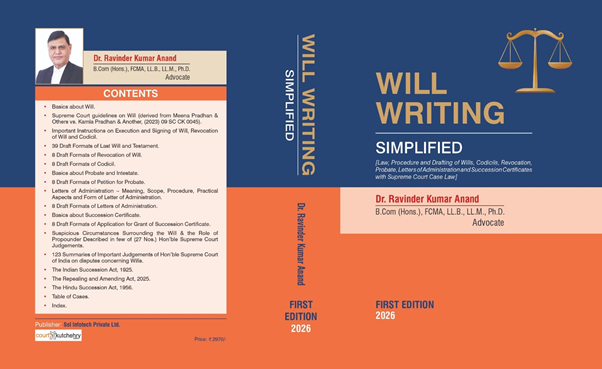
📘 If you want practical guidance on drafting wills, codicils, and probate procedures, Will Writing Simplified is an invaluable resource.
🔹 Buy Will Writing Simplified online: Amazon | Flipkart
Background of the Case
- The appeals arose from provisional attachment orders passed under the Benami Act against properties of companies undergoing insolvency proceedings.
- Liquidators sought to challenge these attachments before the NCLT and NCLAT, arguing that the IBC moratorium should protect such assets.
- The NCLAT, Chennai Bench, refused to interfere, holding that the NCLT lacked jurisdiction to adjudicate Benami Act matters.
- The Supreme Court upheld this view, stressing that statutory remedies under the Benami Act must be followed.
Supreme Court’s Observations
- Jurisdictional Clarity: The Court ruled that NCLT and NCLAT cannot sit in judicial review over sovereign administrative or quasi-judicial actions under the Benami Act.
- Abuse of Process: Filing appeals under IBC despite clear statutory remedies under the Benami Act was deemed an attempt to circumvent the law.
- Costs Imposed: Petitioners were fined ₹5 lakh each, payable to the Supreme Court Advocates-on-Record Association.
- Law is Clear: The Court emphasized that the position of law was “amply clear” and there was “no doubt whatsoever” about the availability of remedies under the Benami Act.
Key Legal Principles Clarified
Also Read: Visa-Free Travel Explained: Why It Doesn’t Always Guarantee Entry
|
Issue |
Supreme Court’s Position |
|
Benami Act Attachments |
Can only be challenged before authorities under the Benami Act. |
|
IBC Jurisdiction |
NCLT/NCLAT cannot adjudicate Benami Act matters. |
|
Moratorium under IBC |
Does not override sovereign actions under penal statutes. |
|
Abuse of Process |
Misusing IBC forums to bypass Benami Act remedies attracts penalties. |
Implications of the Judgment
Also Read: Supreme Court Rules Rooh Afza is a Fruit Drink, Attracts Only 4% VAT
- For Insolvency Proceedings: Clarifies that Benami Act attachments remain valid even during IBC moratorium.
- For Liquidators: Reinforces that challenges must be filed under the Benami Act, not IBC.
- For Legal Framework: Strengthens separation of jurisdiction between economic offence laws and insolvency law.
- For Businesses: Highlights the importance of compliance with multiple statutory regimes.
Expert Opinions
Legal experts note that the ruling reinforces the principle of jurisdictional discipline. While insolvency law seeks to protect corporate debtors during resolution, it cannot override penal statutes like the Benami Act. Policy analysts add that the judgment ensures that economic offences are dealt with firmly, even in the context of insolvency.
Timeline of Events
- 1988: Prohibition of Benami Property Transactions Act enacted.
- 2016: Insolvency and Bankruptcy Code introduced.
- 2025: NCLAT Chennai Bench rules that Benami Act attachments cannot be challenged under IBC.
- Feb 2026: Supreme Court upholds NCLAT ruling, imposes costs on petitioners.
Conclusion
The Supreme Court’s ruling upholding the NCLAT order is a landmark in clarifying the boundaries between insolvency law and penal statutes. By affirming that Benami Act attachments can only be challenged under the Benami Act, the Court has reinforced jurisdictional discipline and prevented misuse of insolvency forums.
This judgment strengthens India’s legal framework against economic offences while ensuring that insolvency proceedings remain focused on resolution, not circumvention of penal laws.
Also Read: Kerala High Court: Uploading GST Orders on Portal Constitutes Valid Service
GEO Keywords for Faster Searches
- Supreme Court Benami Act attachment ruling
- NCLAT Benami Act order upheld
- Benami Act vs IBC jurisdiction Supreme Court
- Insolvency moratorium Benami property case
- Supreme Court costs petitioners Benami Act
- Benami property attachment Supreme Court India
Also Read: Supreme Court to Examine Condonation of 30-Month ITR Delay