
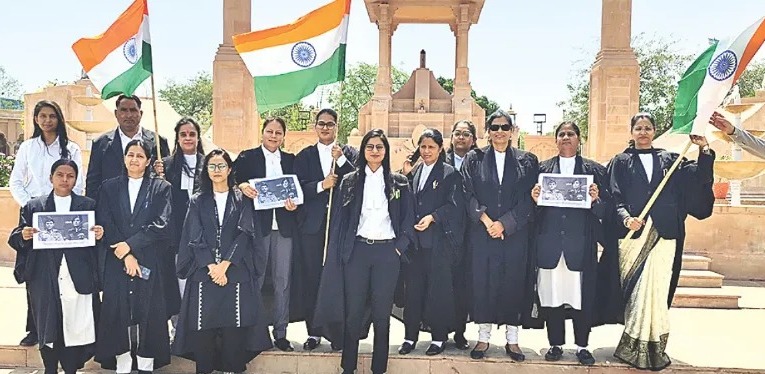
Supreme Court Endorses Women’s Co-option Formula in Bar Council Elections
Apex Court Calls Proposal Fair and Inclusive
Directive to Finalise Framework Strengthens Gender Representation
By Legal Reporter
New Delhi: June 17, 2026:
The Supreme Court of India has recently weighed in on the issue of gender representation in professional regulatory bodies, specifically the Bar Council of India (BCI). In its June 2026 order, the Court endorsed the women’s co-option formula proposed for Bar Council elections, describing it as fair and directing the BCI to finalise the proposal. This ruling marks a significant step toward ensuring gender inclusivity in the governance of the legal profession.
Case Background
Issue Raised: Persistent underrepresentation of women in Bar Council elections.
Proposal: A formula to co-opt women members into Bar Councils to ensure minimum representation.
Supreme Court’s Decision: Found the formula fair and directed the BCI to finalise and implement it.
Key Legal Issues
Representation in Professional Bodies
Whether women lawyers are adequately represented in Bar Councils.
Court recognised structural barriers limiting women’s electoral success.
Legality of Co-option Formula
Whether co-option violates democratic principles of election.
Court held that co-option is permissible to ensure inclusivity.
Constitutional Principles
Article 14: Equality before law.
Article 15(3): Permits special provisions for women.
Court applied these principles to uphold co-option formula.
Court’s Observations
Fairness of Formula: Co-option ensures women’s voices are heard in Bar Councils.
Inclusivity in Governance: Representation must reflect diversity of the profession.
Directive to Finalise: BCI must finalise and implement proposal without delay.
Balance Between Election and Co-option: Formula supplements elections, not replaces them.
Relevant Laws and Rules
Advocates Act, 1961
Governs Bar Councils and regulation of legal profession.
Bar Council of India Rules
Provide framework for elections and governance.
Constitution of India
Article 14: Equality.
Article 15(3): Special provisions for women.
Judicial Precedents
Indra Sawhney v. Union of India (1992): Affirmed principle of affirmative action.
Vishaka v. State of Rajasthan (1997): Recognised need for gender-sensitive frameworks.
Wider Implications
For Women Lawyers: Ensures minimum representation in Bar Councils.
For Bar Councils: Strengthens inclusivity and diversity in governance.
For Judiciary: Reinforces role in promoting gender justice.
For Policy: Encourages similar measures in other professional bodies.
Comparative Perspective
India: Co-option formula endorsed by Supreme Court.
US: Bar associations adopt diversity policies but rely on elections.
UK: Law Society promotes gender representation through committees.
Inference: India’s judicially endorsed co-option formula is unique, reflecting constitutional commitment to inclusivity.
Conclusion
The Supreme Court’s endorsement of the women’s co-option formula in Bar Council elections is a landmark in gender justice within the legal profession. By directing the BCI to finalise the proposal, the Court reinforced the principle that representation must reflect diversity and inclusivity. This ruling sets a precedent for similar measures across professional bodies, strengthening democratic governance through fairness and equality.
FAQs (Searchable Index Format)
1. What did the Supreme Court rule?
That the women’s co-option formula in Bar Council elections is fair and must be finalised.
2. What is the co-option formula?
A mechanism to ensure minimum representation of women in Bar Councils by co-opting members.
3. Does co-option replace elections?
No. It supplements elections to ensure inclusivity.
4. Which law governs Bar Councils?
The Advocates Act, 1961.
5. What constitutional provisions apply?
Article 14 (equality) and Article 15(3) (special provisions for women).
6. Why was co-option needed?
Because women lawyers face structural barriers in electoral success.
7. What precedent supports affirmative action?
Indra Sawhney v. Union of India (1992).
8. How does this compare globally?
India’s judicially endorsed co-option formula is unique; US and UK rely on elections and diversity policies.
9. What is the impact on women lawyers?
Ensures their voices are represented in Bar Councils.
10. What is the broader impact?
Strengthens inclusivity in governance of the legal profession and sets precedent for other bodies.