
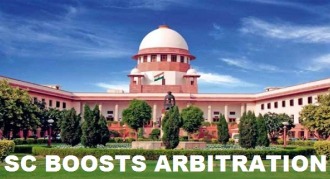
Supreme Court’s Landmark Arbitration Judgments Strengthen Global Outlook
Key Precedents Align Domestic Law with International Standards
Cross-Border Businesses Gain Predictability and Confidence
By Vishwas Kumar
New Delhi: April 25, 2026:
The Supreme Court of India has delivered several landmark arbitration judgments that collectively shaped its internationalist outlook. These rulings emphasize minimal judicial interference, recognition of global standards, and clarity in cross-border disputes—making India more arbitration-friendly and aligned with UNCITRAL principles.
In succession disputes, courts closely examine the intent of the testator and the surrounding circumstances to ensure fairness—this ruling provides clear judicial guidance: Supreme Court judgment on testamentary intent and inheritance disputes in India
Analytical Report
India’s Supreme Court has progressively adopted an internationalist approach to arbitration, harmonizing domestic law with global practices. Below are the most significant judgments that highlight this shift:
1. Central Organisation for Railway Electrification (CORE) v. ECI-SPIC-SMO-MCML (JV) (2025)
- Significance: The Court explicitly referenced UNCITRAL Model Law Article 2A, advocating internationalist interpretation even for India-seated arbitrations.
- Impact: This judgment marked India’s formal embrace of harmonisation, ensuring arbitration clauses are interpreted in line with global standards.
- Business Relevance: Cross-border contracts with Indian firms gain credibility, as disputes are resolved under internationally recognized principles. dailyjus.com
2. Gayatri Balasamy v. ISG Novasoft Technologies Ltd. (2025, Five-Judge Bench)
- Issue: Whether courts can modify arbitral awards under Sections 34 and 37 of the Arbitration Act.
- Holding: Courts have limited power to modify awards—only for clerical, computational, or severable errors. They cannot re-evaluate merits.
- Significance: Aligns Indian law with global practice, reducing judicial interference and ensuring awards remain enforceable internationally.
- Business Relevance: Provides certainty to foreign investors that arbitral awards in India will not be rewritten by courts. LiveLaw
3. Glencore International AG v. Shree Ganesh Metals (2025)
- Issue: Whether an unsigned arbitration agreement can bind parties.
- Holding: Conduct and correspondence can establish acceptance of arbitration clauses, even without signatures.
- Significance: Expands enforceability of arbitration agreements, consistent with international norms.
- Business Relevance: Cross-border businesses relying on electronic communications can enforce arbitration clauses without formal signatures. indialaw.in
4. Disortho S.A.S v. Meril Life Sciences Pvt. Ltd. (2025)
- Issue: Jurisdiction in cross-border arbitration when contract clauses conflict.
- Holding: Applied international precedents (UK’s Enka Insaat and Sulamérica) to clarify distinction between seat and venue of arbitration.
- Significance: Established that Indian courts retain supervisory jurisdiction even when arbitration is seated abroad.
- Business Relevance: Provides clarity for multinational contracts with mixed jurisdiction clauses, reducing uncertainty in enforcement. Law Web
5. Hindustan Construction Company v. Bihar Rajya Pul Nirman Nigam (2025)
- Issue: Whether High Courts can recall their own order appointing arbitrators.
- Holding: Once arbitration proceedings have commenced, courts cannot interfere.
- Significance: Reinforces the principle of minimal judicial intervention, a cornerstone of international arbitration.
- Business Relevance: Ensures arbitral autonomy, making India a more reliable seat for arbitration. indialaw.in
[RESEARCH RESOURCES]
BUY & READ THE BOOK, WILL WRITING SIMPLIFIED, By Dr Ravinder Kumar Anand. [📘 Buy Will Writing Simplified online: Amazon | Flipkart ]
FAQs
Q1: Why are these judgments important for cross-border businesses?
They align Indian arbitration law with international standards, ensuring predictability and reducing risk for foreign investors.
Q2: Does the Supreme Court now follow UNCITRAL principles?
Yes. CORE judgment explicitly adopted Article 2A’s internationalist interpretation, harmonizing Indian law with UNCITRAL.
Q3: Can unsigned contracts still enforce arbitration?
Yes. As held in Glencore v. Shree Ganesh Metals, conduct and correspondence can establish binding arbitration agreements.
Q4: How does this affect disputes with foreign partners?
Disputes are resolved under globally recognized frameworks, boosting confidence in Indian arbitration.
Q5: Does this make India an arbitration hub?
Yes, these rulings collectively strengthen India’s position as a credible arbitration seat, though consistent implementation remains key.
Key Takeaway: Through landmark rulings like CORE, Gayatri Balasamy, Glencore, Disortho, and Hindustan Construction, the Supreme Court has entrenched an internationalist outlook. This enhances India’s credibility in global commerce, offering businesses predictability, reduced judicial interference, and harmonisation with international arbitration standards.