
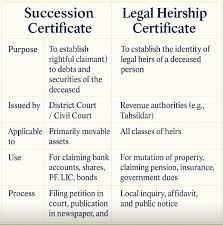
Succession vs. Legal Heir Certificate in Delhi: A Practical Guide
Court-Issued Proof for Movable Assets
Revenue-Issued Document for Administrative Benefits
By Vishwas Kumar
New Delhi: May 07, 2026:
In Delhi, heirs of a deceased person often face confusion about whether to obtain a Succession Certificate or a Legal Heir Certificate. Both documents serve different purposes, are issued by different authorities, and follow distinct procedures. Understanding their differences and the step-by-step process to obtain them is essential for smooth asset transfer and to avoid unnecessary litigation.
Succession Certificate: Judicial Authority
- Law: Indian Succession Act, 1925 (Sections 372–375).
- Issued By: District Judge (Delhi District Courts).
- Purpose: Grants heirs’ authority to collect debts, securities, and movable assets of the deceased.
- Scope: Applicable to movable property such as bank deposits, fixed deposits, shares, bonds, mutual funds, and insurance proceeds.
- Legal Effect: Protects banks and debtors from liability once they honour the certificate.
Step-by-Step Process in Delhi
- Petition Filing: File a petition under Section 372 before the District Judge in whose jurisdiction the deceased resided.
- Details Required: Name of deceased, date of death, list of heirs, description of debts/securities.
- Court Fee: Pay court fee under the Court Fees Act, 1870 (percentage of asset value).
- Public Notice: Court issues notice in newspapers inviting objections (usually 45 days).
- Hearing: Judge examines evidence, family tree, and objections if any.
- Order & Certificate: If uncontested, certificate is issued within 3–6 months.
Legal Heir Certificate: Administrative Recognition
- Law: Governed by Delhi Revenue Department rules.
- Issued By: Sub-Divisional Magistrate (SDM) or Tehsildar.
- Purpose: Identifies heirs for administrative purposes like pension claims, gratuity, utility transfers, or government compensation.
- Scope: Covers both movable and immovable property in terms of recognition but does not confer ownership rights.
- Legal Effect: Serves as proof of relationship, but not enforceable against third parties in contested succession.
Step-by-Step Process in Delhi
- Application: Submit application to the SDM office of the area where the deceased resided.
- Documents Required: Death certificate, ration card, Aadhaar, proof of residence, and family tree affidavit.
- Verification: Local inquiry by revenue officials to confirm heirs.
- Issue of Certificate: Certificate listing all legal heirs is issued within 30–60 days.
- Fee: Nominal administrative fee (much lower than court fee).
Key Differences
|
Feature |
Succession Certificate |
Legal Heir Certificate |
|
Law |
Indian Succession Act, 1925 |
Delhi Revenue Rules |
|
Issued By |
District Judge |
SDM / Tehsildar |
|
Purpose |
To claim movable assets (debts, securities, deposits) |
To establish heirship for pensions, gratuity, utilities |
|
Scope |
Movable property only |
Administrative recognition of heirs |
|
Legal Effect |
Binding on financial institutions, indemnifies debtors |
Proof of relationship, not binding in contested succession |
|
Timeline |
3–6 months |
1–2 months |
|
Cost |
Court fee based on asset value |
Nominal administrative fee |
Practical Implications in Delhi
- For Banks and Companies: Succession certificate is mandatory to release deposits or securities.
- For Government Departments: Legal heir certificate suffices for pension, gratuity, or compensation.
- For Families: Both may be required depending on the nature of assets.
[LEGAL HELP]
CONTENTS FROM BOOK, WILL WRITING SIMPLIFIED, By Dr Ravinder Kumar Anand. [📘 Buy Will Writing Simplified online: Amazon | Flipkart ]
Draft of Application for Grant of Succession Certificate by Son for the Estate of Deceased Father dying Intestate.
IN THE HON’BLE COURT OF THE DISTRICT JUDGE / COMPETENT PROBATE COURT
(Civil Original Jurisdiction)
Succession Case No.___ of 20__
In the matter of the Estate of:
Ms./Mrs. [Name of Deceased]
[Aadhaar No._/PAN No./Passport No. ___, issued on ____ at ____],
Son/Daughter/Wife of [Father’s or Husband’s Name],
Residing at [Full Residential Address].
… Deceased
THE HUMBLE APPLICATION OF
Mr./Ms./Mrs. [Applicant’s Full Name],
[Aadhaar No._/PAN No./Passport No. ___, issued on ___ at ____]
Son/Daughter/Wife of [Father’s or Husband’s Name],
Residing at [Full Residential Address].
… Applicant
Versus
State & Others
… Respondents
Application under Section 372 and 373 of Indian Succession Act, 1925 for Grant of Succession Certificate
Most Respectfully Showeth:-
1. That the Applicant, Mr. __________________, aged approximately ___ years, (holder of Aadhaar No. __________ / PAN No. __________ / Passport No. __________ dated __________ issued on __________ at __________), is the natural-born and lawfully begotten son of Late Mr. __________________, who expired on __________ at __________. The Applicant is competent under law to file the present Application for the grant of a Succession Certificate concerning the estate, assets, debts, securities and movable properties left behind by the deceased.
2. That the Applicant is presently residing at __________________, and therefore this Hon’ble Court has adequate territorial jurisdiction as contemplated under Sections 372 and 373 of the Indian Succession Act, 1925, to entertain, try, and adjudicate upon the present Application, since both the Applicant’s residence and the deceased’s last habitual residence fall within the same jurisdiction.
3. That the deceased, Late Mr. __________________, was a permanent resident of __________________, within the territorial limits of this Hon’ble Court, and continued to reside there until his death. His last rites and ceremonies were also conducted in the same jurisdiction, thereby further substantiating the maintainability of this Application before this Hon’ble Court.
4. That the deceased died intestate, without executing any Will, Codicil, testamentary document, oral directive, or any voluntary disposition relating to his movable estate. The Applicant states on solemn affirmation that no Will of the deceased has ever been found, deposited, registered, proclaimed, or discovered in any public or private records.
5. That the deceased has left behind the following Class-I legal heirs as per the Schedule appended:
(a) The Applicant, being the son;
(b) Mrs. __________________, widow of the deceased;
(c) Ms. __________________, daughter of the deceased;
all of whom are entitled to succeed to the estate under the Hindu Succession Act, 1956, and the general principles of intestate succession applicable thereto.
6. That during his lifetime, the deceased maintained and possessed various bank accounts, fixed deposits, recurring deposits, EPF accounts, pensionary dues, savings schemes, postal investments, insurance policies, mutual fund holdings, dematerialised securities, salary arrears, and other actionable claims. The details of the same are vast and have been collected through extensive enquiry, documentary inspection, bank certificates, employer records, and preliminary statements furnished by relevant institutions. The Applicant craves leave to file supplementary details if any further assets are discovered.
7. That the deceased had longstanding relations with multiple banking institutions, including but not limited to nationalised banks, private sector banks, post offices, financial corporations, and statutory bodies. It is stated on oath that certain policies and FDRs had matured but remain unpaid due to the requirement of a Succession Certificate, thereby making the present Application indispensable for securing lawful transmission of the estate to the rightful heirs.
8. That the Applicant has not filed any similar Application, application, representation or proceeding seeking a Succession Certificate or any other relief concerning the same subject matter before this Hon’ble Court, or before any Hon’ble High Court or before the Hon’ble Supreme Court of India. The Applicant unequivocally declares that no parallel litigation or conflicting claim is pending regarding the estate of the deceased.
9. That the cause of action for filing this Application first arose on the date of the demise of Late Mr. __________________, i.e., on __________, when all movable assets of the deceased became incapable of being operated, encashed, redeemed or transferred without appropriate legal authority, thereby necessitating the Applicant to secure a Succession Certificate. The cause of action is continuous and subsists until the securities, debts, and actionable claims are legally realised.
10. That the present Application is filed within limitation, as the law of limitation does not bar Applications under the Indian Succession Act provided they are brought within reasonable time from the date of death, since the right to apply for a Succession Certificate continues until the estate is duly administered. The Applicant submits that even otherwise the present Application is well within reasonable time and deserves adjudication on merits.
11. That after the death of the deceased, several banking and financial institutions have refused to release the funds in absence of a legal Succession Certificate. The Applicant has been informed by these institutions that without the Certificate, no transfer, withdrawal, redemption, or settlement of the deceased’s financial holdings can be permitted. Hence, the Applicant is constrained to approach this Hon’ble Court.
12. That the Applicant is a fit, proper, and competent person to administer and receive the debts and securities left behind by the deceased. The Applicant undertakes to comply with any direction regarding indemnity bonds, surety bonds, undertakings, guarantees, or court fee required under Sections 375 and 376 of the Indian Succession Act.
13. That the Applicant submits that no legal impediment exists to the grant of the Succession Certificate. The Applicant also undertakes to distribute the estate in accordance with law amongst all legal heirs and shall not misuse the authority conferred by the Certificate.
14. That the Applicant states that the value of the debts, securities, and movable estate is approximately Rs. ___________ (or as may be determined upon further verification). The complete particulars are available in the possession of the respective institutions, which shall be produced or summoned as required.
15. That the Applicant respectfully submits that the grant of a Succession Certificate will neither prejudice any person nor affect any existing right adversely, and is purely intended to facilitate lawful administration of the deceased’s estate.
16. That in the interest of justice, equity, and fair administration of the estate, the present Application deserves to be allowed.
PRAYER
In view of the facts and circumstances stated hereinabove, the Applicant most respectfully prays that this Hon’ble Court may be pleased to:
(a) Issue a Succession Certificate under Sections 372 to 373 of the Indian Succession Act, 1925, in favour of the Applicant, authorising him to collect, receive, redeem, negotiate, transfer, encash and administer all debts, securities, deposits, bank accounts, investments, insurance dues, pensionary benefits, actionable claims and movable estate standing in the name of Late Mr. __________________, who expired on ____________;
(b) Pass any other and/or further order(s) which this Hon’ble Court may deem fit and proper in the interest of justice.
(Applicant)
Through
(Advocate for the Applicant)
Date:
Place:
VERIFICATION
I, Mr./Ms./Mrs. __________________, the Applicant above-named, do hereby verify that the contents of paragraphs ___ to ___ of the present Application are true and correct to my knowledge and belief and nothing material has been concealed therefrom.
Verified at __________ on this ___ day of _______, 20.
FAQ for Quick Understanding
Q1: Which certificate is needed for bank deposits in Delhi?
Succession Certificate, issued by the District Judge.
Q2: Which certificate is needed for pension claims in Delhi?
Legal Heir Certificate, issued by the SDM.
Q3: Can a legal heir certificate transfer ownership of property?
No. It only identifies heirs; ownership disputes require probate or succession proceedings.
Q4: How long does it take to obtain a succession certificate in Delhi?
Typically 3–6 months, depending on objections and court workload.
Q5: How long does it take to obtain a legal heir certificate in Delhi?
Usually 30–60 days.
Q6: What is the cost difference?
Succession certificate requires court fees proportional to asset value; legal heir certificate requires only a nominal administrative fee.
Q7: Can multiple heirs apply jointly?
Yes, both certificates can list multiple heirs.
In conclusion: In Delhi, succession certificates are judicially enforceable documents for movable assets, while legal heir certificates are administrative tools for pensions and government benefits. Families often need both depending on the asset type, and knowing the correct process saves time, cost, and litigation.