
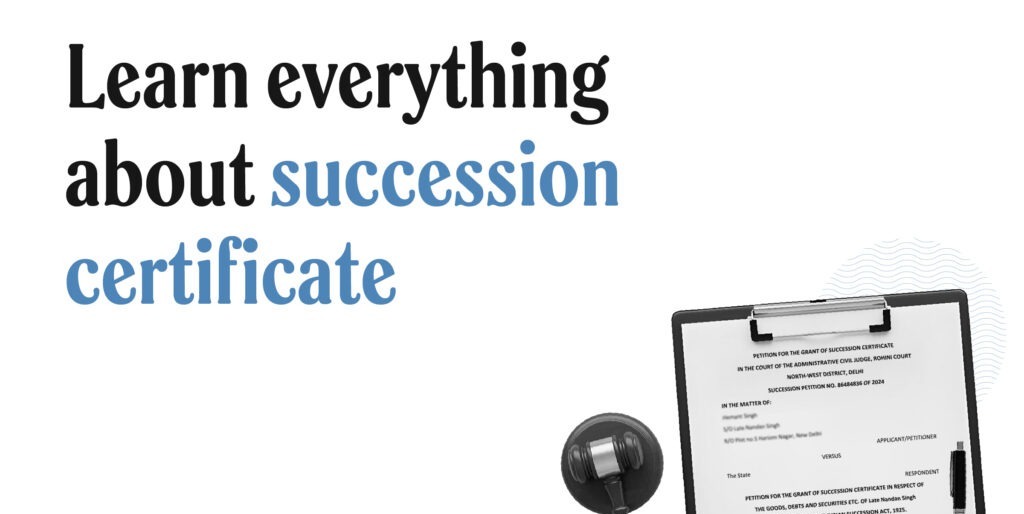
When and Where Succession Certificates Are Required in India
Required Only for Movable Assets
Issued by Civil Courts Under the Indian Succession Act, 1925,
By Vishwas Kumar
New Delhi: May 07, 2026:
Succession certificates in India are required only for movable assets like bank deposits, fixed deposits, shares, mutual funds, and debts owed to the deceased. They are issued by civil courts under the Indian Succession Act, 1925, and are not applicable to immovable property such as land or houses.
If you want to understand how Indian courts interpret disputed wills, suspicious circumstances, probate proceedings, testamentary capacity and succession rights, explore these Supreme Court Judgments on Wills that explain the legal principles governing execution, validity and challenge of wills under Indian succession law.
✅ Situations Where They Are Mandatory
- Bank Accounts & Fixed Deposits: To withdraw or transfer funds of a deceased person when no will exists.
- Shares & Securities: For transfer of ownership in listed companies or dematerialized accounts.
- Mutual Funds & Insurance Proceeds: Financial institutions often require a succession certificate before releasing investments.
- Debts Owed to the Deceased: Creditors may demand proof of rightful heirship before repayment.
- Pension or Provident Fund Balances: In cases where nomination is absent or disputed.
Situations Where They Are Not Required
- Immovable Property (Land, Houses): These require probate of a will or a legal heir certificate, not a succession certificate.
- Government Service Benefits (Compassionate Appointment, Pension Transfer): Governed by service rules and welfare policies, not succession law.
- Cases with Valid Will: Probate of the will suffices; succession certificate is unnecessary.
Governing Law
- Indian Succession Act, 1925
- Section 372: Petition for succession certificate.
- Section 373: Court procedure for granting certificate.
- Section 374: Contents of certificate (details of debts/securities).
- Section 375: Effect and validity of certificate.
Who Issues It?
- District Judge of the jurisdiction where the deceased resided at the time of death.
- If residence is unclear, jurisdiction lies where the assets are located. Rest The Case NoBroker lawnotes.co
[LEGAL HELP]
CONTENTS FROM BOOK, WILL WRITING SIMPLIFIED, By Dr Ravinder Kumar Anand. [📘 Buy Will Writing Simplified online: Amazon | Flipkart ]
Meaning of a Succession Certificate
A Succession Certificate is a legal document issued by a competent court under Section 370–374 of the Indian Succession Act, 1925, entitling the holder to collect debts, securities, and other movable assets of a deceased person. It is primarily used to transfer or realise:
(i). bank accounts,
(ii). fixed deposits (FDRs),
(iii). bonds, debentures, and government securities,
(iv). shares and demat holdings,
(v). PF, PPF, insurance receivables,
(vi). mutual funds and other financial instruments.
It is not concerned with immovable property.
11.2. When a Succession Certificate is required
A Succession Certificate is typically required when:
(i). The deceased has died without leaving a Will, or
(ii). The deceased has left a Will but no executor is appointed for movable assets, or
(iii). The financial institution insists on a certificate even where a Will exists, or
(iv). There is no nomination, or the nomination is disputed, or
(v). Multiple heirs claim entitlement to bank accounts or securities.
It serves as judicial confirmation of the rightful claimant.
11.3. Who may apply
The application may be filed by:
(i). Any legal heir,
(ii). A beneficiary under a Will,
(iii). A nominee or person claiming entitlement,
(iv). A guardian, in case of minor claimants Courts generally prefer granting the certificate to the nearest heir
Quick FAQ
Q1: Is a succession certificate needed for property like land or houses?
No. Immovable property requires probate or a legal heir certificate, not a succession certificate.
Q2: Who can apply for a succession certificate?
Class I heirs (spouse, children, parents) or legal representatives of the deceased.
Q3: How is it different from a legal heir certificate?
- Succession Certificate: Judicial document for movable assets.
- Legal Heir Certificate: Administrative document for pensions, gratuity, or utility transfers.
Q4: What happens if there is a will?
If a valid will exists, probate is required instead of a succession certificate.
Q5: Why do banks insist on succession certificates?
It protects them from liability by ensuring they hand over funds to the rightful heir.
In summary: Succession certificates are essential only for movable financial assets when a person dies intestate. They are issued by civil courts under the Indian Succession Act, 1925, and serve as proof of legitimacy for heirs to claim debts and securities. They are not required for immovable property or welfare-related benefits like compassionate appointments.