
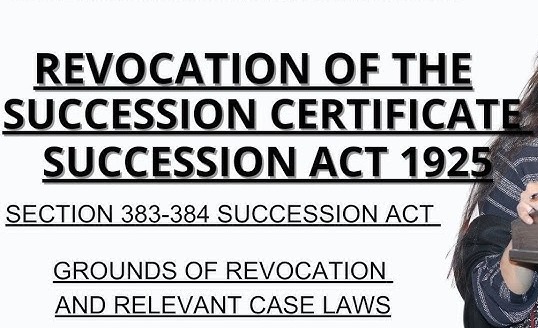
How to Prepare Arguments for Revocation of Succession Certificates: Supreme Court’s Guiding Hand
Fraud, Suppression, and Procedural Defects
Appeals, Minors’ Rights, and Judicial Safeguards
By Vishwas Kumar
New Delhi: April 22, 2026:
The Supreme Court of India has clarified that succession certificates can be revoked for fraud, suppression of facts, or defective proceedings, and appeals lie to the High Court under Section 384 of the Indian Succession Act, 1925. Authoritative rulings such as Deepesh Maheswari v. Renu Maheswari (2026) and Banarsi Dass v. Teeku Dutta (2005) provide strong precedents for both challenging and defending certificates.
In disputes concerning wills and succession, courts often scrutinize the genuineness of documents, surrounding circumstances, and the credibility of evidence before determining rights of heirs. A significant ruling in this area is the 👉 Vrindavanibai Sambhaji Mane vs Ramachandra Vithal Ganeshkar & Others judgment, which offers valuable insight into how Indian courts assess validity of wills and resolve inheritance disputes.
Analytical Report
1. Deepesh Maheswari v. Renu Maheswari (2026 INSC 306)
- Facts: A succession certificate was granted ex parte, excluding a minor heir. The mother and child challenged it under Order IX Rule 13 CPC.
- Supreme Court’s Holding: The Court quashed the certificate, stressing that minors cannot be expected to implead themselves and must be represented by guardians. Suppression of heirs and misstatements violated Section 372 disclosure requirements.
- Relevance: This case is a powerful precedent for revocation under Section 383—especially where minors or omitted heirs are involved. It underscores that certificates obtained through defective proceedings or concealment are void.
2. Banarsi Dass v. Teeku Dutta (2005) 4 SCC 449
- Facts: Dispute arose over whether a succession certificate conferred ownership rights.
- Supreme Court’s Holding: The Court clarified that a succession certificate only authorizes collection of debts and securities; it does not establish title.
- Relevance: Useful in defending against claims that a certificate equals ownership. It supports arguments that title disputes must be resolved separately through probate or civil suits.
3. Suppression of Material Facts Case (2026, SC)
- Facts: Probate was obtained by concealing property sales and excluding interested parties.
- Supreme Court’s Holding: The Court ruled that suppression of material facts and non-joinder of parties constitutes “just cause” for revocation under Section 263 of the Succession Act.
- Relevance: Though a probate case, the principle applies equally to succession certificates under Section 383—concealment or fraud justifies revocation.
4. Appeals in Succession Certificate Cases (Section 384)
- Legal Basis: Appeals lie to the High Court against grant, refusal, or revocation.
- Case Law Guidance: Courts emphasize timely filing within CPC limitation periods and that appellate courts can supersede existing certificates.
- Relevance: Critical for litigants seeking to overturn District Judge orders.
5. Other Supporting Principles
- Joint Certificates: Courts have upheld issuance to multiple heirs, preventing monopolization.
- Validation of Payments (Section 386): Protects debtors who pay certificate holders in good faith, even if the certificate is later revoked.
- Finality (Section 387): Decisions under the Act do not bar subsequent suits on ownership, keeping substantive rights intact.
Practical Usage in Drafts or Arguments
- To Challenge a Certificate: Cite Deepesh Maheswari and the suppression case (2026) to argue revocation for concealment or omission of heirs.
- To Defend a Certificate: Use Banarsi Dass to show certificate validity for debt collection, and Section 386 to protect payments made in good faith.
- For Appeals: Section 384 provides appellate recourse; highlight procedural defects or fraud as grounds.
[RESEARCH RESOURCES]
BUY & READ THE BOOK, WILL WRITING SIMPLIFIED, By Dr Ravinder Kumar Anand. [📘 Buy Will Writing Simplified online: Amazon | Flipkart ]
FAQs
Q1. On what grounds can a succession certificate be revoked?
Fraud, suppression of facts, defective proceedings, false allegations, or if it becomes useless. (Section 383)
Q2. Does a succession certificate prove ownership?
No. It only authorizes collection of debts/securities. Ownership must be established separately. (Banarsi Dass v. Teeku Dutta)
Q3. What if minors are excluded from the application?
The certificate can be revoked. Minors must be represented by guardians. (Deepesh Maheswari v. Renu Maheswari)
Q4. Can payments made to a revoked certificate holder be challenged?
No. Payments made in good faith remain valid. (Section 386)
Q5. Who hears appeals against succession certificate orders?
The High Court hears appeals against District Judge orders under Section 384.
Conclusion
Supreme Court precedents firmly establish that succession certificates are limited instruments—they protect debtors and authorize heirs to collect debts but do not confer ownership. Revocation is justified where fraud, suppression, or procedural defects exist, while appeals provide a safeguard against unjust orders. For courtroom strategy, these rulings offer strong grounds both to challenge certificates and to defend them against undue revocation.