
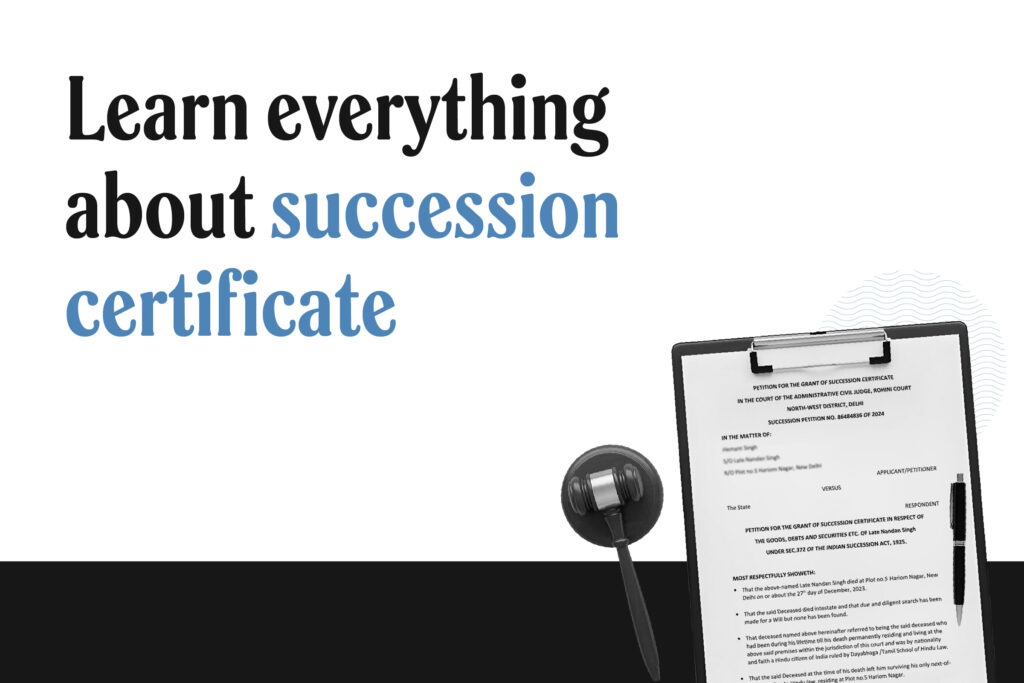
Succession Certificates: Navigating Legal Pathways in India
Jurisdiction and Restrictions Explained
Understanding Securities and Court Authority
By Vishwas Kumar
New Delhi: April 22, 2026:
Succession certificates are a crucial legal instrument under Indian law, designed to streamline the transfer of debts and securities of a deceased person to rightful heirs. The provisions in Sections 370 and 371 of the Indian Succession Act, 1925 lay down the framework for their issuance, restrictions, and jurisdiction.
If you’re researching property disputes and inheritance rights, this detailed case explains key principles of ownership and succession. You can read the full judgment here: 👉 Nagulapati Lakshmamma vs Mupparaju Subbaiah judgment which highlights important legal interpretations.
Analytical Overview
1. Restriction on Grant of Certificates (Section 370)
- Core Principle: A succession certificate cannot be granted for debts or securities where rights must be established through probate or letters of administration under Sections 212 or 213.
- Exception: Indian Christians can still obtain certificates for debts or securities, even if rights could be established through letters of administration.
- Definition of “Security”: The law provides a detailed classification:
- Promissory notes, debentures, stocks of Central/State Governments.
-
- Shares or debentures of companies or incorporated institutions.
- Securities issued by local authorities.
- Any other instrument notified by the State Government.
This ensures clarity on what financial instruments fall under the ambit of succession certificates, preventing ambiguity in inheritance disputes.
2. Jurisdiction to Grant Certificates (Section 371)
- Authority: The District Judge is empowered to grant certificates.
- Criteria:
- If the deceased had a fixed residence, jurisdiction lies with the District Judge of that area.
- If no fixed residence, jurisdiction lies where any part of the deceased’s property is located.
This provision ensures accessibility and prevents forum shopping, thereby maintaining judicial efficiency.
[RESEARCH RESOURCES]
EXTRACTS FROM BOOK, WILL WRITING SIMPLIFIED, By Dr Ravinder Kumar Anand. [📘 Buy Will Writing Simplified online: Amazon | Flipkart ]
SUCCESSION CERTIFICATES
370. Restriction on grant of certificates under this part.—
[1](1) A succession certificate (hereinafter in this Part referred to as a certificate) shall not be granted under this Part with respect to any debt or security to which a right is required by section 212 or section 213 to be established by letters of administration or probate:
Provided that nothing contained in this section shall be deemed to prevent the grant of a certificate to any person claiming to be entitled to the effects of a deceased Indian Christian, or to any part thereof, with respect to any debt or security, by reason that a right thereto can be established by letters of administration under this Act.
(2) For the purposes of this Part, “security” means—
(a) any promissory note, debenture, stock or other security of the Central Government or of a State Government;
[2](b) any bond, debenture, or annuity charged by Act of Parliament [3][of the United Kingdom] on the revenues of India;
(c) any stock or debenture of, or share in, a company or other incorporated institution;
(d) any debenture or other security for money issued by, or on behalf of, a local authority;
(e) any other security which the [4][State Government] may, by notification in the Official Gazette, declare to be a security for the purposes of this Part.
371. Court having jurisdiction to grant certificate.—The District Judge within whose jurisdiction the deceased ordinarily resided at the time of his death, or, if at that time he had no fixed place of residence, the District Judge, within whose jurisdiction any part of the property of the deceased may be found, may grant a certificate under this Part.
Detailed FAQ for Quick Understanding
Q1. What is a succession certificate?
A succession certificate is a legal document issued by a District Court that authorizes the rightful heir to collect debts and securities of a deceased person.
Q2. Can it be issued for all assets of the deceased?
No. It applies only to debts and securities. Immovable property like land or houses requires probate or letters of administration.
Q3. Who can apply for a succession certificate?
Any legal heir of the deceased, such as spouse, children, or parents, can apply. The applicant must prove their relationship and entitlement.
Q4. What is the role of public notice?
The court issues a notice to invite objections from other potential heirs or claimants. This ensures transparency and prevents fraudulent claims.
Q5. Is it mandatory to obtain a succession certificate?
Yes, for debts and securities like bank deposits, shares, or bonds. Without it, financial institutions may refuse to release funds.
Q6. Which court has jurisdiction?
The District Judge of the area where the deceased resided at death, or where any property is located if no fixed residence existed.
Q7. How does it differ from probate?
Probate validates a will, while a succession certificate deals with debts and securities when no will exist or probate is not required.
Q8. What is the legal effect of the certificate?
It provides indemnity to debtors who release funds to the certificate holder, protecting them from future claims.
Conclusion
Succession certificates under Sections 370 and 371 of the Indian Succession Act serve as a vital mechanism for heirs to access financial assets of the deceased. By clearly defining securities, restricting overlapping claims, and establishing jurisdiction, the law ensures orderly succession and protects both heirs and debtors.
[1] Subs. by Act 37 of 2025. (iii) in section 370,–– (a) in sub-section (1), for the words and figures “or section 213 to be established by letters of administration or probate”, the words “to be established by letters of administration” shall be substituted.