

COURTKUTCHEHRY SPECIAL SERIES ON LANDMARKS JUDGEMENTS ON WILLS, CODICIL & PROBATE
Sridevi and Others v. Jayaraja Shetty and Others: Supreme Court Affirms Validity of Padmayya Kambali’s Will
Suspicious Circumstances Allegation Rejected by Apex Court
Consistent Testimony and Expert Evidence Proved Will’s Authenticity
By Vishwas Kumar
New Delhi: March 25, 2026:
In Sridevi and Others v. Jayaraja Shetty and Others (Civil Appeal No. 3749 of 1999, decided on 28 January 2005), the Supreme Court of India addressed a contentious probate dispute concerning the Will of Padmayya Kambali. The appellants challenged the Will, alleging lack of testamentary capacity, active involvement of a beneficiary son, and suppression of the document for nearly four years before registration.
browse Supreme Court decisions on will disputes of Sridevi Case
The trial court had upheld the Will, finding it genuine and duly executed. However, the appellants pressed their case before the Supreme Court, arguing that the circumstances surrounding the Will were suspicious and undermined its validity.
The Division Bench, comprising Hon’ble Mr. Justice Ashok Bhan and Hon’ble Mr. Justice A.K. Mathur, dismissed these contentions. The Court relied on the consistent testimony of the scribe, attesting witnesses, and the handwriting expert, all of whom confirmed the authenticity of the Will. Importantly, the Court accepted the explanation for the delay in registration, holding that it did not cast doubt on the document’s genuineness.
The Supreme Court concluded that the Will was natural, validly executed, and not vitiated by any suspicious circumstance. The appeal was dismissed, thereby affirming the lower court’s findings in favour of the Will’s beneficiaries.
This ruling reinforces the principle that once a Will is proved through credible evidence and proper attestation, mere allegations of suspicion or delay cannot invalidate it. It underscores the judiciary’s emphasis on respecting testamentary intent when supported by reliable testimony and expert corroboration.
For More, Read Here the Summary of the Judgement from the Book: WILL WRITING SIMPLIFIED, read below or open page no 436, Chapter 14.1 in the book. (Online book purchase link available here on: Buy online: Amazon | Flipkart
|
|
Case Summary |
: |
Sridevi and Others v. Jayaraja Shetty and Others. |
|
|
Court |
: |
Supreme Court of India |
|
|
Citations |
: |
(2005) 01 SC CK 0034: Civil Appeal No. 3749 of 1999. |
|
|
Link |
: |
https://www.courtkutchehry.com/judgements/657565/sridevi-and-others-vs-jayaraja-shetty-and-others/
|
|
|
Decided on |
: |
28 January 2005 |
|
|
Coram |
: |
Hon’ble Mr. Justice Ashok Bhan and Hon’ble Mr. Justice A.K. Mathur. (Division Bench) |
|
|
Relevant Paragraphs |
: |
Para Nos. 2–19 |
1. Facts of the Case:
Padmayya Kambali owned extensive ancestral and self-acquired properties. He had four sons and three daughters. The appellants—two daughters and one granddaughter—filed a suit for partition claiming 1/7th share each. Respondents (his sons and their heirs) set up a registered Will dated 28.03.1976 (Exh. D-1) bequeathing certain properties in favour of two sons, Dharmaraja Kadamba and Raviraja Kadamba, and granting to the daughters only a right to receive compensation for tenanted lands that had vested in the State under the Karnataka Land Reforms (Amendment) Act, 1973. The Trial Court upheld the Will as genuine and excluded properties “A” & “B” from partition. The High Court affirmed. Hence the appeal.
2. Law Points Involved:
(i). Proof and validity of a Will under Section 63 of the Indian Succession Act, 1925.
(ii). Burden of proof on the propounder to establish due execution and dispel suspicious circumstances.
(iii). Judicial test for “suspicious circumstances” and “sound disposing mind” of the testator.
(iv). Effect of delay in registration and alleged suppression of Will.
3. Acts / Provisions / Articles Referred:
(i). Indian Succession Act, 1925 – Section 63
(ii). Evidence Act, 1872 – Sections 68–71 (implied principles on attestation and proof)
(iii). Karnataka Land Reforms (Amendment) Act, 1973 – Act 1 of 1974 (as contextual background)
4. Judgments Referred:
(i). H. Venkatachala Iyengar v. B.N. Thimmajamma (1958) 11 SC CK 0008;
(ii). Ramchandra Rambux v. Champabai, (1964) 02 SC CK 0018.
(iii). Surendra Pal v. Dr. Saraswati Arora, (1974) 08 SC CK 0018.
(iv). Smt. Jaswant Kaur v. Smt. Amrit Kaur, (1976) 10 SC CK 0028.
https://www.courtkutchehry.com/judgements/649331/smt-jaswant-kaur-vs-smt-amrit-kaur-and-others/]
(v). Meenakshiammal (Dead) through LRs & Others v. Chandrasekaran & Another., (2004) 11 SC CK 0050.
5. Obiter Dicta:
The Court reiterated that mere old age or proximity of death does not make a Will suspicious, and that mere presence of a beneficiary at the time of
execution, without active participation, is insufficient to infer undue influence or coercion. Delay in registration or disclosure of a Will, when explained, is not fatal to its genuineness.
6. Ratio Decidendi:
The Will was duly executed in accordance with Section 63 of the Succession Act. The propounders discharged their burden by examining the scribe and two attesting witnesses, corroborated by handwriting expert evidence proving the testator’s signatures on all six pages. The testator was in a sound and disposing state of mind. Alleged suspicious circumstances testator’s age (80 years), death within 15 days, presence of one son during execution, and delay in registration were satisfactorily explained and not sufficient to discredit the Will. The Will reflected a rational and equitable distribution justified by earlier partition and land vesting circumstances.
7. Final Ruling:
The Supreme Court dismissed the appeal, holding the Will genuine, valid, and duly executed. No order as to costs.
8. Gist Highlighting Dispute with Final Decision:
The dispute centred on whether the Will executed by Padmayya Kambali was genuine or surrounded by suspicious circumstances. The appellants contended lack of testamentary capacity, active participation of a beneficiary son, and suppression of the Will for four years. The Court found the Will proved through consistent testimony of the scribe, attesting witnesses, and handwriting expert, and accepted the explanation for delay in registration. The appeal was dismissed, confirming that the Will was validly executed and not vitiated by any suspicious circumstance.
Read full Judgement Here:
Sridevi and Others v. Jayaraja Shetty and Others.
Supreme Court of India
(2005) 01 SC CK 0034: Civil Appeal No. 3749 of 1999.
https://www.courtkutchehry.com/judgements/657565/sridevi-and-others-vs-jayaraja-shetty-and-others/
You Can Also Purchase the Book from here on: Buy online: Amazon | Flipkart
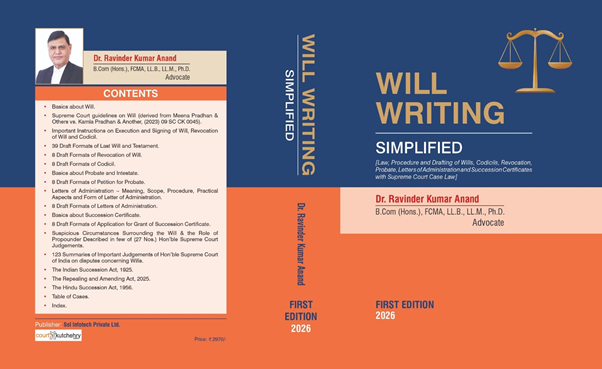
OUR RECOMMENDATION: Check out 123 Key Judgements, as highlighted in the book, WILL WRITING SIMPLIFIED, for the quick research and reference purposes. Click the link here: https://www.courtkutchehry.com/pages/blog/123-supreme-court-judgments-on-wills/
Keywords for SEO & Quick Search
- Sridevi v. Jayaraja Shetty case
- Supreme Court probate judgment 2005
- Padmayya Kambali Will dispute
- Suspicious circumstances in Will India
- Civil Appeal No. 3749 of 1999 judgment
- Justice Ashok Bhan and Justice A.K. Mathur decisions
- Validity of Will Supreme Court ruling