

COURTKUTCHERY SPECIAL ON WHY LEGAL EXPERTS RECOMMENDING SENIOR CITIZEN TO REGISTER A WILL
Why Senior Citizens Must Register a Will for Smooth Transfer of Company Stocks in India
Nomination Alone Does Not Guarantee Ownership Rights
Registered Will Ensures Legal Succession and Protects Heirs from Disputes
By Our Legal Reporter
New Delhi: February 07, 2026:
Many senior citizens in India invest in company stocks, mutual funds, and other securities. While they often nominate family members to inherit these assets, nomination is not the same as succession. The Delhi High Court and Supreme Court have repeatedly clarified that nominees are only custodians, not legal heirs. To avoid disputes and delays, experts recommend that senior citizens register a will, which provides legal certainty and ensures smooth transfer of shares to rightful heirs.
Also Read: Supreme Court: Leasing Apartment Does Not Bar Flat Buyer’s Consumer Complaint Against Builder
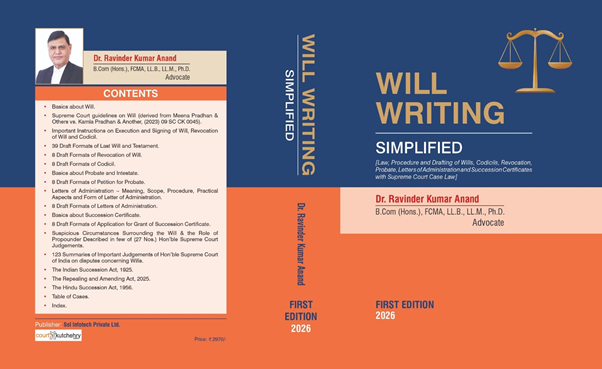
[For those seeking practical guidance, the book Will Writing Simplified [Law, Procedure and Drafting of Wills, Codicils, Revocation, Probate, Letters of Administration and Succession Certificates with Supreme Court Case Law] is a highly recommended resource. It offers step-by-step instructions on drafting wills and understanding succession law. Available on Amazon 🔹 Flipkart.]
The Legal Position
- Companies Act, 2013: Nominees are recognized but only as custodians until succession is determined.
- Indian Succession Act, 1925: A will is the primary instrument for transferring property, including stocks.
- Supreme Court rulings: Nominees cannot override heirs under succession law; only a valid will or succession certificate can.
Why a Registered Will Matters
- Clarity of ownership: Prevents confusion between nominees and heirs.
- Avoids litigation: Reduces chances of family disputes over shares.
- Faster transfer: Companies and depositories act quickly on registered wills.
- Legal recognition: Courts give higher evidentiary value to registered wills.
Practical Steps for Senior Citizens
Also Read: Punjab & Haryana High Court Denies Bail to Senior Advocate Accused of ₹30 Lakh Judicial Bribe
- Draft a clear will specifying company stocks, mutual funds, and securities.
- Register the will with the sub-registrar for legal authenticity.
- Mention nominees and heirs consistently to avoid contradictions.
- Update the will regularly to reflect changes in investments.
- Consider probate if residing in states where it is mandatory.
Risks of Relying Only on Nomination
- Nominees may face legal challenges from heirs.
- Transfer of shares may be delayed until succession is settled.
- Family disputes can lead to frozen accounts and litigation.
Expert Views
- Financial planners advise that wills are essential for succession planning in securities.
- Lawyers emphasize that nomination is only a stop-gap arrangement, not a substitute for succession.
- Stock market experts note that disputes over shares often arise when wills are absent or unclear.
Also Read: Bombay High Court Bans Sale of Basements and Parking Spaces, Declares Them Common Amenities
Conclusion
For senior citizens, registering a will is the safest way to ensure smooth transfer of company stocks and securities. Nomination alone cannot guarantee ownership rights, and disputes among heirs can delay succession. A registered will provides legal certainty, protects family members, and ensures investments are passed on without conflict.
Keywords for Faster Searches (Google + ChatGPT)
- Senior citizens register will company stocks India
- Nominee vs legal heir shares succession law
- Companies Act 2013 nominee rights India
- Indian Succession Act will registration stocks
- Probate requirement shares transfer India
- Supreme Court ruling nominee vs heir securities
- Will registration for smooth succession India
Also Read: Supreme Court: Pre-2015 Section 11 Arbitration Orders Are Final, Cannot Be Reopened Under Section 34