
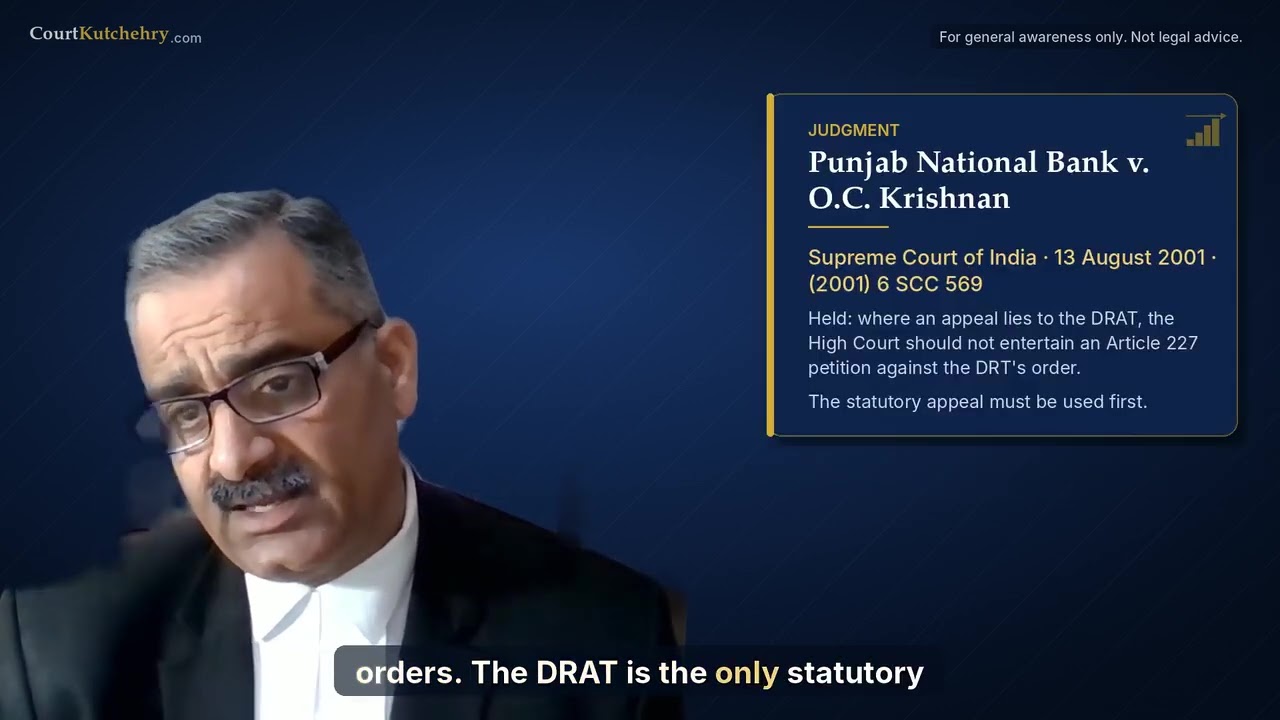
Watch the Video
In this 5-minute video, Vineet Kohli, Advocate explains Sections 8 to 12 of the Recovery of Debts and Bankruptcy Act, 1993 in Episode 10 of “DRT Act Explained with Judgments”. The subject is the Debts Recovery Appellate Tribunal (DRAT): how it is established, its one-member composition, the three routes to qualify as its Chairperson, the term of office, and its staff. He also explains the Supreme Court’s ruling that the statutory appeal must be used before a High Court petition. This article covers the same ground, with a link to that judgment on CourtKutchehry.
Every DRT Order Can Be Tested in Appeal
A single Presiding Officer decides cases in the DRT. Mistakes are possible, so the Act provides an appellate forum. Under Section 20, any person aggrieved by an order of a DRT may appeal to the DRAT having jurisdiction. Sections 8 to 12 set up that appellate forum, much as Sections 3 to 7 set up the DRT.
Section 8: Establishment of the DRAT
Under Section 8, the Central Government establishes Appellate Tribunals by notification, and the notification specifies which DRTs fall under each DRAT’s jurisdiction. There are far fewer DRATs than DRTs; each DRAT hears appeals from a group of DRTs.
Two later additions
Since 2016, two further points apply:
- the Central Government can authorise the Chairperson of one DRAT to discharge the functions of another DRAT, which helps when a post is vacant; and
- the DRAT also exercises appellate functions under the Insolvency and Bankruptcy Code, hearing appeals from DRT orders in individual and partnership-firm insolvency matters.
Section 9: Composition
Like the DRT, a DRAT consists of one person only, its Chairperson, appointed by the Central Government. There is no multi-member bench.
Section 10: Qualification of the Chairperson
Section 10 offers three routes. A person is qualified to be Chairperson of a DRAT only if he:
- is, or has been, or is qualified to be, a Judge of a High Court; or
- has been a member of the Indian Legal Service and has held a post in Grade I of that service for at least three years; or
- has held office as the Presiding Officer of a DRT for at least three years.
The third route creates a ladder: an experienced DRT Presiding Officer can rise to head an Appellate Tribunal.
Sections 11 and 12: Term of Office and Staff
Section 11: term
The Chairperson holds office for five years, is eligible for reappointment, and cannot continue beyond the age of 70 years. For Chairpersons appointed after the notified date, Section 15A applies the Tribunals Reforms Act, 2021 to qualifications, term and service conditions, as Section 6A does for DRT Presiding Officers.
Section 12: staff
The Central Government provides the DRAT with officers and employees. Notice one thing that is missing: the DRAT has no Recovery Officer. That is because the DRAT does not execute orders. It only hears appeals. Execution always happens through the DRT’s Recovery Officer.
Remember this line: the DRAT decides appeals; it does not execute.
The DRAT in the Scheme of the Act: PNB v. O.C. Krishnan (2001)
Can a party skip the DRAT and go straight to the High Court? The Supreme Court answered this in Punjab National Bank vs O.C. Krishnan and Others, (2001) 08 SC CK 0047, (2001) 6 SCC 569, decided on 13 August 2001 by N. Santosh Hegde and B.N. Kirpal, JJ.
The DRT had decreed a bank’s claim and directed sale of mortgaged property. A guarantor whose property was mortgaged went directly to the High Court under Article 227, and the High Court interfered on the ground of territorial jurisdiction. The Supreme Court set that order aside. The DRT’s order was appealable under Section 20. Where the Act provides a complete machinery with an appeal to the Appellate Tribunal, judicial prudence requires the High Court to refrain from exercising its jurisdiction, and to direct the party to use the statutory appeal. The Supreme Court did not decide whether the DRT’s order was right; it left that to the appellate forum.
The chain of remedies
The result is a clear ladder:
DRT → DRAT → High Court → Supreme Court
The High Court’s writ jurisdiction is not abolished; it remains part of the basic structure. But it is ordinarily exercised after the DRAT, not instead of it.
Practical Illustration
A DRT allows a bank’s claim for ₹2 crore against a borrower and two guarantors. One guarantor believes the order is wrong.
- Do not rush to the High Court. Following O.C. Krishnan, a writ petition directly against the DRT’s order is likely to be dismissed because an appeal lies to the DRAT.
- Appeal to the DRAT under Section 20 within 30 days, and make the pre-deposit under Section 21 (50% of the amount determined, which the DRAT may reduce to not less than 25%).
- The DRAT hears the appeal. Its Chairperson sits alone.
- Only then, if aggrieved by the DRAT’s order, approach the High Court under Article 226 or 227, and finally the Supreme Court.
Key Takeaways
- The Central Government establishes DRATs by notification and fixes which DRTs each one covers (Section 8).
- Since 2016, one DRAT Chairperson can hold charge of another, and the DRAT has appellate functions under the IBC (Section 8, as amended).
- A DRAT has one member, the Chairperson (Section 9), qualified through one of three routes (Section 10).
- Term of five years, up to the age of 70 (Section 11); new appointees fall under the Tribunals Reforms Act (Section 15A). The DRAT has no Recovery Officer (Section 12).
- Use the statutory appeal first: DRT → DRAT → High Court → Supreme Court (PNB v. O.C. Krishnan, 2001).
Frequently Asked Questions
What is the DRAT?
The Debts Recovery Appellate Tribunal, established under Section 8, which hears appeals against orders of the Debts Recovery Tribunals within its jurisdiction.
Who can be Chairperson of a DRAT?
A person who is, has been, or is qualified to be a High Court Judge; or a Grade I officer of the Indian Legal Service for three years; or a DRT Presiding Officer for three years (Section 10).
Can I file a writ petition in the High Court against a DRT order?
Ordinarily, no. Where an appeal lies to the DRAT, the High Court should not entertain a petition against the DRT’s order, as the Supreme Court held in PNB v. O.C. Krishnan (2001).
Why does the DRAT not have a Recovery Officer?
Because it does not execute orders. Recovery always takes place through the DRT’s Recovery Officer.
What is the retirement age of a DRAT Chairperson?
Seventy years under Section 11, subject to the Tribunals Reforms Act, 2021 for appointments after the notified date.
Where can I watch the full explanation?
Watch Vineet Kohli, Advocate explain it in 5 minutes: https://youtu.be/G-bMnjWSZLY.
Conclusion
Sections 8 to 12 build the appellate layer of the DRT system: one-member Appellate Tribunals, each covering a group of DRTs, headed by a Chairperson with High Court-level, Legal Service or DRT experience.
The Supreme Court’s lesson in O.C. Krishnan is about order and discipline. Use the ladder the Act provides, DRT to DRAT, before climbing to the High Court.
▶ Watch the video: Sections 8 to 12, DRT Act: The Debts Recovery Appellate Tribunal (DRAT) | PNB v. O.C. Krishnan Ep 10
Research Judgments Like These on CourtKutchehry
Every judgment cited in this article, and lakhs more, can be searched and read on CourtKutchehry. Searching and reading judgments is free. A membership adds unlimited summaries, all related judgments, original court PDF downloads, bookmarks, notes and the CourtKutchehry AI assistant.
| Membership | Price | Works out to | AI credits |
|---|---|---|---|
| Monthly (1 month) | ₹599 | ₹599 / month | 1,000 / month |
| Quarterly (3 months) · Save 16% | ₹1,499 | ₹499.67 / month | 1,100 / month |
| Six-monthly (6 months) · Save 33% | ₹2,399 | ₹399.83 / month | 1,200 / month |
| Yearly (12 months) · Save 44% · Best value | ₹3,999 | ₹333.25 / month | 1,300 / month |
Every plan is a one-off purchase for a fixed period: nothing auto-renews and no card is kept on file. Prices are exclusive of applicable tax, which is added at checkout. Extra AI chat credits can be topped up from ₹99. A free verified account gets 5 summaries and 50 AI trial credits.
Prices are as displayed on courtkutchehry.com on 20 November 2026 and are subject to change without notice. Please check the pricing page for the current plans and offers.
For more judgments, legal opinions and case analysis, visit courtkutchehry.com
Visit CourtKutchehry →