
Watch the Video
In this 5-minute video, Vineet Kohli, Advocate opens Chapter II of the Recovery of Debts and Bankruptcy Act, 1993 in Episode 8 of “DRT Act Explained with Judgments”. He explains Sections 3, 4 and 5: how a Debts Recovery Tribunal is established, its role under the Insolvency and Bankruptcy Code, its one-member composition, additional charge when the post falls vacant, and who can be its Presiding Officer. This article covers each section, and why the Supreme Court upheld this structure.
Chapter II Begins
Chapter I of the Act gave us the title, extent, commencement and definitions. Chapter II builds the forum itself. It answers three practical questions that every litigant before a DRT will sooner or later ask: who created this Tribunal, how many members sit on it, and what qualifications must the person deciding my case have?
Section 3: Establishment of the Tribunal
Under Section 3, the Central Government establishes DRTs by notification. The same notification specifies the area within which each Tribunal exercises jurisdiction.
A DRT’s area is not tied to one district. A single Tribunal may cover several districts, and some DRTs cover more than one State. So before filing, always check the notification to see which DRT has territorial jurisdiction over the case.
Section 3(1A): The DRT Under the Insolvency and Bankruptcy Code
When the Insolvency and Bankruptcy Code, 2016 was enacted, it gave the DRT a second role. Under Section 3(1A), the Central Government may establish DRTs to exercise jurisdiction under Part III of the IBC. In other words, the DRT is the Adjudicating Authority for the insolvency and bankruptcy of individuals and partnership firms, while the NCLT deals with companies (and, under Section 60 of the Code, with personal guarantors of corporate debtors).
So today a DRT wears two hats: a recovery tribunal under the DRT Act, and an insolvency forum for individuals under the IBC.
Section 4: Composition and Additional Charge
One member
Under Section 4(1), a DRT consists of one person only, the Presiding Officer, appointed by the Central Government. There is no bench of two or three; a single Presiding Officer hears and decides every case.
Additional charge
This creates an obvious risk. If the Presiding Officer retires, resigns or is transferred and the post is vacant, the Tribunal stops. Section 4(2), as substituted in 2016, addresses this. The Central Government may authorise the Presiding Officer of another DRT, or a judicial member of another tribunal, to discharge the functions of the vacant DRT in addition to his own.
Remember this line: one Tribunal, one Presiding Officer; when the post is vacant, additional charge keeps it working.
In practice, vacancies remain a real concern, and courts have sometimes had to step in to protect borrowers who had no forum to approach. CourtKutchehry has reported one such Madhya Pradesh High Court decision (see the “Read more” link below).
Section 5: Qualification of the Presiding Officer
Section 5 lays down a single qualification: a person shall not be qualified for appointment as Presiding Officer unless he is, or has been, or is qualified to be, a District Judge.
This is deliberate. The DRT replaces the civil court for bank recovery cases, so the person presiding over it must have judicial qualifications equivalent to a District Judge. For appointments after the Tribunals Reforms Act, 2021 came into force, qualifications and service conditions are also governed by that Act, as the next episode explains.
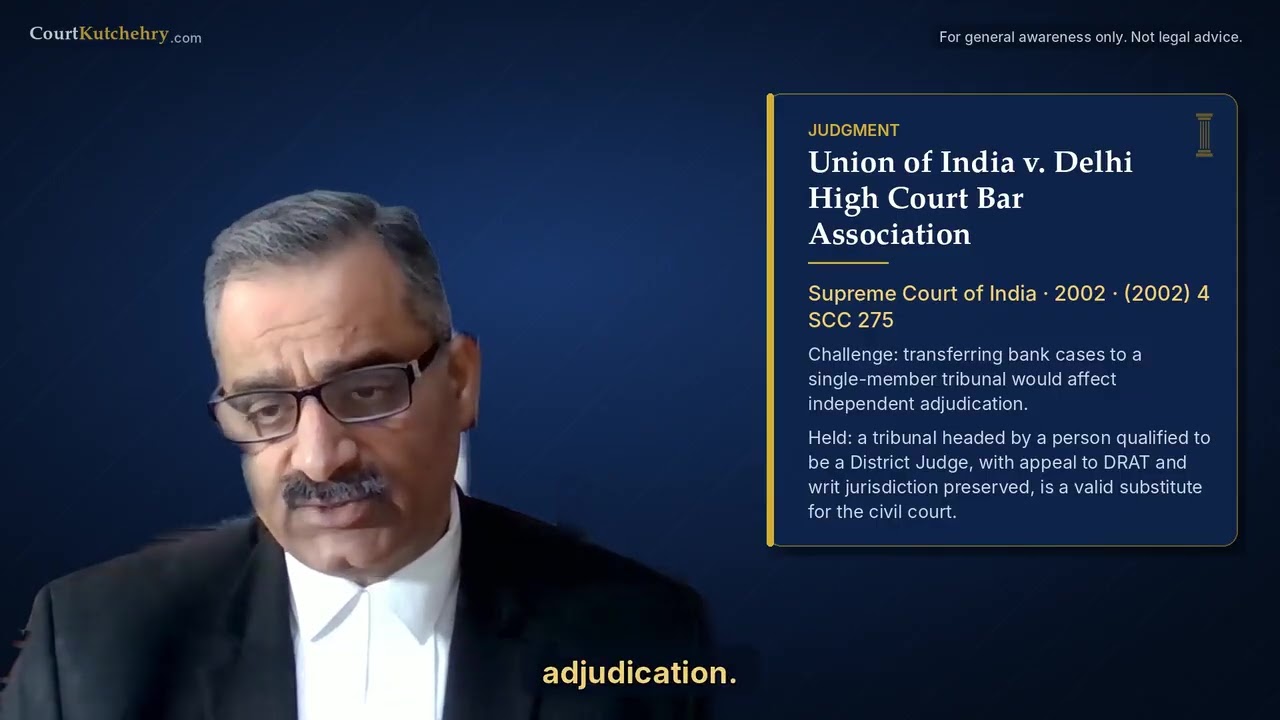
Why the Structure Matters: Union of India v. Delhi High Court Bar Association (2002)
When the Act was challenged, one argument was that a tribunal of officers appointed by the Government could not replace the civil courts without damaging the independence of the judiciary. The Delhi High Court had accepted that argument in 1995.
The Supreme Court disagreed in Union of India and Another vs Delhi High Court Bar Association and Others, (2002) 03 SC CK 0097, (2002) 4 SCC 275, decided on 14 March 2002. It held that Parliament could set up the DRT under Entry 45 of List I (Banking), that a tribunal can function independently, and that the requirement of prescribed qualifications for the Presiding Officer, together with the High Court’s continuing jurisdiction under Articles 226 and 227, answered the concern. The DRT was upheld as a valid substitute for the civil court in bank recovery matters.
Practical Illustration
A bank in a district town wants to file an original application against a borrower for ₹1.2 crore.
- Which DRT? The bank checks the Section 3 notification. Its district falls within the area of a DRT located in another city, perhaps even in a neighbouring State. That is where it must file.
- Who decides? A single Presiding Officer, qualified to be a District Judge, hears the case.
- What if the post is vacant? If the Presiding Officer has retired and no successor has been appointed, the bank and the borrower should check whether another Presiding Officer has been given additional charge under Section 4(2), and list urgent matters before that officer.
- What if the borrower is an individual facing insolvency? The same DRT may also be the Adjudicating Authority for the borrower’s personal insolvency under Part III of the IBC.
Key Takeaways
- DRTs are established by Central Government notification, which also fixes each Tribunal’s area (Section 3).
- A DRT is the Adjudicating Authority for individuals and partnership firms under Part III of the IBC (Section 3(1A)).
- A DRT has one member, the Presiding Officer (Section 4(1)).
- When the post is vacant, additional charge can be given to another Presiding Officer or a judicial member of another tribunal (Section 4(2)).
- The Presiding Officer must be, have been, or be qualified to be, a District Judge (Section 5); the Supreme Court upheld this structure in 2002.
Frequently Asked Questions
Who establishes the Debts Recovery Tribunal?
The Central Government, by notification under Section 3. The notification also specifies the area of each Tribunal.
How many members does a DRT have?
One. Under Section 4(1), a DRT consists of a single Presiding Officer.
What happens when the DRT Presiding Officer’s post is vacant?
Under Section 4(2), the Central Government can authorise another DRT Presiding Officer, or a judicial member of another tribunal, to hold additional charge.
Who can be appointed Presiding Officer of a DRT?
A person who is, or has been, or is qualified to be, a District Judge (Section 5).
Does the DRT deal with insolvency?
Yes. Under Section 3(1A), the DRT is the Adjudicating Authority for the insolvency of individuals and partnership firms under Part III of the IBC.
Where can I watch the full explanation?
Watch Vineet Kohli, Advocate explain it in 5 minutes: https://youtu.be/XYOTEmuxpcQ.
Conclusion
Sections 3 to 5 build the DRT: a Tribunal created by the Central Government for a notified area, presided over by one officer with the qualifications of a District Judge, and kept running through additional charge when the post falls vacant.
The Supreme Court accepted this design in 2002 as a valid substitute for the civil court. And since 2016, the same Tribunal also serves as the insolvency forum for individuals and partnership firms.
▶ Watch the video: Sections 3 to 5, DRT Act: How the DRT Is Set Up & Who Can Be Presiding Officer | Ep 8
Research Judgments Like These on CourtKutchehry
Every judgment cited in this article, and lakhs more, can be searched and read on CourtKutchehry. Searching and reading judgments is free. A membership adds unlimited summaries, all related judgments, original court PDF downloads, bookmarks, notes and the CourtKutchehry AI assistant.
| Membership | Price | Works out to | AI credits |
|---|---|---|---|
| Monthly (1 month) | ₹599 | ₹599 / month | 1,000 / month |
| Quarterly (3 months) · Save 16% | ₹1,499 | ₹499.67 / month | 1,100 / month |
| Six-monthly (6 months) · Save 33% | ₹2,399 | ₹399.83 / month | 1,200 / month |
| Yearly (12 months) · Save 44% · Best value | ₹3,999 | ₹333.25 / month | 1,300 / month |
Every plan is a one-off purchase for a fixed period: nothing auto-renews and no card is kept on file. Prices are exclusive of applicable tax, which is added at checkout. Extra AI chat credits can be topped up from ₹99. A free verified account gets 5 summaries and 50 AI trial credits.
Prices are as displayed on courtkutchehry.com on 20 November 2026 and are subject to change without notice. Please check the pricing page for the current plans and offers.
For more judgments, legal opinions and case analysis, visit courtkutchehry.com
Visit CourtKutchehry →