
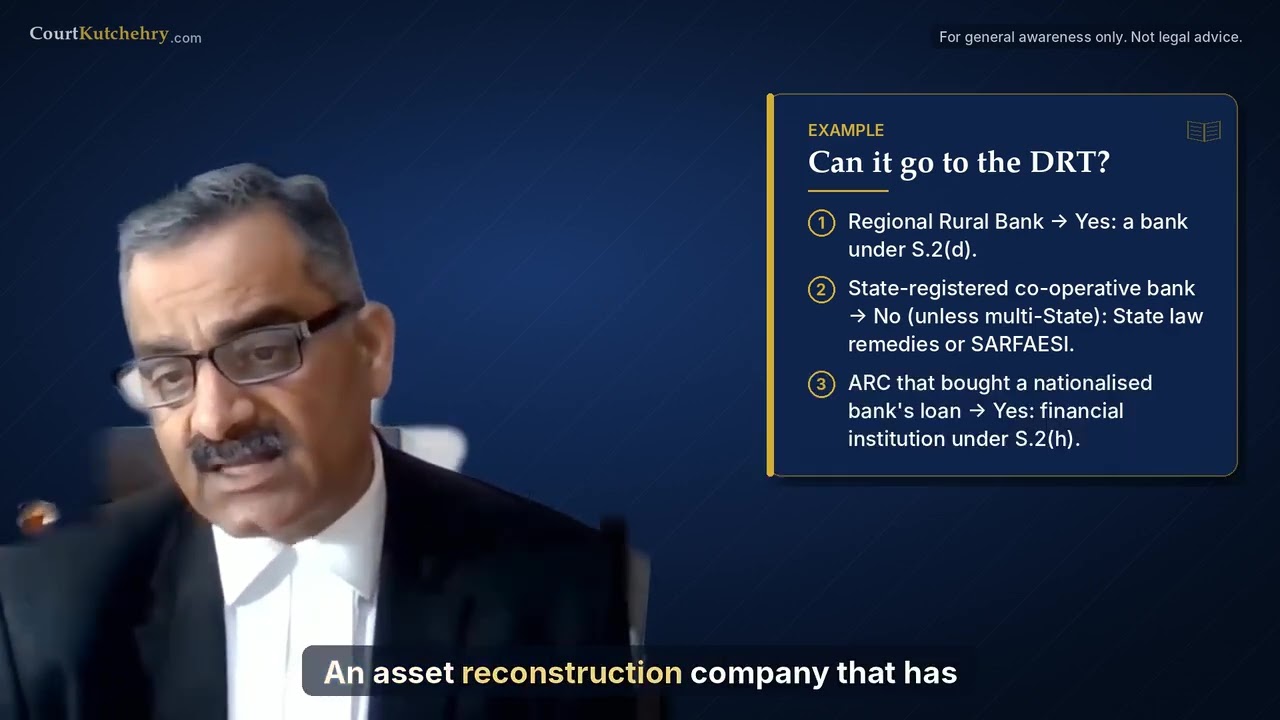
Watch the Video
In this 6-minute video, Vineet Kohli, Advocate begins Section 2 of the Recovery of Debts and Bankruptcy Act, 1993, the dictionary of the Act, in Episode 5 of “DRT Act Explained with Judgments”. He explains who counts as a “bank” and a “financial institution”, why that decides who can use the Debts Recovery Tribunal, and the Supreme Court’s ruling on assignment of debts between banks. This article covers the same definitions with the worked examples from the episode.
Why Definitions Decide Who Can Use the DRT
The DRT is not open to every creditor. Only a bank, a financial institution, or a consortium of them can file an original application to recover a debt. A private lender, a supplier with unpaid bills, or an ordinary finance company cannot use the Tribunal unless it falls within the definitions. So before asking whether a claim is a “debt”, the first question is: is the applicant a bank or a financial institution under Section 2?
The Basic Definitions
The video starts with four everyday terms that appear throughout the Act:
- Appellate Tribunal means the Debts Recovery Appellate Tribunal (DRAT) established under Section 8.
- Application means an application made to a Tribunal, chiefly the original application by a bank or financial institution under Section 19.
- Recovery Officer means the officer appointed to execute the Tribunal’s recovery certificates.
- Tribunal means the Debts Recovery Tribunal (DRT) established under Section 3.
Section 2(d): Who Is a “Bank”?
Under Section 2(d), a “bank” includes:
- a banking company (a company carrying on banking business under the Banking Regulation Act, 1949);
- a corresponding new bank, that is, the nationalised banks;
- the State Bank of India;
- a subsidiary bank;
- a Regional Rural Bank; and
- since 2013, a multi-State co-operative bank.
The important exclusion is that co-operative banks registered under State co-operative societies laws are not “banks” under the DRT Act. Such banks usually recover their dues through the remedies available under the State co-operative law.
Section 2(h): Who Is a “Financial Institution”?
Under Section 2(h), a “financial institution” covers:
- a public financial institution within the meaning of the Companies Act;
- a securitisation company or asset reconstruction company registered under the SARFAESI Act;
- a debenture trustee registered with SEBI, for secured debt securities; and
- any other institution that the Central Government notifies.
The practical message is that a non-banking finance company (NBFC) that has not been notified cannot use the DRT. Being regulated by the Reserve Bank is not enough. An NBFC must look to a civil suit, arbitration or, where it qualifies, the SARFAESI Act.
Remember this line: no bank or notified financial institution, no DRT.
Assignment of Debts: ICICI Bank v. Official Liquidator of APS Star Industries (2010)
What if a bank sells its loan to another bank? Can the buyer bank recover the debt? This question reached the Supreme Court in ICICI Bank Limited vs Official Liquidator of APS Star Industries Ltd. and Others, (2010) 09 SC CK 0043, (2010) 10 SCC 1, decided on 30 September 2010 by a Bench of S.H. Kapadia, C.J. and Swatanter Kumar, J.
The Gujarat High Court had taken the view that banks could not deal in debts in this way. The Supreme Court disagreed. It held that assignment of debts between banks is not prohibited by the Banking Regulation Act, 1949. The forms of business allowed to banks under Section 6(1) of that Act are wide, and the Reserve Bank’s guidelines of 2005 on sale and purchase of non-performing assets, issued under its statutory powers, permit such transactions. The assignor bank transfers its own asset, the debt, and the assignee steps into its shoes. The Court set aside the High Court’s view on this point and sent the remaining issues back to the High Court.
For the DRT, this matters directly: the definition of “debt” covers a debt that has been assigned, and an assignee bank can recover it.
Other Definitions: Property and Security Interest
Two more definitions become important at the recovery stage:
- Property (Section 2(jb)) is defined widely, to include immovable and movable property, debts and receivables, and intangible assets.
- Security interest (Section 2(lb)) means a right, title or interest created in favour of a secured creditor over property, such as a mortgage, charge, hypothecation or assignment.
Because these definitions are wide, the Recovery Officer has a broad range of assets to attach when executing a recovery certificate.
Practical Illustration: Who Can Go to the DRT?
- A nationalised bank with a ₹50 lakh claim: a “bank”. It can go to the DRT.
- A State co-operative bank registered under a State law with a ₹40 lakh claim: not a “bank” under the Act. It cannot use the DRT.
- A multi-State co-operative bank: a “bank” since 2013. It can go to the DRT.
- An asset reconstruction company that bought a loan from a bank: a “financial institution”. It can go to the DRT.
- A private NBFC not notified by the Central Government: it cannot use the DRT.
Key Takeaways
- Only a bank, a financial institution or a consortium can file an original application in the DRT.
- Section 2(d) includes banking companies, nationalised banks, SBI, subsidiary banks, RRBs and, since 2013, multi-State co-operative banks. State co-operative banks are not covered.
- Section 2(h) includes public financial institutions, asset reconstruction companies, SEBI-registered debenture trustees and notified institutions.
- A non-notified NBFC cannot use the DRT.
- Assignment of debts between banks is lawful, and the assignee can recover the debt (ICICI Bank v. APS Star Industries, 2010).
Frequently Asked Questions
Can a co-operative bank file a case in the DRT?
Only a multi-State co-operative bank, which has been a “bank” under Section 2(d) since 2013. A co-operative bank registered under a State law is not covered.
Can an NBFC approach the DRT?
Only if it falls within Section 2(h), for example by being notified by the Central Government. An ordinary NBFC cannot.
Is an asset reconstruction company a financial institution under the DRT Act?
Yes. A securitisation or asset reconstruction company registered under the SARFAESI Act is a financial institution under Section 2(h).
Can a bank that bought a loan from another bank recover it?
Yes. In ICICI Bank v. Official Liquidator of APS Star Industries (2010), the Supreme Court held that assignment of debts between banks is permissible under the Banking Regulation Act.
Why are the definitions of property and security interest important?
Because they are wide, and they decide what the Recovery Officer can attach and sell to recover the debt.
Where can I watch the full explanation?
Watch Vineet Kohli, Advocate explain it in 6 minutes: https://youtu.be/Y8tqAuHcwpA.
Conclusion
The door to the DRT opens only for banks and financial institutions as defined in Section 2. Multi-State co-operative banks, asset reconstruction companies and SEBI-registered debenture trustees are inside; State co-operative banks and non-notified NBFCs are outside.
And when debts change hands between banks, the Supreme Court has confirmed that the assignee can recover them. The next episode takes up the most important definition of all: “debt”.
▶ Watch the video: Section 2, DRT Act: Who Is a “Bank” and a “Financial Institution”? | Definitions Part 1 | Ep 5
Research Judgments Like These on CourtKutchehry
Every judgment cited in this article, and lakhs more, can be searched and read on CourtKutchehry. Searching and reading judgments is free. A membership adds unlimited summaries, all related judgments, original court PDF downloads, bookmarks, notes and the CourtKutchehry AI assistant.
| Membership | Price | Works out to | AI credits |
|---|---|---|---|
| Monthly (1 month) | ₹599 | ₹599 / month | 1,000 / month |
| Quarterly (3 months) · Save 16% | ₹1,499 | ₹499.67 / month | 1,100 / month |
| Six-monthly (6 months) · Save 33% | ₹2,399 | ₹399.83 / month | 1,200 / month |
| Yearly (12 months) · Save 44% · Best value | ₹3,999 | ₹333.25 / month | 1,300 / month |
Every plan is a one-off purchase for a fixed period: nothing auto-renews and no card is kept on file. Prices are exclusive of applicable tax, which is added at checkout. Extra AI chat credits can be topped up from ₹99. A free verified account gets 5 summaries and 50 AI trial credits.
Prices are as displayed on courtkutchehry.com on 20 November 2026 and are subject to change without notice. Please check the pricing page for the current plans and offers.
For more judgments, legal opinions and case analysis, visit courtkutchehry.com
Visit CourtKutchehry →