
Watch the Video
In this 7-minute video, Episode 15 of “RERA Act Explained with Judgments” looks at how the Supreme Court has answered the builder’s favourite defence: the delay was not my fault. It covers four judgments, Newtech, Kolkata West International City, Arifur Rahman Khan and Experion, on refunds, delay compensation and the choice of forum under the Real Estate (Regulation and Development) Act, 2016. This article explains each case and what they mean together, with links to all four judgments on CourtKutchehry.
“The Delay Was Not My Fault”
When a buyer files under Section 18, the builder’s reply is usually predictable. There was a court stay. There was a pandemic. Approvals were held up. The contractor walked away. The agreement allowed only a small fixed amount for delay. The buyer took possession, so he cannot complain now.
The Supreme Court has dealt with each of these arguments. The four judgments below, read together, set the ground rules for refunds and delay compensation.
Newtech Promoters v. State of U.P. (2021)
In M/s Newtech Promoters and Developers Pvt. Ltd. v. State of U.P. & Ors., (2021) 11 SC CK 0015, decided on 11 November 2021, the Supreme Court heard a batch of appeals by promoters against refund orders passed under the RERA Act in Uttar Pradesh.
The two arguments
The promoters argued, first, that the buyers’ agreements were signed before RERA came into force, so the buyers should be bound by the agreed terms; and second, that they could not be held responsible for delays caused by events beyond their control.
What the Court held
- RERA applies to ongoing projects that had not received a completion certificate when the Act came into force. The Court described the Act as retroactive in character for such projects, and upheld it.
- The right of the allottee to seek a refund under Section 18(1)(a) and Section 19(4) is unqualified. The legislature consciously provided it as an “unconditional absolute right to the allottee” if the promoter fails to give possession within the time stipulated in the agreement, “regardless of unforeseen events or stay orders of the Court/Tribunal”.
- In that situation, the promoter must refund the amount with interest at the prescribed rate, if the allottee wishes to withdraw.
The reason is simple. The promoter fixed the timeline and promised it. The allottee should not have to carry the risk of delay.
Why Force Majeure Cannot Defeat a Refund
The Act does mention force majeure, but in a different place. Section 6 allows the Authority to extend the registration of a project in a case of force majeure. Section 18 contains no such exception.
That contrast is the heart of the argument. If Parliament had wanted force majeure to defeat refunds, it would have said so in Section 18, as it did in Section 6. Force majeure may justify more time on the register; it does not take away the buyer’s right to walk out with his money and interest.
Remember this line: Section 6 mentions force majeure; Section 18 does not.
Kolkata West International City v. Devasis Rudra (2019)
In Kolkata West International City Pvt. Ltd. v. Devasis Rudra, (2019) 03 SC CK 0101, decided on 25 March 2019 by Dr. D.Y. Chandrachud and Hemant Gupta, JJ., a buyer had booked a row house in 2006–07. Possession was promised by the end of 2008, with a short grace period. Years passed without a proper handover.
- The Court held that a buyer can be expected to wait for possession for a reasonable period, but reading the contract as requiring the buyer to wait indefinitely would be manifestly unreasonable.
- It upheld the refund ordered by the consumer commissions, but reduced the interest from 12% to 9% per annum, a rate it considered reasonable.
The case arose under the consumer law, but its principle is the same as Section 18: a buyer cannot be held to a project that never arrives.
Wg. Cdr. Arifur Rahman Khan v. DLF Southern Homes (2020)
In Wg. Cdr. Arifur Rahman Khan and Aleya Sultana & Ors. v. DLF Southern Homes Pvt. Ltd., (2020) 08 SC CK 0026, decided on 24 August 2020 by Dr. D.Y. Chandrachud and K.M. Joseph, JJ. (judgment by Chandrachud, J.), the flats were in a DLF project in Bengaluru, and possession was delayed by two to four years.
The clauses
The apartment buyer’s agreement gave buyers only ₹5 per square foot per month as compensation for delay, while buyers who paid late were charged interest that rose to 18% per annum. The National Commission had held the buyers to that clause and refused relief to those who had taken possession.
What the Supreme Court held
- The agreement was one-sided, and the fixed ₹5 rate did not prevent the award of just and reasonable compensation.
- Buyers who took possession or executed conveyance deeds did not lose the right to claim compensation for delay. Forcing a buyer to choose between his flat and his claim was unreasonable.
- The Court awarded compensation at 6% per annum on the amounts paid, for the period of delay until the offer of possession after the occupation certificate, in addition to the ₹5 per square foot already paid.
Buyers who had signed specific settlement deeds, or had sold their flats, were held to those transactions. The case mirrors the second choice under Section 18: stay in the project and be paid for the delay.
Experion Developers v. Sushma Ashok Shiroor (2022)
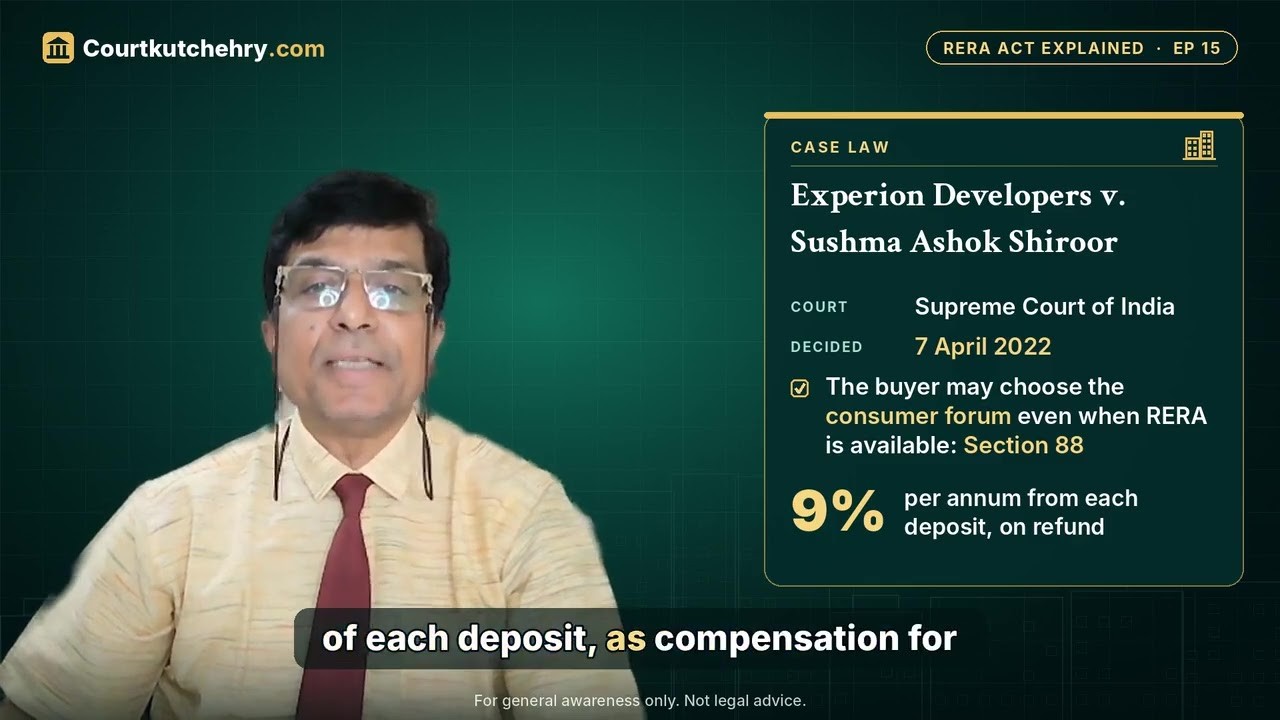
In Experion Developers Pvt. Ltd. v. Sushma Ashok Shiroor, (2022) 04 SC CK 0015, decided on 7 April 2022 by Uday Umesh Lalit, S. Ravindra Bhat and P.S. Narasimha, JJ. (judgment by Narasimha, J.), the question was whether a buyer could go to the consumer commission when RERA was available.
- The Court held that the Consumer Protection Act and the RERA Act neither exclude nor contradict each other. Relying on Section 88 of RERA, and on the fact that Section 79 bars only civil courts, it held that a buyer may choose the consumer forum.
- The developer’s delay compensation clause of ₹7.50 per square foot per month was held one-sided, and the buyer was not bound to accept possession on those terms.
- On refund, the Court upheld interest at 9% per annum as fair and just, and directed that it run from the date of each deposit, as compensation for the loss of use of the money.
What These Cases Mean Together
- A buyer can always withdraw when possession is delayed beyond the promised date, and get his money back with interest.
- A buyer who stays gets interest or compensation for the delay, even after taking possession.
- One-sided clauses that cap the builder’s liability do not bind the buyer.
- The builder cannot escape by pleading events beyond his control, at least as far as the refund is concerned.
Compensation must be reasonable
The Court has also made clear that compensation must be reasonable, not a windfall. In Kolkata West it reduced 12% to 9%; in Experion it refused to raise 9% to 24%. A buyer should claim the prescribed rate, and separate compensation for proved losses such as rent, rather than an inflated figure.
Practice Point and Quick Test
When the builder pleads force majeure, quote Newtech. The refund right does not depend on the reason for the delay. Force majeure may matter for extending registration under Section 6, but it does not defeat an allottee’s right to withdraw.
- According to Newtech, does a court stay order defeat the allottee’s right to a refund? No.
- Can a buyer who took possession still claim compensation for delay? Yes.
- Which section of RERA allows a buyer to choose the consumer forum as well? Section 88.
The next episode reads Section 19, the rights and duties of allottees, because RERA places obligations on buyers too.
Key Takeaways
- Newtech (11 November 2021): the refund right under Sections 18(1)(a) and 19(4) is unqualified, regardless of unforeseen events or court stay orders.
- Force majeure appears in Section 6 (extension of registration), not in Section 18, so it cannot defeat a refund.
- Kolkata West (25 March 2019): a buyer cannot be made to wait indefinitely; refund upheld with interest reduced to 9%.
- Arifur Rahman Khan (24 August 2020): a one-sided ₹5 per sq ft clause does not bind buyers; taking possession does not waive delay compensation; 6% per annum awarded.
- Experion (7 April 2022): the buyer may choose the consumer forum (Section 88); 9% interest on refund from each deposit upheld.
- Claim the prescribed rate plus proved losses; courts reject windfall rates.
Frequently Asked Questions
Can a builder refuse a refund because of a court stay or the pandemic?
Not under Section 18(1)(a). In Newtech the Supreme Court held that the right to a refund is unconditional and applies regardless of unforeseen events or stay orders of a court or tribunal.
If I took possession of a delayed flat, can I still claim compensation?
Yes. In Arifur Rahman Khan v. DLF Southern Homes (2020), the Supreme Court held that buyers who took possession did not lose their claim and awarded 6% per annum for the delay.
Does a small delay-compensation clause in my agreement limit my claim?
Not if it is one-sided. The Supreme Court has repeatedly held such clauses, like ₹5 or ₹7.50 per square foot per month, not binding on buyers.
Can I go to the consumer commission instead of RERA?
Yes. In Experion v. Sushma Ashok Shiroor (2022), the Court held the two laws are concurrent remedies; Section 88 keeps other laws available and Section 79 bars only civil courts.
What rate of interest should I claim on a refund?
Claim the rate prescribed under your State’s RERA rules, and separately prove actual losses for compensation. The Supreme Court has reduced or refused rates it considered excessive.
Where can I watch the full explanation?
Watch the 7-minute video here: https://youtu.be/hLwoPCqECNw.
Conclusion
Four Supreme Court judgments answer the builder’s “not my fault” defence. The refund right is unconditional (Newtech); a buyer cannot be kept waiting forever (Kolkata West); taking possession does not waive delay compensation and one-sided clauses do not bind (Arifur Rahman Khan); and the buyer may pick his forum (Experion).
Equally, the Court expects claims to be reasonable. The strongest Section 18 case pairs the prescribed rate of interest with properly proved losses.
▶ Watch the video: Section 18 in the Supreme Court: Newtech, DLF Arifur Rahman, Experion | RERA Explained Ep 15
Research Judgments Like These on CourtKutchehry
Every judgment cited in this article, and lakhs more, can be searched and read on CourtKutchehry. Searching and reading judgments is free. A membership adds unlimited summaries, all related judgments, original court PDF downloads, bookmarks, notes and the CourtKutchehry AI assistant.
| Membership | Price | Works out to | AI credits |
|---|---|---|---|
| Monthly (1 month) | ₹599 | ₹599 / month | 1,000 / month |
| Quarterly (3 months) · Save 16% | ₹1,499 | ₹499.67 / month | 1,100 / month |
| Six-monthly (6 months) · Save 33% | ₹2,399 | ₹399.83 / month | 1,200 / month |
| Yearly (12 months) · Save 44% · Best value | ₹3,999 | ₹333.25 / month | 1,300 / month |
Every plan is a one-off purchase for a fixed period: nothing auto-renews and no card is kept on file. Prices are exclusive of applicable tax, which is added at checkout. Extra AI chat credits can be topped up from ₹99. A free verified account gets 5 summaries and 50 AI trial credits.
Prices are as displayed on courtkutchehry.com on 20 November 2026 and are subject to change without notice. Please check the pricing page for the current plans and offers.
For more judgments, legal opinions and case analysis, visit courtkutchehry.com
Visit CourtKutchehry →