
Watch the Video
In this 8-minute video, Vineet Kohli, Advocate, explains the four measures a bank can take under Section 13(4) once the 60 days after the demand notice are over, and what “possession” really means, in Episode 13 of “SARFAESI Act Explained with Judgments”. This article sets out the same points in writing, with links to the judgments on CourtKutchehry.
After the 60 Days: What Can the Bank Do?
The demand notice under Section 13(2) of the Securitisation and Reconstruction of Financial Assets and Enforcement of Security Interest Act, 2002 gives the borrower 60 days to pay. The borrower may object, and the bank must consider the objection. But if the liability is not discharged in full within those 60 days, the secured creditor may act. Section 13(4) lists what it can do, and Rule 8 of the Security Interest (Enforcement) Rules, 2002 explains how possession is taken.
The Four Measures Under Section 13(4)
If the borrower fails to discharge his liability in full within the notice period, the secured creditor may take one or more of these measures to recover its secured debt:
- Take possession of the secured assets, including the right to transfer them by way of lease, assignment or sale for realising the secured asset.
- Take over the management of the business of the borrower, including the right to transfer by lease, assignment or sale. A proviso limits this: the right to transfer arises only where a substantial part of the business is held as security, and where the business is severable, the creditor may take over only the part relatable to the security.
- Appoint any person as manager to manage the secured assets taken over by the secured creditor.
- Require the borrower’s debtors to pay the bank directly: by notice in writing, any person who has acquired any of the secured assets from the borrower, and from whom money is due or may become due to the borrower, can be required to pay the secured creditor so much of that money as is sufficient to pay the secured debt.
Note the words “in full”. A part payment within 60 days does not stop the bank from acting.
Section 13(12): The Authorised Officer
Under Section 13(12), the rights of a secured creditor under the Act may be exercised by one or more of its officers authorised in this behalf, in the manner prescribed by the Rules. Under Rule 2 of the Enforcement Rules, the authorised officer is an officer not below the rank of a chief manager of a public sector bank, or an equivalent officer, authorised by the creditor’s board or governing body.
So every possession notice and every sale step should be signed by an officer who actually holds that authority. Checking this is a basic step in any challenge.
Symbolic and Physical Possession Under Rule 8
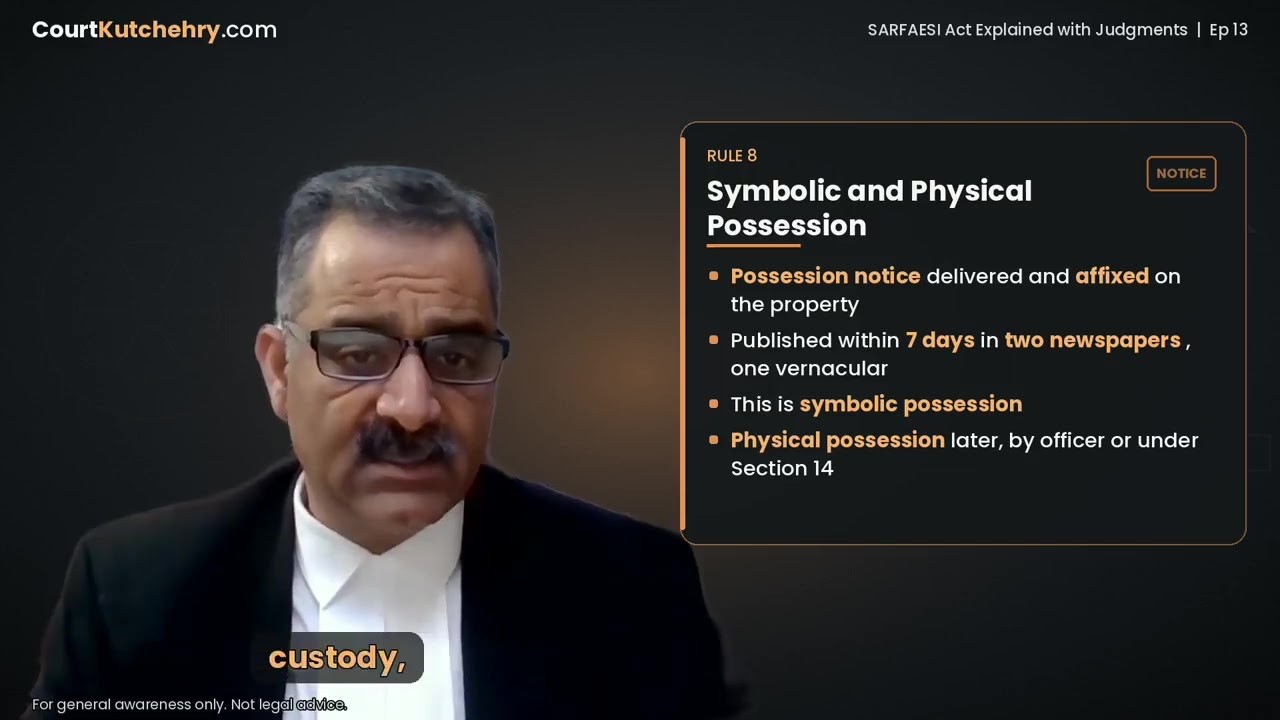
Under Rule 8, the authorised officer takes possession of immovable property by:
- delivering a possession notice to the borrower, in the form in the Appendix to the Rules;
- affixing the notice on the outer door or another conspicuous place of the property; and
- publishing it, as soon as possible and in any case within seven days of taking possession, in two leading newspapers, one of them in the vernacular language.
This is usually called symbolic (or constructive) possession: the borrower may still be physically in the property. Physical possession can follow later, taken by the officer himself or with the help of the Magistrate under Section 14. Once the property is in his custody, the officer must take the care of it that an owner of ordinary prudence would.
Hindon Forge v. State of U.P. (2019)
The key question was this: can a borrower go to the DRT as soon as symbolic possession is taken, or must he wait until he is physically dispossessed?
A Full Bench of the Allahabad High Court had held that a Section 17 application lies only after actual physical possession is taken. In M/s Hindon Forge Pvt. Ltd. vs State of Uttar Pradesh, (2018) 11 SC CK 0001, decided on 1 November 2018 by Justice R.F. Nariman and Justice Navin Sinha and reported in (2019) 2 SCC 198, the Supreme Court set that view aside.
The Court held that taking possession under Rule 8(1) and 8(2), by delivering, affixing and publishing the possession notice, is itself a mode of taking possession under Section 13(4), and so it is a measure. The borrower can therefore approach the DRT under Section 17 from that stage. He need not wait for physical possession, because by then the creditor may already be moving to sell the property.
Remember this line: a possession notice on the door is already a measure; the 45 days to approach the DRT start running.
Standard Chartered Bank v. V. Noble Kumar (2013)
In Standard Chartered Bank vs V. Noble Kumar, (2013) 08 SC CK 0053, the Supreme Court explained that the Act gives the secured creditor two routes to possession. It may take possession itself under Section 13(4), without the coercive power of the State, or it may apply to the Chief Metropolitan Magistrate or District Magistrate under Section 14 for help in taking possession.
The Court rejected the view that the creditor must first try to take possession on its own and face resistance before going to the Magistrate. It held that it is not mandatory for the secured creditor to attempt to obtain possession on its own first. Whichever route is used, taking possession is a measure that the borrower may challenge under Section 17.
Practice Points for Advocates
- Note the dates. Record the date of the possession notice, its affixation and its newspaper publication. The 45-day limitation for a Section 17 application is counted from the measure.
- Check the notice against the Rules. Is it in the Appendix form? Was it affixed on the property? Was it published in two newspapers, one in the vernacular? Was it signed by an authorised officer of the required rank?
- Advise third-party debtors. Under Section 13(5), a person who pays the secured creditor in response to a Section 13(4)(d) notice gets a valid discharge from the borrower. Such a person should check that the notice is proper before paying.
A Practical Example: A Possession Notice on a Running Shop
The 60 days expire without full payment. The bank’s authorised officer delivers a possession notice, affixes it on the borrower’s shop and publishes it in two newspapers. The borrower continues to run the shop.
Has anything happened? Yes. Under Hindon Forge, this symbolic possession is already a measure under Section 13(4). If the borrower wants to challenge it, he should file his application before the DRT under Section 17 within 45 days. Waiting until the bank comes to take physical possession could mean losing time that the law does not give back.
Quick Test
- Name any two measures under Section 13(4). Taking possession of the secured assets, and taking over the management of the business.
- Who exercises the powers under Section 13(4)? The authorised officer of the secured creditor, under Section 13(12).
- Is symbolic possession a measure under Section 13(4)? Yes, as held in Hindon Forge.
Key Takeaways
- If the liability is not discharged in full within 60 days, the secured creditor may take one or more of the four measures in Section 13(4).
- The measures: possession of secured assets, takeover of management, appointment of a manager, and notice to the borrower’s debtors to pay the bank.
- Under Section 13(12) and Rule 2, the powers are exercised by an authorised officer of the required rank.
- Rule 8: possession notice, affixation and publication in two newspapers (one vernacular). Hindon Forge: this symbolic possession is a measure, so Section 17 is available from that stage.
- Noble Kumar: the creditor may take possession itself or go straight to the Magistrate under Section 14.
Frequently Asked Questions
What are the measures under Section 13(4) of the SARFAESI Act?
Taking possession of the secured assets, taking over management of the business, appointing a manager, and requiring persons who owe money to the borrower to pay the secured creditor.
What is symbolic possession?
Possession taken under Rule 8 by delivering a possession notice, affixing it on the property and publishing it in two newspapers, while the borrower may still be physically in occupation.
Can I approach the DRT after symbolic possession, or must I wait for physical possession?
You can approach the DRT under Section 17 from the stage of symbolic possession, as the Supreme Court held in Hindon Forge. The 45 days run from the measure.
Must the bank try to take possession itself before going to the Magistrate?
No. In Standard Chartered Bank v. V. Noble Kumar, the Supreme Court held this is not mandatory; the creditor may apply under Section 14 directly.
I paid part of the dues within 60 days. Can the bank still act?
Yes. Section 13(4) applies where the borrower fails to discharge the liability in full within the notice period.
Where can I watch the full explanation?
Watch Vineet Kohli, Advocate, explain it in 8 minutes: https://youtu.be/nNX_ZHpTVDM.
Conclusion
Section 13(4) is where SARFAESI action becomes real. After the 60 days, the bank can take possession, take over management, appoint a manager or collect from the borrower’s debtors, through its authorised officer and in the manner the Rules prescribe.
For the borrower, the possession notice is the moment to act: under Hindon Forge the clock for a Section 17 application starts then. The next episode asks whether a lender can drop its Section 13(4) measures midway and go straight to the Magistrate under Section 14.
▶ Watch the video: Section 13(4) Measures: Possession, Takeover and Hindon Forge (2019) | SARFAESI Explained Ep 13
📖 Read more: Madhya Pradesh High Court Clarifies SARFAESI Act: Banks Can Take Direct Possession Without DM’s Approval
Research Judgments Like These on CourtKutchehry
Every judgment cited in this article, and lakhs more, can be searched and read on CourtKutchehry. Searching and reading judgments is free. A membership adds unlimited summaries, all related judgments, original court PDF downloads, bookmarks, notes and the CourtKutchehry AI assistant.
| Membership | Price | Works out to | AI credits |
|---|---|---|---|
| Monthly (1 month) | ₹599 | ₹599 / month | 1,000 / month |
| Quarterly (3 months) · Save 16% | ₹1,499 | ₹499.67 / month | 1,100 / month |
| Six-monthly (6 months) · Save 33% | ₹2,399 | ₹399.83 / month | 1,200 / month |
| Yearly (12 months) · Save 44% · Best value | ₹3,999 | ₹333.25 / month | 1,300 / month |
Every plan is a one-off purchase for a fixed period: nothing auto-renews and no card is kept on file. Prices are exclusive of applicable tax, which is added at checkout. Extra AI chat credits can be topped up from ₹99. A free verified account gets 5 summaries and 50 AI trial credits.
Prices are as displayed on courtkutchehry.com on 20 November 2026 and are subject to change without notice. Please check the pricing page for the current plans and offers.
For more judgments, legal opinions and case analysis, visit courtkutchehry.com
Visit CourtKutchehry →