
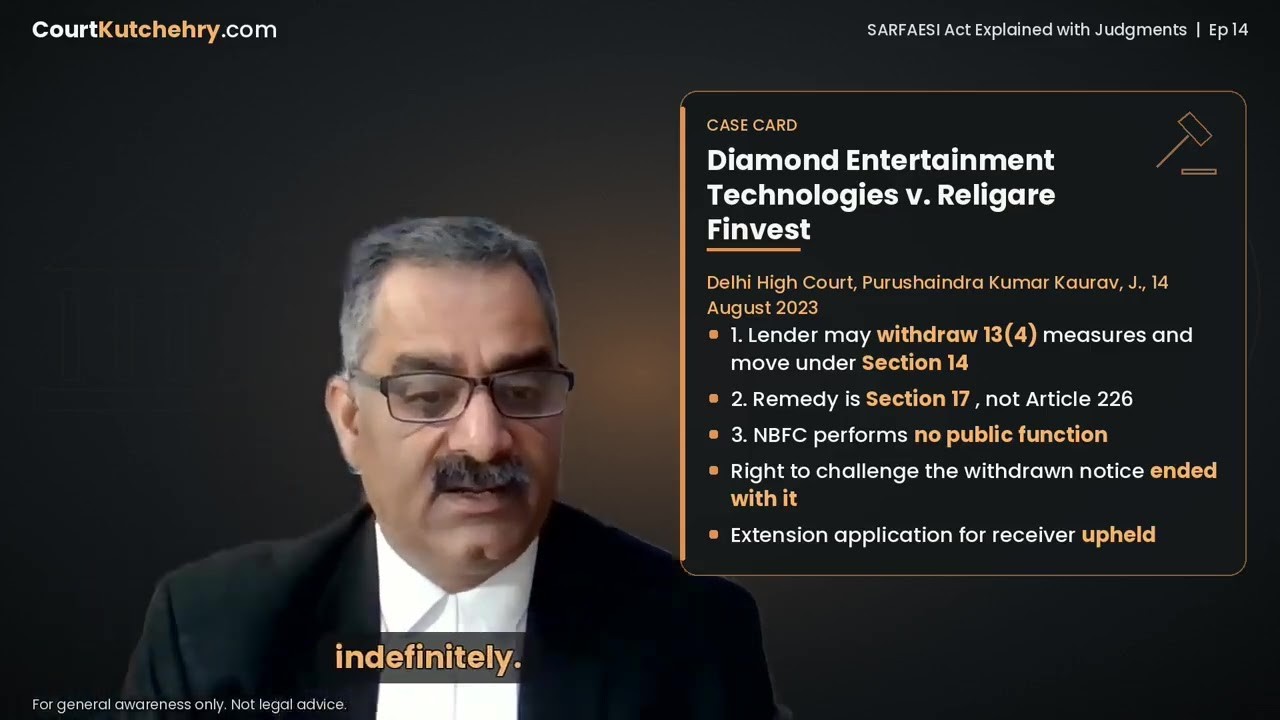
Watch the Video
In this 8-minute video, Vineet Kohli, Advocate, explains whether a lender can withdraw its Section 13(4) measures midway and go straight to the Magistrate under Section 14, and whether a borrower can stop it with a writ petition, through a Delhi High Court judgment, in Episode 14 of “SARFAESI Act Explained with Judgments”. This article sets out the same points in writing, with links to the judgments on CourtKutchehry.
Two Questions, One Judgment
Under the Securitisation and Reconstruction of Financial Assets and Enforcement of Security Interest Act, 2002, a lender can take possession of a secured asset in two ways: through its own authorised officer under Section 13(4) read with Rule 8, or with the help of the Chief Metropolitan Magistrate or District Magistrate under Section 14. This episode asks two practical questions:
- Can a lender that has started under Section 13(4) drop those measures midway and go straight to the Magistrate under Section 14?
- Can the borrower stop it with a writ petition in the High Court?
A 2023 Delhi High Court judgment answers both.
The Two Routes to Possession
Recall the position from the last episode. Under Section 13(4), the lender’s authorised officer takes possession by delivering, affixing and publishing a possession notice under Rule 8. Under Section 14, the lender applies to the Magistrate, who can take possession of the secured asset and its documents and hand them over to the lender, usually where resistance is expected.
In Standard Chartered Bank vs V. Noble Kumar, (2013) 08 SC CK 0053, the Supreme Court held that the secured creditor need not first try to take possession on its own before applying under Section 14. The choice of route is the creditor’s.
Diamond Entertainment v. Religare Finvest (Delhi High Court, 2023)
The facts
In Diamond Entertainment Technologies Pvt. Ltd. vs Religare Finvest Limited, (2023) 08 DEL CK 1086, Religare Finvest, a non-banking financial company (NBFC), had sanctioned a loan of ₹10 crore in 2012 against a mortgaged property in New Delhi, and the loan was restructured in 2014. The account was classified as an NPA in June 2021, and a Section 13(2) notice for about ₹5.72 crore followed in July 2021. The borrowers objected under Section 13(3A), and in September 2021 the lender took constructive possession under Section 13(4).
The lender then withdrew its Section 13(4) notice and applied under Section 14. The Chief Metropolitan Magistrate appointed a Receiver to take possession, and on 2 December 2022 extended the Receiver’s term. The borrowers challenged that extension order in a writ petition, arguing that having started under Section 13(4), the lender could not switch routes and take away rights that had accrued to them.
The decision
On 14 August 2023, Justice Purushaindra Kumar Kaurav dismissed the writ petition. The Court held:
- Switching routes is permitted. Nothing in the law bars a secured creditor from withdrawing its Section 13(4) measures and proceeding directly under Section 14. The choice of mode belongs to the creditor. Once the possession notice was withdrawn, any right to challenge that notice under Section 17 ended with it.
- The remedy is Section 17, not Article 226. Following Noble Kumar and Hindon Forge, the borrowers’ remedy lies before the DRT under Section 17; a writ petition at this intermediate stage was not appropriate.
- A private NBFC is not performing a public function. The loan was a private commercial transaction, so the dispute fell outside writ jurisdiction.
The Court also held that the lender did not need a fresh application or affidavit to have the Receiver’s term extended.
Remember this line: the lender chooses the road to possession; the borrower’s road to challenge it runs through the DRT.
Phoenix ARC v. Vishwa Bharati Vidya Mandir (2022): The Same Principle
The Delhi High Court relied on the Supreme Court’s decision in Phoenix ARC Private Limited vs Vishwa Bharati Vidya Mandir, (2022) 01 SC CK 0034, decided on 12 January 2022. There, the Supreme Court held that a writ petition under Article 226 against a private asset reconstruction company over proposed action under Section 13(4) is not maintainable. The company had lent money under a commercial contract and was not performing a public function normally expected of the State.
The Court also stressed that where an effective remedy exists under Section 17, the High Court should not entertain a writ petition, and called the borrowers’ petitions in that case an abuse of process.
Read together, these judgments send one message: the SARFAESI Act has its own forum, and irregularities in measures are examined by the Tribunal, not the writ court.
Practice Points for Advocates
- Examine each measure on its own terms. When the lender changes course, do not assume the earlier steps are wasted, or that the new steps are illegal. Ask whether each step, as it stands, complies with the Act and Rules.
- File under Section 17 within 45 days. If your client is aggrieved by the Section 14 proceeding or by possession taken under it, the DRT is the forum, and limitation matters.
- Don’t lose time on a writ against a private lender. After Phoenix ARC and Diamond Entertainment, such a petition is likely to be dismissed, and the time spent may be time lost before the DRT.
- For lenders: if you change route, record the withdrawal of the earlier measure in writing and disclose it in the Section 14 application. A clean record protects the second step.
A Practical Example: An NBFC Switches to the CMM
An NBFC issues a possession notice under Section 13(4), then realises the borrower will resist. It withdraws the notice and applies to the Chief Metropolitan Magistrate under Section 14. The borrower files a writ petition in the High Court, arguing that the lender cannot change course.
Following Diamond Entertainment, the High Court is likely to dismiss the petition and leave the borrower to his remedy before the DRT. The borrower’s better course is to prepare a well-documented Section 17 application, pointing out any real defect in the Section 14 proceeding or in the possession taken under it.
Quick Test
- Can a secured creditor withdraw its Section 13(4) measures and proceed under Section 14? Yes, as held in Diamond Entertainment (Delhi High Court, 2023).
- Where should the borrower challenge the Section 14 proceedings? Before the DRT, under Section 17.
- Is a private NBFC ordinarily subject to writ jurisdiction in a loan dispute? No, because it does not perform a public function.
Key Takeaways
- A secured creditor has two routes to possession: its own authorised officer under Section 13(4), or the Magistrate under Section 14; the choice is the creditor’s (Noble Kumar).
- Diamond Entertainment v. Religare Finvest (Delhi HC, Justice Purushaindra Kumar Kaurav, 14 August 2023): a lender may withdraw its Section 13(4) measures and proceed under Section 14.
- The borrower’s remedy is under Section 17 before the DRT, not Article 226.
- A private NBFC does not perform a public function, so a loan dispute with it is outside writ jurisdiction.
- Phoenix ARC v. Vishwa Bharati Vidya Mandir (SC, 2022) lays down the same principle for private lenders and ARCs.
Frequently Asked Questions
Can a lender change from Section 13(4) to Section 14 midway?
Yes. In Diamond Entertainment v. Religare Finvest, the Delhi High Court held that nothing in the law bars a secured creditor from withdrawing its Section 13(4) measures and proceeding directly under Section 14.
Does the withdrawn possession notice still matter?
The Court held that once the notice was withdrawn, the right to challenge that notice under Section 17 ended with it. What matters is the Section 14 proceeding and the possession taken under it.
Can I file a writ petition against a private NBFC in a SARFAESI matter?
Ordinarily, no. A private NBFC or ARC does not perform a public function, and the Supreme Court in Phoenix ARC held such writ petitions not maintainable where the Act provides a remedy.
Where should I challenge the Section 14 proceeding?
Before the DRT, under Section 17, within the limitation of 45 days.
Must the lender try to take possession itself before going to the Magistrate?
No. The Supreme Court held in Standard Chartered Bank v. V. Noble Kumar that this is not mandatory.
Where can I watch the full explanation?
Watch Vineet Kohli, Advocate, explain it in 8 minutes: https://youtu.be/VMLiZuULeR0.
Conclusion
A lender is free to choose, and even to change, its road to possession: its own officer under Section 13(4), or the Magistrate under Section 14. The courts will not read into the Act a bar that Parliament did not write.
For borrowers, the practical lesson is to put their energy into a timely, well-prepared Section 17 application rather than a writ petition against a private lender. The next episode follows the secured asset to the auction: how it is sold, whether the bank can bid, and where the money goes.
▶ Watch the video: Section 13(4) or Section 14? Diamond Entertainment v. Religare, Delhi HC | SARFAESI Explained Ep 14
📖 Read more: Supreme Court Clarifies: District Magistrates’ Powers Under SARFAESI Act Section 14 Are Ministerial, Not Adjudicatory
Research Judgments Like These on CourtKutchehry
Every judgment cited in this article, and lakhs more, can be searched and read on CourtKutchehry. Searching and reading judgments is free. A membership adds unlimited summaries, all related judgments, original court PDF downloads, bookmarks, notes and the CourtKutchehry AI assistant.
| Membership | Price | Works out to | AI credits |
|---|---|---|---|
| Monthly (1 month) | ₹599 | ₹599 / month | 1,000 / month |
| Quarterly (3 months) · Save 16% | ₹1,499 | ₹499.67 / month | 1,100 / month |
| Six-monthly (6 months) · Save 33% | ₹2,399 | ₹399.83 / month | 1,200 / month |
| Yearly (12 months) · Save 44% · Best value | ₹3,999 | ₹333.25 / month | 1,300 / month |
Every plan is a one-off purchase for a fixed period: nothing auto-renews and no card is kept on file. Prices are exclusive of applicable tax, which is added at checkout. Extra AI chat credits can be topped up from ₹99. A free verified account gets 5 summaries and 50 AI trial credits.
Prices are as displayed on courtkutchehry.com on 20 November 2026 and are subject to change without notice. Please check the pricing page for the current plans and offers.
For more judgments, legal opinions and case analysis, visit courtkutchehry.com
Visit CourtKutchehry →