
Watch the Video
In this 8-minute video, Vineet Kohli, Advocate, explains the power to enforce security without going to court and the 60-day demand notice that starts every SARFAESI case, in Episode 10 of “SARFAESI Act Explained with Judgments”. This article sets out the same points in writing, with links to the judgments on CourtKutchehry.
Why Section 13 Matters
Section 13 is the most used provision of the Securitisation and Reconstruction of Financial Assets and Enforcement of Security Interest Act, 2002 (the SARFAESI Act). It is the provision that lets a bank or financial institution recover a secured debt by enforcing its security directly, without first filing a suit or an application. Almost every SARFAESI case begins with the same document: the demand notice under Section 13(2).
This episode covers the first three sub-sections of Section 13: the power to enforce without court, the 60-day demand notice, and what that notice must contain. It then looks at two Supreme Court judgments that shape this early stage of every case.
Section 13(1): Enforcement Without Court
Section 13(1) says that, notwithstanding anything in Sections 69 and 69A of the Transfer of Property Act, 1882, a security interest created in favour of a secured creditor may be enforced without the intervention of a court or tribunal, in accordance with the provisions of the Act.
Why mention those two sections? Under the Transfer of Property Act, a mortgagee can sell the mortgaged property without going to court only in limited cases (Section 69), and can appoint a receiver only in limited cases (Section 69A). Section 13(1) removes those limits for secured creditors covered by the SARFAESI Act.
But the last words matter just as much: in accordance with the provisions of this Act. The power is wide, but every step must follow the Act and the Security Interest (Enforcement) Rules, 2002. That is why so many SARFAESI cases are won or lost on procedure.
Section 13(2): The 60-Day Demand Notice
Under Section 13(2), where a borrower is in default in repaying a secured debt or any instalment, and the account has been classified as a non-performing asset (NPA), the secured creditor may require the borrower, by a notice in writing, to discharge his liabilities in full within 60 days from the date of the notice. If the borrower fails to do so, the secured creditor may exercise its rights under Section 13(4).
The conditions, one by one
- A security agreement creating a security interest in favour of the secured creditor.
- A default in repayment of the secured debt or any instalment of it.
- NPA classification of the account, according to the applicable directions or guidelines.
- A written notice giving the borrower 60 days to pay in full.
Remember that a “borrower” under Section 2(1)(f) includes a guarantor and a person who has created a mortgage or pledge as security. A notice that reaches the main borrower but not the guarantor or mortgagor can create problems later.
Two provisos added in 2016 deal with special cases: the NPA condition does not apply to a borrower who has raised funds by issuing debt securities, and on default a debenture trustee can enforce the security interest in the same manner.
Section 13(3): What the Notice Must Contain
Section 13(3) requires the notice to give details of the amount payable by the borrower and of the secured assets intended to be enforced by the secured creditor in the event of non-payment.
A vague notice that gives only a lump sum, without the details of the dues, or that does not identify the property, is open to challenge. The borrower must be able to understand from the notice itself what he is asked to pay and what he stands to lose.
Serving the notice: Rule 3
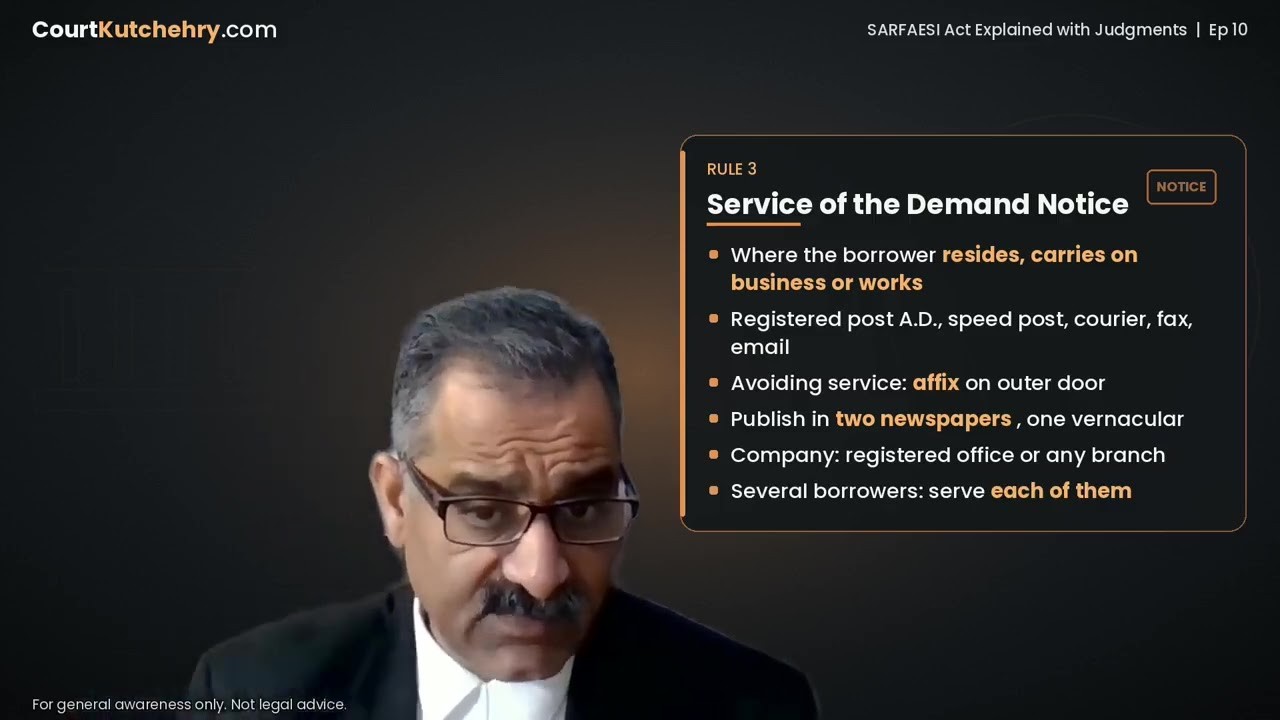
The video’s practice points stress checking service under Rule 3 of the Security Interest (Enforcement) Rules, 2002. The notice is to be delivered at the place where the borrower resides, carries on business or works for gain, by registered post with acknowledgement due, speed post, courier, or other means such as fax or e-mail. A company may be served at its registered office or a branch. If the authorised officer has reason to believe that the borrower is avoiding service, or service cannot otherwise be made, the notice may be affixed on the premises and published in two leading newspapers, one of them in the vernacular language. Where there are several borrowers, each must be served.
Transcore: No Doctrine of Election
Many borrowers argue that a bank which has already filed a recovery application before the Debts Recovery Tribunal (DRT) must choose one remedy and cannot start SARFAESI action as well. The Supreme Court rejected that argument in Transcore vs Union of India, (2006) 11 SC CK 0164 (decided on 29 November 2006 and reported in 2008).
The Court held that the doctrine of election does not apply between the DRT Act and the SARFAESI Act. The two Acts are complementary remedies for the same purpose, the recovery of dues of banks and financial institutions. Withdrawal of the pending original application is not a precondition for invoking the SARFAESI Act. So a bank may issue a Section 13(2) notice even while its DRT case is pending.
Mardia Chemicals: No Immediate Remedy at the Notice Stage
The constitutional validity of the SARFAESI Act was examined in Mardia Chemicals Ltd. vs Union of India, (2004) 04 SC CK 0076. The Supreme Court upheld the Act, struck down the old requirement of a pre-deposit for approaching the DRT, and explained how the early stages of the Act work.
One of its points is directly relevant here. The Section 13(2) notice is not yet a “measure”. Nothing has been done to the property. So at this stage the borrower’s remedy is to send a representation or objection to the bank, which the bank must consider and answer. The application to the DRT under Section 17 lies against the measures taken under Section 13(4), not against the notice.
Mardia also said that the bank must apply its mind to the borrower’s reply and communicate its reasons for not accepting it. Parliament wrote that duty into the Act as Section 13(3A), which is the subject of the next episode.
Remember this line: at the Section 13(2) stage, the borrower writes to the bank; he does not yet go to the DRT.
Practice Points for Advocates
- Read the notice line by line. Check the date, the NPA date, the amount and how it is made up, the description of the secured asset, and whether it was addressed to every borrower, guarantor and mortgagor.
- Check service under Rule 3. Ask for proof of the mode of service. If the bank relied on affixation and newspaper publication, check whether the conditions for that substituted mode existed.
- Use the 60 days well. The period runs from the date of the notice. It is the time to pay, to negotiate a restructuring or settlement, or to prepare a detailed representation with the borrower’s own calculation of the dues.
A Practical Example: A ₹25 Lakh Home Loan
A borrower’s home loan account is classified as an NPA. The bank then issues a Section 13(2) notice demanding ₹25 lakh and identifies the flat by its address and registration details. The borrower now has 60 days from the date of the notice to pay in full.
During those 60 days, the bank cannot take any measure under Section 13(4). The borrower’s sensible course is not to rush to the DRT, but to check the figures and, if he disputes them, to send a detailed representation to the bank. Only after the 60 days expire without full payment can the bank move to possession.
Quick Test
- Within how many days must the borrower pay after a Section 13(2) notice? Sixty days from the date of the notice.
- What must the notice contain under Section 13(3)? Details of the amount payable and of the secured assets to be enforced.
- Can a bank issue a Section 13(2) notice while its DRT case is pending? Yes. As held in Transcore, there is no doctrine of election between the two Acts.
Key Takeaways
- Section 13(1) lets a secured creditor enforce its security without the intervention of a court or tribunal, notwithstanding Sections 69 and 69A of the Transfer of Property Act, but only in accordance with the Act and Rules.
- A Section 13(2) notice needs default plus NPA classification, and gives the borrower 60 days to pay in full.
- Under Section 13(3), the notice must state the amount payable and the secured assets to be enforced.
- Transcore: no doctrine of election; a bank may issue a Section 13(2) notice while its DRT application is pending.
- Mardia Chemicals: the notice is not yet a measure; the borrower’s remedy at this stage is a representation, not a DRT application.
Frequently Asked Questions
What is a Section 13(2) notice under the SARFAESI Act?
It is the written demand notice a secured creditor issues after the borrower defaults and the account is classified as an NPA, calling on the borrower to pay the full dues within 60 days.
Can I file a case in the DRT as soon as I receive a Section 13(2) notice?
Ordinarily, no. As explained in Mardia Chemicals, the notice is not yet a measure. The remedy at this stage is a representation to the bank; the Section 17 application lies against measures under Section 13(4).
What if the notice does not give details of the dues or the property?
Section 13(3) requires both. A notice that does not give the amount payable and the secured assets to be enforced is open to challenge when a later measure is questioned.
Can the bank use SARFAESI if it has already filed a recovery case in the DRT?
Yes. In Transcore v. Union of India, the Supreme Court held that the two remedies are complementary and the bank need not withdraw its DRT application first.
Is a guarantor entitled to the notice?
A guarantor and a mortgagor fall within the definition of “borrower” in Section 2(1)(f), so the notice should be served on each of them.
Where can I watch the full explanation?
Watch Vineet Kohli, Advocate, explain it in 8 minutes: https://youtu.be/_DSssRiWapA.
Conclusion
Section 13 gives banks a powerful remedy: they can enforce security without going to court. But the remedy begins with a carefully drafted, properly served 60-day notice that states the dues and the secured assets.
For the borrower, the notice is a warning, not yet an action. The right step now is to check it, use the 60 days, and send a detailed representation. That representation, and the bank’s duty to reply to it under Section 13(3A), is where the next episode begins.
▶ Watch the video: Section 13(2) Demand Notice: 60 Days and Enforcement Without Court | SARFAESI Explained Ep 10
📖 Read more: Already Have a DRT Decree on the Debt? The Bank Can Still Come After You Under SARFAESI, Rules Supreme Court
Research Judgments Like These on CourtKutchehry
Every judgment cited in this article, and lakhs more, can be searched and read on CourtKutchehry. Searching and reading judgments is free. A membership adds unlimited summaries, all related judgments, original court PDF downloads, bookmarks, notes and the CourtKutchehry AI assistant.
| Membership | Price | Works out to | AI credits |
|---|---|---|---|
| Monthly (1 month) | ₹599 | ₹599 / month | 1,000 / month |
| Quarterly (3 months) · Save 16% | ₹1,499 | ₹499.67 / month | 1,100 / month |
| Six-monthly (6 months) · Save 33% | ₹2,399 | ₹399.83 / month | 1,200 / month |
| Yearly (12 months) · Save 44% · Best value | ₹3,999 | ₹333.25 / month | 1,300 / month |
Every plan is a one-off purchase for a fixed period: nothing auto-renews and no card is kept on file. Prices are exclusive of applicable tax, which is added at checkout. Extra AI chat credits can be topped up from ₹99. A free verified account gets 5 summaries and 50 AI trial credits.
Prices are as displayed on courtkutchehry.com on 20 November 2026 and are subject to change without notice. Please check the pricing page for the current plans and offers.
For more judgments, legal opinions and case analysis, visit courtkutchehry.com
Visit CourtKutchehry →