
Section 10(14)(i) Audit Warning: How Misusing Tax-Free Allowances Can Trigger a 200% Penalty
The Thin Line Between Legitimate Official Deductions and Intentional Tax Misreporting Under Income Tax Statutes
Why Missing Form 16 Records, Unsubstantiated Expense Vouchers, and Automated AIS Audits Are Exposed to Severe Penalties Under Section 270A
By Legal Editor
New Delhi: August 04, 2026:
As annual income tax filing deadlines draw near, taxpayers frequently seek ways to optimize tax liabilities. Among salaried employees, Section 10(14)(i) of the Income-tax Act has become a central focus of tax-planning strategies. While the statutory provision allows tax-free exemptions for official expenses, misinterpreting or misusing these provisions introduces significant regulatory exposure.
Tax authorities utilize advanced digital systems—such as the Annual Information Statement (AIS) and Taxpayer Information Summary (TIS)—to cross-reference deductions against employer filings. Claiming exemptions without strict compliance or documentary proof can trigger notices and statutory penalties.
Understanding Section 10(14)(i): Statutory Purpose and Scope
Section 10(14)(i) governs tax exemptions for specific allowances granted by employers. To qualify, an allowance must meet three strict statutory criteria:
[Employer Grant] ➔ [Wholly, Necessarily & Exclusively for Official Duties] ➔ [Exempt Only to Actual Amount Expended]
Wholly, Necessarily, and Exclusively: Expenses must directly support official duties. Personal benefits or general compensation do not qualify.
Actual Expenditure Limitation: The exemption is limited strictly to the amount spent. Any unspent surplus remains fully taxable.
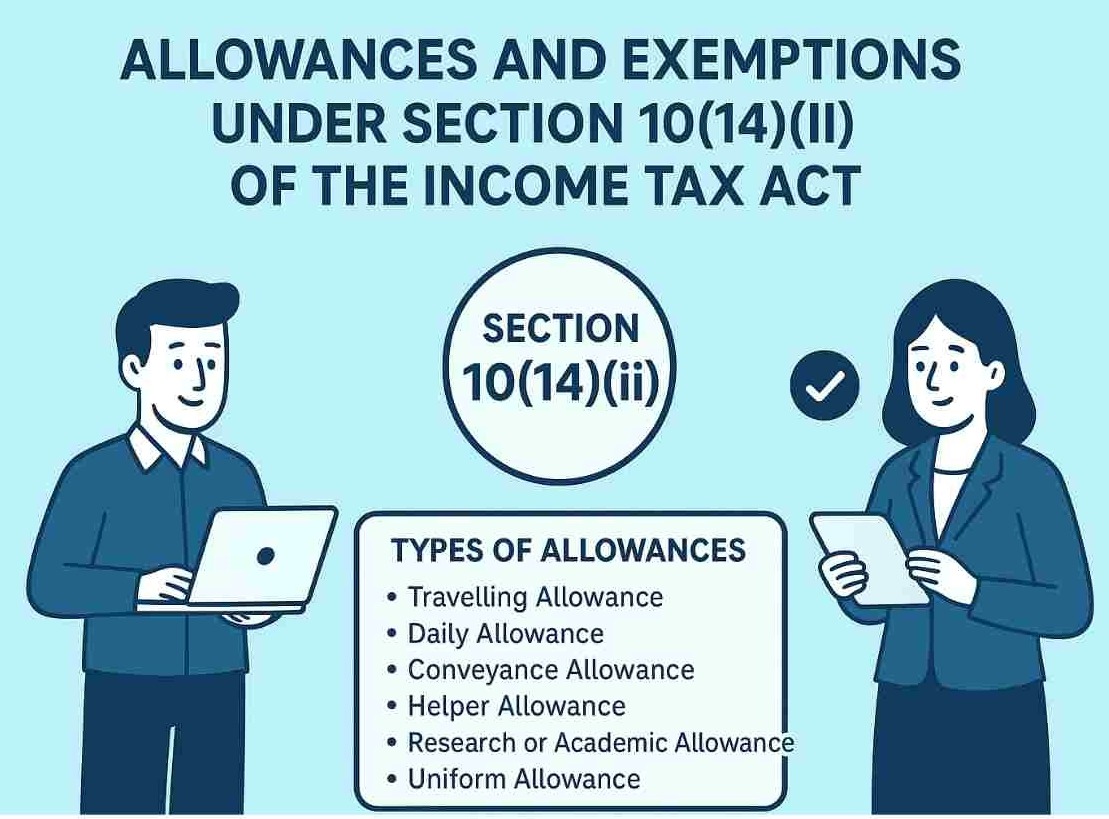
Eligible Allowance Categories: Qualifying categories typically include:
Travel & Transfer Allowances: Reimbursements for official business travel or job transfers.
Daily Allowances: Payments covering ordinary daily expenses incurred during official travel.
Conveyance & Helper Allowances: Expenses for local duty-related travel or assistance employed for official duties.
Academic, Research, and Uniform Allowances: Outlays for professional development, research, or mandatory work attire.
The Misreporting Risk: Consequences Under Section 270A
Claiming an exemption without meeting statutory conditions exposes taxpayers to severe financial penalties. Section 270A categorizes non-compliance into two distinct types: Under-Reporting and Misreporting.
When an exemption claimed under Section 10(14)(i) lacks supporting vouchers or conflicts with Form 16, assessing officers may classify the deduction as misreporting. In addition to the 200% penalty, taxpayers face mandatory interest under Sections 234B and 234C on all unpaid tax amounts.
Total Financial Recovery = Primary Outstanding Tax + Mandatory Interest (u/s 234B/C) + 200% Misreporting Penalty
Discrepancies Between Form 16 and Self-Filed Returns
A common compliance issue occurs when an exemption claimed in an Income Tax Return (ITR) is missing from the employer's Form 16.
Form 16 Issued by Employer
├─► Exemption Reflected ──► Lower Assessment Scrutiny
└─► Exemption Omitted ──► High Scrutiny Exposure ──► Requires Independent Proof
While an omission in Form 16 does not automatically make a claim invalid, it shifts the burden of proof entirely to the employee. The taxpayer must independently substantiate that:
The allowance was granted as part of their official employment terms.
The funds were actually spent on official duties.
Valid receipts, invoices, and employer authorization records exist to support the entire claim.
Evidentiary Compliance: Required Documentation
To withstand tax audits, taxpayers claiming Section 10(14)(i) exemptions should maintain comprehensive evidentiary records:
Employment Agreements & HR Policies: Formal documentation establishing the purpose and eligibility of the allowance.
Employer Sanction Letters: Written authorization approving specific travel, transfers, or official assignments.
Itemized Expense Records: Bills, boarding passes, lodging invoices, and official expense claims.
Bank Statements: Payment records matching claim dates and amounts.
Practical Remediation: Correcting Erroneous Claims
Taxpayers who discover inaccurate exemption claims should take immediate corrective action based on their return status:
Return Status & Remediation Path:
[Within Revision Window] ─────► File Revised Return u/s 139(5) ──► Pay Tax + Interest
[Within 24 Months] ─────► File Updated Return u/s 139(8A) ──► Pay Tax + Additional Tax
[Audit Notice Issued] ─────► Submit Full Disclosure ──► Limit Misreporting Penalties
Within the Revision Window: File a revised return under Section 139(5) to correct the error and pay applicable taxes and interest.
Post-Revision Window: Utilize an Updated Return under Section 139(8A) (available up to 24 months from the end of the relevant assessment year) to pay voluntary taxes alongside statutory fees.
During Active Assessment: Provide full, transparent documentation during inquiries to demonstrate good faith and minimize misreporting penalties.
Frequently Asked Questions (FAQ) & Searchable Index
Index of Terms
[ALLOW-01] Scope of Section 10(14)(i)
[ALLOW-02] Unspent Allowance Portions
[FORM16-01] Omissions in Form 16
[PENAL-01] Difference Between 50% and 200% Penalties
[PROOF-01] Essential Evidentiary Documents
[CORR-01] Rectifying Unintentional Mistakes
[ALLOW-01] What is the core objective of Section 10(14)(i)?
Section 10(14)(i) exempts allowances granted specifically to meet expenses incurred wholly, necessarily, and exclusively for official duties. The exemption is capped at the actual amount spent for official purposes.
[ALLOW-02] Are unspent allowance funds taxable?
Yes. If an employee receives an official allowance but spends only a portion of it, the unspent balance is taxable income under the head "Salaries".
[FORM16-01] Can I claim an exemption if it is not listed in my Form 16?
Yes, but the burden of proof rests on you. You must provide independent documentary evidence—such as employer authorization letters, expense receipts, and bank statements—proving the funds were received and spent on official duties.
[PENAL-01] How does Section 270A distinguish between 50% and 200% penalties?
A 50% penalty applies to unintentional under-reporting resulting from honest errors. A 200% penalty applies to misreporting involving intentional deception, false claims, or fabricated expense records.
[PROOF-01] What proof is required during an income tax audit?
You must present:
Official employment agreements or HR sanction orders.
Original invoices, receipts, and travel vouchers.
Bank account statements showing matching transactions.
[CORR-01] What steps should I take if I incorrectly claimed an exemption?
File a revised return under Section 139(5) if within the permissible window. If that window has passed, submit an updated return under Section 139(8A) to pay the required tax and interest, reducing the risk of misreporting penalties.
Non-Compliance Type — Legal Definition — Statutory Penalty Rate
Under-Reporting — Unintentional omissions, clerical errors, or honest miscomputations without fraudulent intent. — 50% of the tax payable on the under-reported amount.
Misreporting — Willful misrepresentation, false documentation, or claiming unspent allowances to evade taxes. — 200% of the tax payable on the misreported amount.