
Watch the Video
In this 5-minute video, Vineet Kohli, Advocate begins the section-by-section journey through the Recovery of Debts and Bankruptcy Act, 1993 in Episode 3 of “DRT Act Explained with Judgments”. The subject is Section 1: the short title, extent and commencement of the Act, and the minimum amount below which the Debts Recovery Tribunal has no jurisdiction at all. This article explains each sub-section and the three worked examples from the episode.
Why Section 1 Matters More Than It Looks
Most readers skip the first section of an Act. In the DRT Act, that would be a mistake. Section 1(4) decides a basic question that comes before everything else: can this case go to the DRT at all? If the debt is below the minimum amount, the Act does not apply, and the Tribunal cannot hear the bank’s claim, however strong it may be.
Section 1(1) to 1(3): Title, Extent and Commencement
Section 1(1): short title
The Act may be called the Recovery of Debts and Bankruptcy Act, 1993. This is the name after the amendments made by the Insolvency and Bankruptcy Code, 2016. Earlier it was the Recovery of Debts Due to Banks and Financial Institutions Act, 1993.
Section 1(2): extent
The Act extends to the whole of India. As the video points out, since October 2019 it also extends to the Union Territories of Jammu and Kashmir and Ladakh, following the reorganisation of the former State.
Section 1(3): commencement
The Act is deemed to have come into force on 24 June 1993, the date on which the Ordinance was promulgated. The Act itself was passed later, but its operation runs from the date of the Ordinance.
Section 1(4): The Minimum Amount
Section 1(4) says that the Act shall not apply where the amount of debt due to a bank, a financial institution or a consortium of them is less than ten lakh rupees, or such other amount, not less than one lakh rupees, as the Central Government may notify.
So the Act itself fixes ₹10 lakh, but leaves the Central Government free to change the figure by notification, with a floor of ₹1 lakh. There is no ceiling: the Government may raise the limit as high as it thinks fit.
Remember this line: below the notified minimum, the DRT Act simply does not apply.
The 2018 Notification: ₹20 Lakh
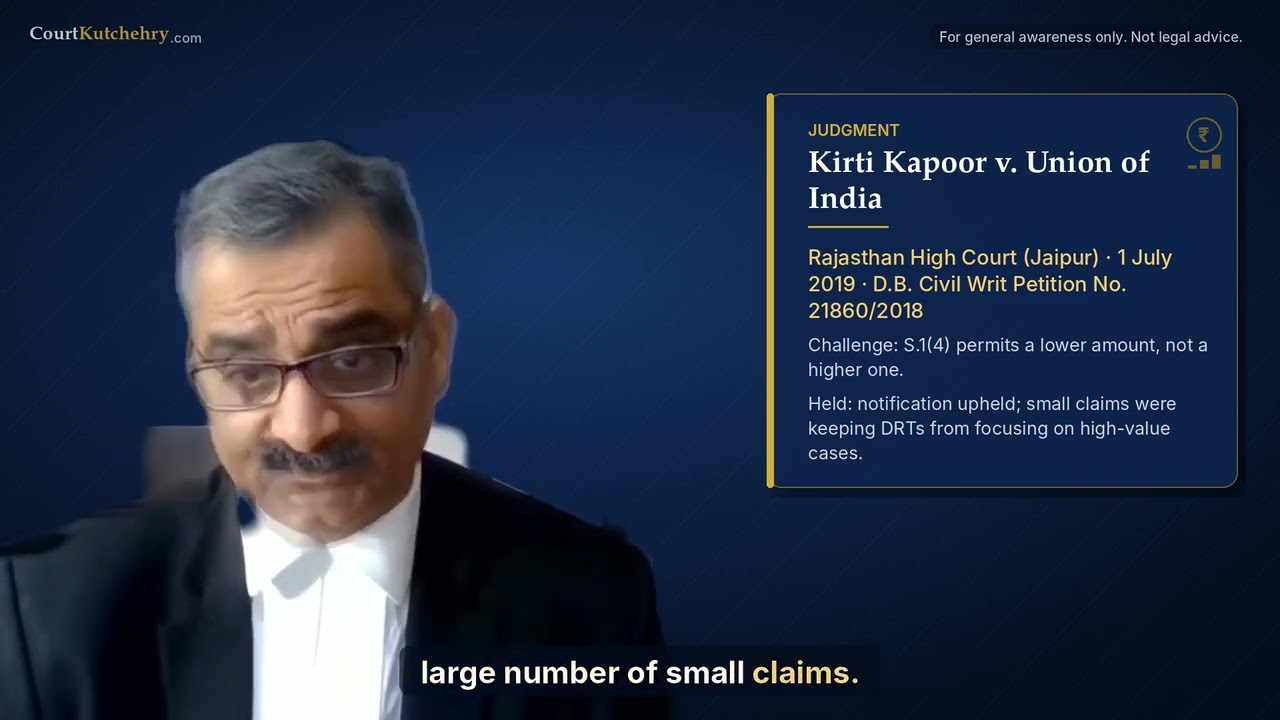
Using this power, the Central Government issued a notification dated 6 September 2018 raising the minimum amount from ₹10 lakh to ₹20 lakh. Since then, a bank or financial institution can file an original application before the DRT only if the debt is ₹20 lakh or more.
The purpose was practical. DRTs were overloaded with smaller claims, and raising the limit allowed them to concentrate on larger defaults.
How the High Courts Have Viewed the Notification
The video then turns to how High Courts have treated the notification. The questions that arise in practice are usually about how to apply the limit: how the amount is calculated, whether the limit applies to every kind of application under the Act, and which forum is left for smaller claims. Episode 4 of the series takes up two important judgments on exactly these questions, one from the Delhi High Court and one from the Supreme Court.
Practical Effect for Banks and Borrowers
The episode draws out three working rules:
- “Debt” includes interest. The definition of debt in Section 2(g) expressly includes interest. So what counts is the amount due with interest on the date of filing, not just the principal sanctioned.
- A consortium claim is one debt. Where several banks have lent together as a consortium, their combined claim is treated as one debt for the purpose of the limit.
- Below ₹20 lakh, other remedies remain. A bank can file a civil suit, use the SARFAESI Act if the loan is secured, or try settlement through a Lok Adalat.
For borrowers, the limit is a ground of defence. If the bank has filed before the DRT for a debt that is below the limit, the borrower should raise the objection of pecuniary jurisdiction at the very first opportunity.
Practical Illustration: Three Examples
- Example 1. A bank lent ₹15 lakh. With interest, ₹22 lakh is due on the date of filing. The debt is above ₹20 lakh, so the bank can go to the DRT.
- Example 2. A bank lent ₹18 lakh, and ₹19.5 lakh is due on the date of filing. The debt is below ₹20 lakh. The DRT has no jurisdiction; the bank must use a civil suit, SARFAESI (if secured) or a Lok Adalat.
- Example 3. Three banks in a consortium are owed ₹8 lakh, ₹7 lakh and ₹9 lakh by the same borrower. Separately each claim is below the limit, but together the consortium is owed ₹24 lakh, so the claim can go to the DRT.
Quick Test
- What is the present minimum amount for the DRT? ₹20 lakh, under the notification of 6 September 2018.
- Is interest counted? Yes. Debt includes interest, and the amount due on the date of filing is what counts.
- What is the lowest figure the Government can notify? ₹1 lakh.
Key Takeaways
- Section 1(1) gives the present name: the Recovery of Debts and Bankruptcy Act, 1993.
- The Act extends to the whole of India, including the Union Territories of Jammu and Kashmir and Ladakh since October 2019.
- It is deemed in force from 24 June 1993 under Section 1(3).
- Under Section 1(4) and the 6 September 2018 notification, the DRT cannot hear a bank’s claim below ₹20 lakh.
- Count the debt with interest on the date of filing; a consortium’s combined claim is one debt.
Frequently Asked Questions
What is the minimum amount to file a case in the DRT?
₹20 lakh, since the Central Government’s notification of 6 September 2018 under Section 1(4). Earlier it was ₹10 lakh.
Is the ₹20 lakh limit calculated on the principal only?
No. A “debt” includes interest, so the amount due with interest on the date of filing is what counts.
What can a bank do if the debt is below ₹20 lakh?
It can file a civil suit, use the SARFAESI Act if the loan is secured, or seek a settlement through a Lok Adalat.
Can the Government change the limit again?
Yes. Section 1(4) allows the Central Government to notify another amount, as long as it is not less than ₹1 lakh.
From when is the DRT Act in force?
It is deemed to have come into force on 24 June 1993 under Section 1(3).
Where can I watch the full explanation?
Watch Vineet Kohli, Advocate explain it in 5 minutes: https://youtu.be/MG5S9rdkBV4.
Conclusion
Section 1 is short, but Section 1(4) is a gatekeeper. Before a bank files, and before a borrower defends, both must ask the same question: is the debt, with interest on the date of filing, at least ₹20 lakh?
If it is, the DRT is the forum. If it is not, the bank must look to the civil court, SARFAESI or a Lok Adalat, and the borrower has a clear jurisdictional objection.
▶ Watch the video: Section 1, DRT Act: Extent, Commencement & the ₹20 Lakh Minimum Limit | DRT Act Ep 3
Research Judgments Like These on CourtKutchehry
Every judgment cited in this article, and lakhs more, can be searched and read on CourtKutchehry. Searching and reading judgments is free. A membership adds unlimited summaries, all related judgments, original court PDF downloads, bookmarks, notes and the CourtKutchehry AI assistant.
| Membership | Price | Works out to | AI credits |
|---|---|---|---|
| Monthly (1 month) | ₹599 | ₹599 / month | 1,000 / month |
| Quarterly (3 months) · Save 16% | ₹1,499 | ₹499.67 / month | 1,100 / month |
| Six-monthly (6 months) · Save 33% | ₹2,399 | ₹399.83 / month | 1,200 / month |
| Yearly (12 months) · Save 44% · Best value | ₹3,999 | ₹333.25 / month | 1,300 / month |
Every plan is a one-off purchase for a fixed period: nothing auto-renews and no card is kept on file. Prices are exclusive of applicable tax, which is added at checkout. Extra AI chat credits can be topped up from ₹99. A free verified account gets 5 summaries and 50 AI trial credits.
Prices are as displayed on courtkutchehry.com on 20 November 2026 and are subject to change without notice. Please check the pricing page for the current plans and offers.
For more judgments, legal opinions and case analysis, visit courtkutchehry.com
Visit CourtKutchehry →