
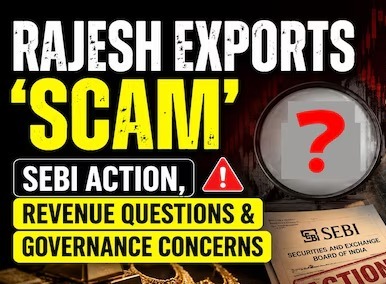
Gold Giant Under Fire: SEBI’s ₹15 Lakh Crore Allegations Against Rajesh Exports
Regulator flags inflated revenues, diversion of funds, and auditor lapses.
Case highlights urgent need for stronger corporate governance and investor safeguards.
By Legal Reporter
New Delhi: June 07, 2026:
SEBI has accused Rajesh Exports of inflating revenues worth ₹15.15 lakh crore between FY21–FY25, alleging misrepresentation, diversion of funds, and misleading disclosures. The interim order has barred the company and its promoter Rajesh Mehta from accessing the securities market, raising serious questions about corporate governance, auditor accountability, and investor protection in India. Introduction
Rajesh Exports Limited (REL), once celebrated as India’s global gold refining powerhouse, is now embroiled in one of the largest alleged financial misrepresentation cases in Indian corporate history. SEBI’s interim order in June 2026 alleged that REL inflated revenues by ₹15.15 lakh crore over five years, misclassified personal transactions as corporate sales, and diverted funds. The case has shaken investor confidence and reignited debates on corporate governance and disclosure standards.
Background of Allegations
The controversy began with a shareholder complaint in March 2024, pointing to unusually large trade receivables outstanding for over two years. SEBI initiated a probe, appointing forensic auditors to examine REL’s books. Findings suggested that nearly all consolidated revenues came from overseas subsidiaries, raising doubts about authenticity. NDTV
Key Legal Frameworks Involved
- SEBI Act, 1992: Grants SEBI powers to regulate securities markets and protect investors.
- SEBI (Prohibition of Fraudulent and Unfair Trade Practices) Regulations, 2003: Prohibits misleading statements, fraudulent schemes, and misrepresentation.
- Listing Obligations and Disclosure Requirements (LODR) Regulations, 2015: Mandates accurate disclosures, timely reporting, and auditor accountability.
- Companies Act, 2013: Sections 129–134 require true and fair financial statements, board responsibility, and auditor diligence.
- Indian Penal Code (IPC): Potential charges under Sections 420 (cheating) and 477A (falsification of accounts) if fraud is proven.
SEBI’s Findings
- Revenue Inflation: Alleged misrepresentation of ₹15.15 lakh crore cumulative revenue between FY21–FY25.
- Personal Transactions: Gold trades allegedly passed off as corporate sales.
- Fund Diversion: Company funds allegedly moved into personal accounts.
- Auditor Lapses: SEBI flagged insufficient cooperation and oversight failures. The Economic Times
Corporate Governance Concerns
The case underscores systemic weaknesses:
- Auditor Independence: Questions about whether auditors exercised due diligence.
- Subsidiary Oversight: Overseas subsidiaries used to inflate figures highlight regulatory blind spots.
- Investor Protection: Retail investors misled by inflated revenue disclosures.
Industry Impact
- Stock Market: REL’s shares plummeted after SEBI’s order, eroding investor wealth.
- Jewellery Sector: Raises concerns about transparency in India’s gold trade.
- Regulatory Landscape: Likely to trigger stricter disclosure norms and enhanced forensic audits.
Comparative Perspective
Globally, similar scandals—such as Enron (US) and Wirecard (Germany)—led to sweeping reforms. India may see stronger enforcement of LODR regulations and enhanced auditor liability.
Conclusion
SEBI’s allegations against Rajesh Exports represent a watershed moment in India’s corporate governance landscape. If proven, the case will rank among the largest financial misrepresentation scandals in Indian history. Regardless of the final outcome, it has already catalyzed calls for stricter oversight, stronger auditor accountability, and enhanced investor safeguards.
Detailed FAQ
Q1. What triggered SEBI’s investigation?
A shareholder complaint in March 2024 flagged unusually large trade receivables outstanding for over two years. NDTV
Q2. What are SEBI’s main allegations?
Revenue inflation of ₹15.15 lakh crore, misclassification of personal trades as corporate sales, diversion of funds, and auditor lapses. The Economic Times
Q3. Which laws are relevant?
- SEBI Act, 1992
- SEBI (PFUTP) Regulations, 2003
- LODR Regulations, 2015
- Companies Act, 2013
- IPC provisions on fraud and falsification
Q4. What penalties can SEBI impose?
Market bans, monetary penalties, disgorgement of gains, and referral for criminal prosecution under IPC.
Q5. How does this affect investors?
Investors face losses due to share price collapse and uncertainty about REL’s financial health.
Q6. What role did auditors play?
SEBI flagged lapses in auditor diligence and lack of cooperation during investigation. The Economic Times
Q7. How does this compare to global scandals?
Similar to Enron and Wirecard, where inflated revenues and auditor failures led to systemic reforms.
Q8. What remedies exist for investors?
Investors can seek compensation through SEBI’s Investor Protection Fund and pursue civil remedies under the Companies Act.
Q9. What happens next?
SEBI’s interim order bars REL and its promoter from securities markets. Final adjudication will determine penalties and reforms. Bar and Bench
Q10. What broader lessons emerge?
- Need for stronger auditor accountability.
- Enhanced scrutiny of overseas subsidiaries.
- Importance of forensic audits in detecting fraud.